Clear Sky Science · en
Hybrid fuzzy machine learning models optimized with meta-heuristics for accurate EEG-based neurological assessment
Listening to Brain Waves
When someone has epilepsy or falls into a deep coma, doctors often turn to electroencephalograms (EEGs) — recordings of the brain’s electrical activity — to understand what is happening. But reading these delicate squiggles by eye is slow, subjective, and depends heavily on expert judgment. This paper introduces an automated, highly accurate system that learns to interpret EEG patterns for both seizure detection and coma assessment, promising faster, more consistent help for patients when every second counts.
Why Brain Signals Are Hard to Read
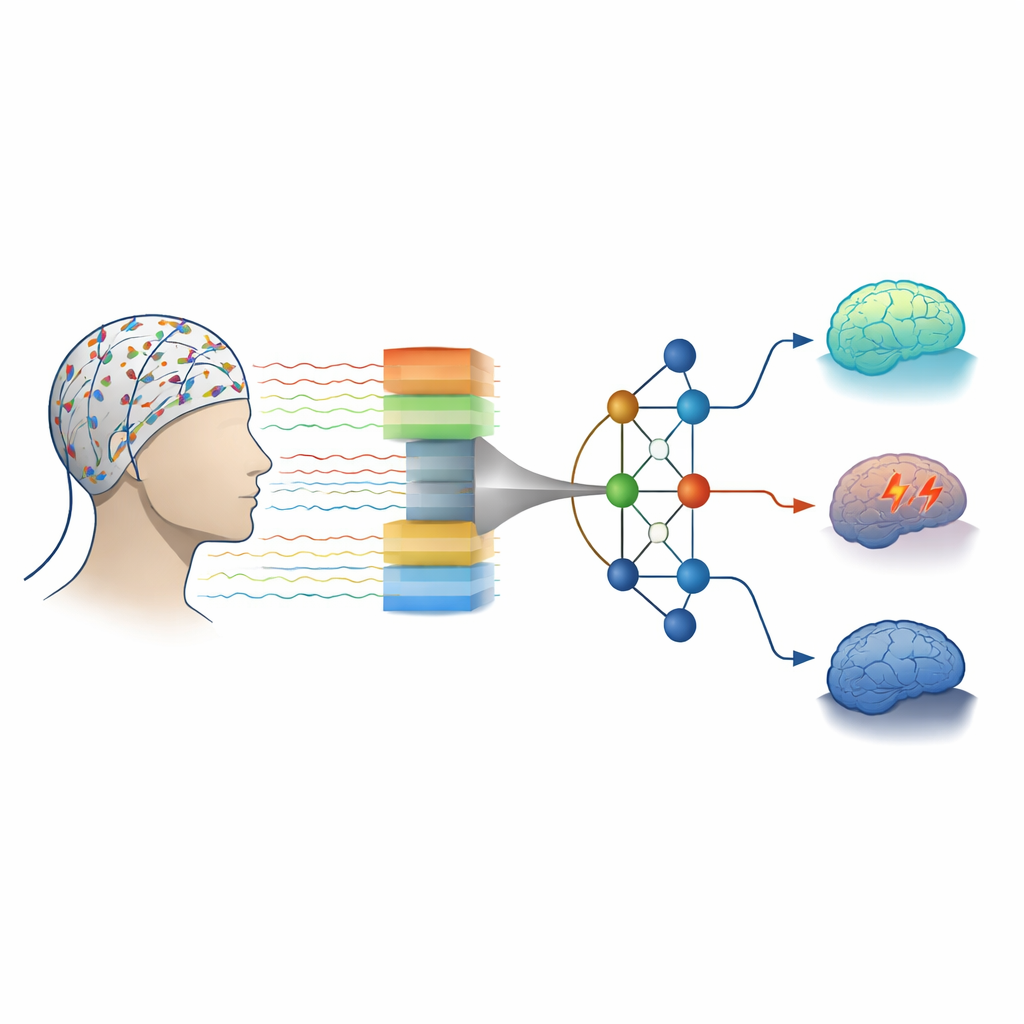
EEG has been used for a century to monitor brain activity without surgery. It is vital for spotting epileptic seizures and for gauging how conscious a coma patient really is. Yet raw EEG signals are messy: they contain noise from muscle movements, electrical interference, and natural variability between people. Subtle differences between normal brain activity, tumor-affected regions, and seizure events can be buried in this clutter. Doctors currently spend long hours scanning these traces, and in many parts of the world there are too few specialists, meaning seizures may be missed and coma depth misjudged. The authors aim to offload much of this burden onto intelligent software that can pick out reliable patterns in the chaos.
Boiling Down Complex Brain Waves
The system begins by cleaning and dissecting the EEG signals. It filters out noise, then measures a wide range of properties from each recording window: simple statistics such as average level and variability, how signal power is spread across different frequency bands (like the familiar delta, theta, alpha and beta waves), and more advanced "irregularity" measures called entropies that capture how unpredictable the signal is. These many measurements form a very high‑dimensional description of each moment in brain time. To make this manageable, the authors introduce a feature reduction stage that mathematically compresses dozens of numbers down to a compact set while preserving what best separates one brain state from another.
Nature-Inspired Tuning of the Classifier
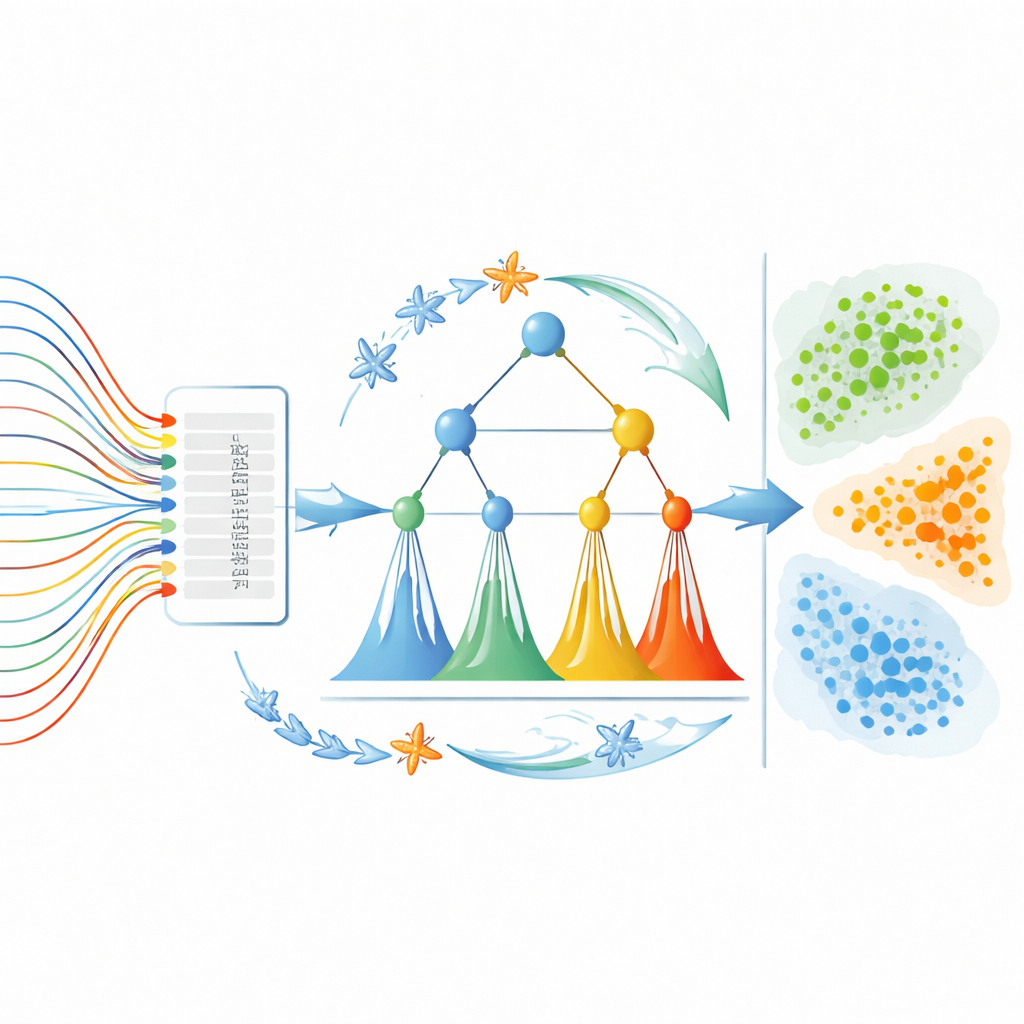
To design this compression step and the classifier that follows, the researchers borrow ideas from nature. A "water cycle" algorithm mimics how streams flow into rivers and seas, exploring many alternative ways to combine features and keeping those that cluster similar EEG patterns tightly together while pushing different patterns further apart. In parallel, a "starfish" optimization algorithm imitates how starfish move and adapt, using virtual swarms to fine‑tune the internal settings of a decision system. That decision system, called DT‑FIS, blends a decision tree (which splits data into branches) with fuzzy logic (which allows for soft, gradual boundaries instead of rigid cutoffs). Together, these elements let the model cope with uncertainty and subtlety in the brain signals rather than forcing crude yes/no choices too early.
Sorting Seizures and Levels of Consciousness
The authors test their framework on two demanding tasks. First, using EEG recordings from the American University of Beirut Medical Center, the system must distinguish between several types of seizure activity and quiet, non‑seizure periods. Second, using a separate dataset from intensive care units, it must estimate how conscious coma patients are, based on the widely used Glasgow Coma Scale, while patients move through rest and stimulation phases with nurses and family. After training, the hybrid models reach striking performance: around 99% accuracy for identifying deep coma levels, and similar scores for separating seizure from non‑seizure states, outperforming many recent deep learning approaches while using fewer features and remaining more interpretable.
What This Means for Patients
In plain terms, the study shows that combining carefully chosen EEG measurements, smart dimensionality reduction, and fuzzy, nature‑tuned decision rules can yield an almost "always right" automatic reader of brain waves. Such systems could run at a bedside monitor or on portable hardware, flagging seizures within seconds and giving staff an objective second opinion on how awake or unaware a patient really is. While the models still need to be validated on larger and more diverse populations, the work points toward a future where continuous, reliable brain monitoring is available even in resource‑limited hospitals, helping ensure that dangerous events are caught early and treatment decisions rest on solid, data‑driven insight.
Citation: Lak, M., Jamali, J., Adlband, N. et al. Hybrid fuzzy machine learning models optimized with meta-heuristics for accurate EEG-based neurological assessment. Sci Rep 16, 11888 (2026). https://doi.org/10.1038/s41598-026-35669-1
Keywords: EEG, epileptic seizures, coma assessment, fuzzy machine learning, neurological monitoring