Clear Sky Science · en
Eye tracking and machine learning to assess cognitive impairment in post-COVID-19 patients
Why your eyes may reveal lingering COVID brain effects
Many people recovering from COVID-19 continue to struggle with brain fog, poor concentration and slowed thinking months after the infection has passed. Traditional memory and attention tests are useful, but they are time‑consuming, depend on language and education, and require trained specialists. This study asks a simple question with big implications: can a quick, camera‑based measure of how your eyes move while you look at simple shapes help flag subtle thinking problems in people with post‑COVID‑19 condition?
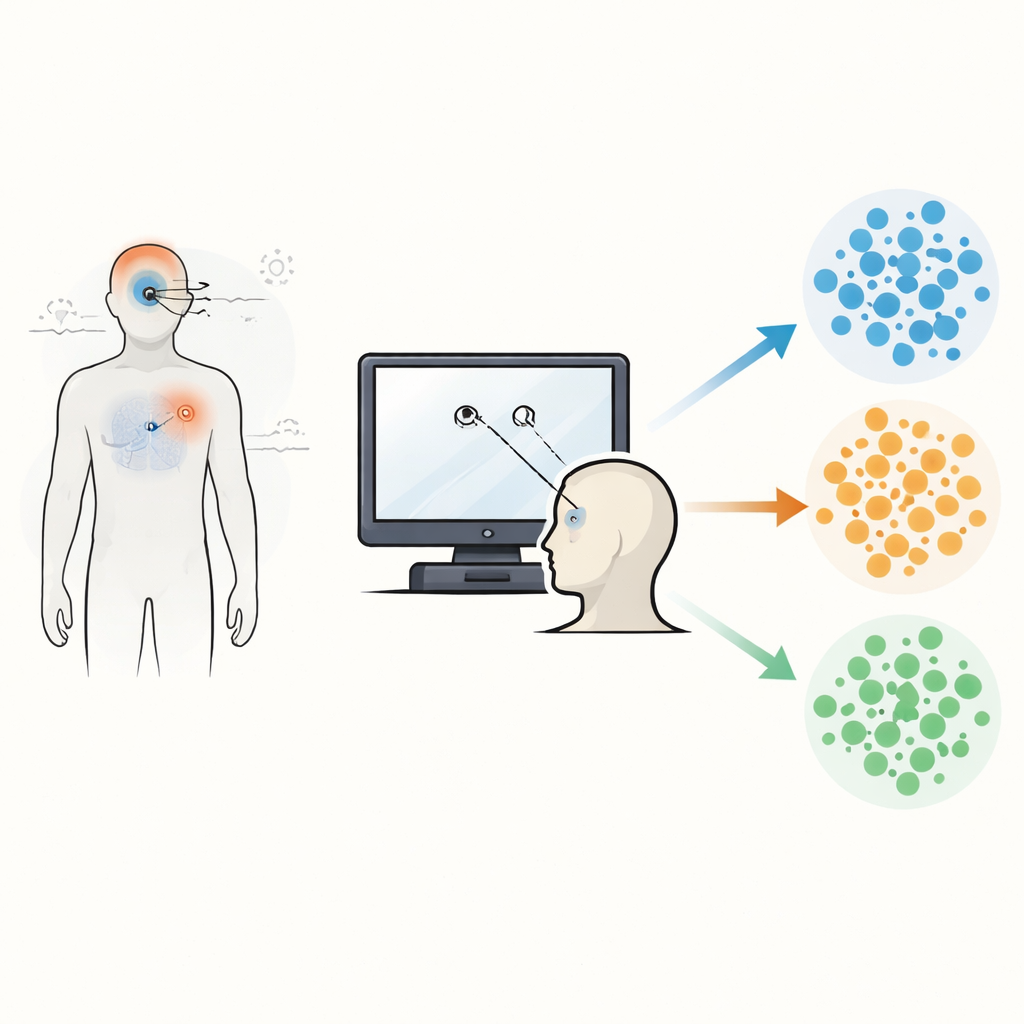
Looking at long COVID through the eyes
The researchers focused on people with post‑COVID‑19 condition, a collection of symptoms such as fatigue, headaches, breathlessness and cognitive difficulties that can persist for months after infection. More than 100 adults who had COVID-19 at least three months earlier and still had ongoing symptoms came to the lab for two main types of assessments. First, trained neuropsychologists measured their attention, processing speed, mental flexibility and verbal fluency using standard paper‑and‑pencil tests. Second, the participants sat in front of a computer while a high‑speed camera tracked tiny movements of their eyes and changes in pupil size as they stared at a fixed point, followed moving targets, and reacted to brief flashes of light.
What eye movements can say about thinking speed
When the team compared eye data with cognitive test scores, they found a consistent pattern: people whose eyes followed targets more steadily and kept their gaze more stable tended to perform better on tasks needing quick and controlled thinking. For example, those who could hold their eyes steadily on a cross while distracting spots appeared elsewhere on the screen did better on a classic color‑word test that measures how quickly a person can read, name colors and resist distraction. Similarly, participants whose eyes tracked a smoothly moving dot more accurately, especially along a wavy path, also did better on tests of mental flexibility and the ability to quickly retrieve words from memory.
Rapid jumps, pupil changes and hidden brain work
Not all eye movements are smooth. Our eyes also make rapid jumps, called saccades, to bring new objects into focus. In a challenging version of this task, volunteers had to look away from a suddenly appearing target, a move that demands strong self‑control. In this study, people whose eye jumps were less precisely directed in this task generally did worse on working‑memory and inhibition tests, suggesting that the same brain systems that control these eye movements also support higher‑level thinking. Changes in pupil size, triggered by a brief light, also held clues: larger light‑driven constriction tended to go along with better working memory and mental flexibility, hinting that basic reflexes in the eye may be subtly tuned by how well the brain regulates effort and alertness.
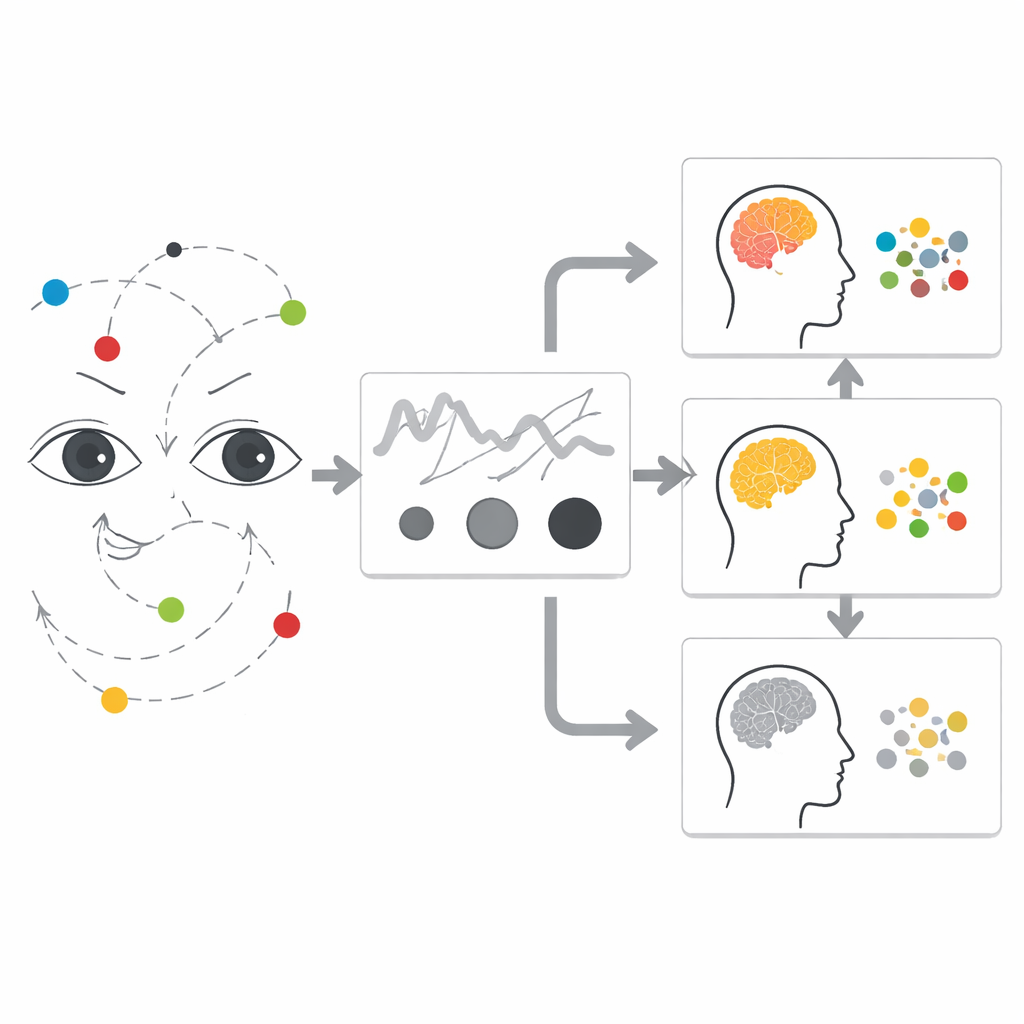
Grouping patients by eye movement signatures
The researchers then used a machine‑learning approach, called k‑means clustering, to see whether the many eye‑tracking measures naturally sorted patients into distinct profiles. After compressing the data into a few summary components, they identified three broad oculomotor patterns that ranged from relatively efficient to less efficient eye control. Participants in the weakest eye‑movement group had the most unstable fixation, less accurate tracking and smaller pupil responses—and, on average, they scored lowest on several thinking tests, especially those tapping processing speed, complex attention and word retrieval. Those with intermediate eye control showed mid‑range cognitive performance, while the group with the most favorable eye metrics tended to perform best.
What this means for patients and clinics
For people living with post‑COVID‑19 condition, these findings suggest that a short, language‑free eye‑tracking session could someday help flag who is at greater risk of subtle but meaningful thinking difficulties. The links between eye behavior and cognition were modest and the clusters of patients overlapped, so this method is not ready to replace standard testing. But because eye tracking is objective, quick and less affected by education or culture, it could become a useful companion tool—helping clinicians decide who needs further evaluation, and perhaps one day tracking recovery or response to treatment in long COVID and other brain disorders.
Citation: Goset, J., Ariza, M., Mestre, C. et al. Eye tracking and machine learning to assess cognitive impairment in post-COVID-19 patients. Sci Rep 16, 9637 (2026). https://doi.org/10.1038/s41598-025-34664-2
Keywords: long COVID, cognitive impairment, eye tracking, machine learning, neuropsychology