Clear Sky Science · en
Mechanical degradation induced by the alkaline water effects of weakly cemented fine-grained sandstone
Why crumbling rock matters underground
Deep below the surface, tunnels and roadways for coal mining and other projects depend on the strength of the surrounding rock. In parts of northwestern China, some mine roofs have collapsed even though the steel bolts and supports stayed intact. This study investigates a hidden culprit: very alkaline groundwater that slowly eats away at a weak type of sandstone, turning once-solid ceilings into loose rubble and posing serious safety risks for miners and underground engineers.
Gentle-looking rock with a fragile heart
The researchers focused on weakly cemented fine-grained sandstone from the Da’nanhu No. 7 Coal Mine in Xinjiang. This rock formed relatively recently in geological terms, so the grains are only loosely glued together. Above the coal seam lies an aquifer with highly mineralized, alkaline water rich in salts. When mining fractures connect the aquifer to the mine roadway, this water can seep into the sandstone roof and walls. The team wanted to know how different water conditions—from pure water to strongly alkaline solutions—change the rock’s strength and what this means for long-term stability.
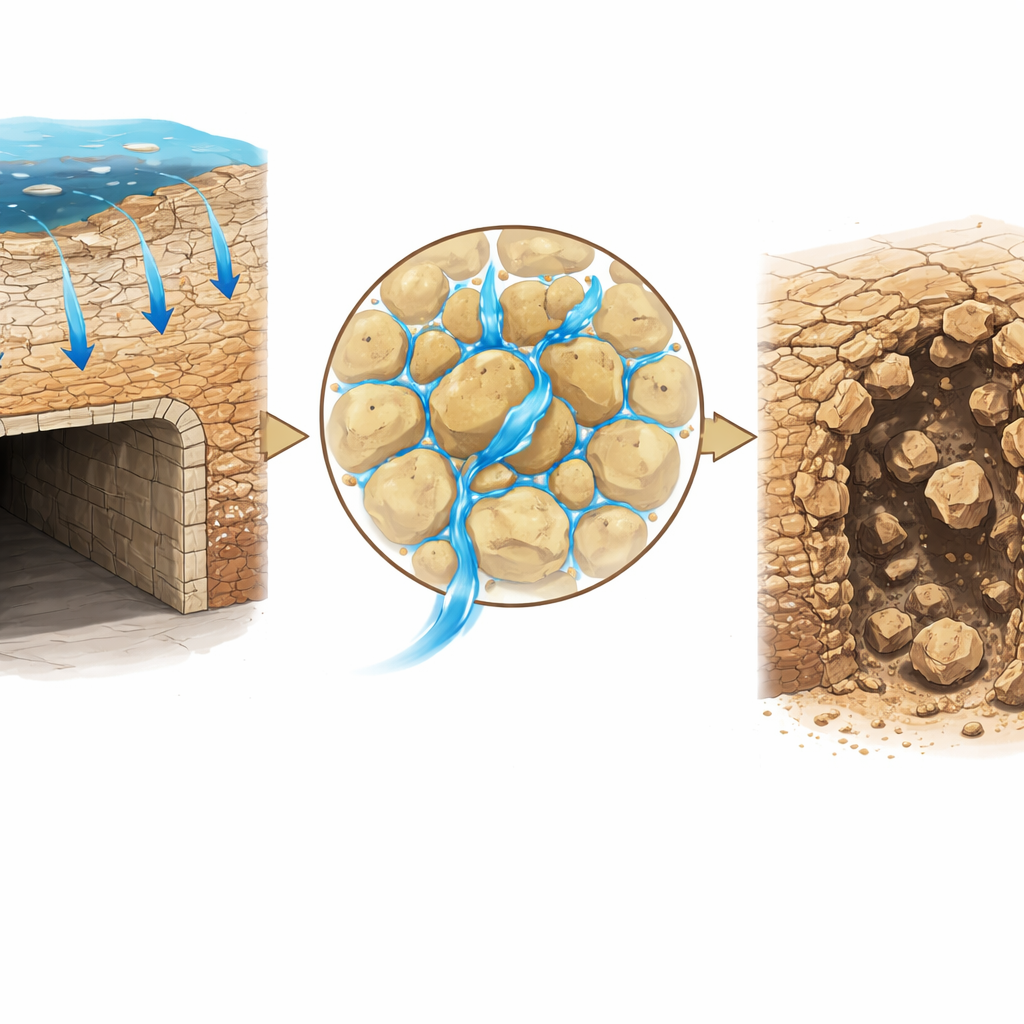
Putting rock samples through a soaking test
In the lab, cylindrical rock cores were dried and then soaked for up to 20 hours in solutions representing mine water: deionized water and salt-rich water adjusted to pH 7, 10, and 12. After soaking, the samples were squeezed, pulled, and sheared in mechanical tests to measure properties such as compressive strength, stiffness, shear resistance, and tensile strength. The scientists also used X-ray diffraction to track which minerals were present, electron microscopes to inspect tiny cracks and pores, and chemical tests to monitor how ions moved between the rock and water.
How alkaline water quietly destroys strength
The results show that the rock’s strength falls rapidly as soaking time and alkalinity increase. Uniaxial compressive strength follows an almost negative exponential decay with time: the strongest drop happens in the first few hours, especially in highly alkaline water, and then the weakening slows. The rock’s stiffness (elastic modulus) and initial compression behavior show similar trends: a sharp early decline, then a gradual leveling-off as the structure becomes thoroughly damaged. Shear cohesion plunges within the first four hours, while the internal friction angle steadily shrinks with time, more so in stronger alkalis. Tensile strength is especially sensitive; in salt solutions, it collapses to only a few percent of its original value within hours and then changes little afterward. Compared with conventional dense rocks such as granite or limestone, this weak sandstone degrades far more severely over much shorter exposure times.
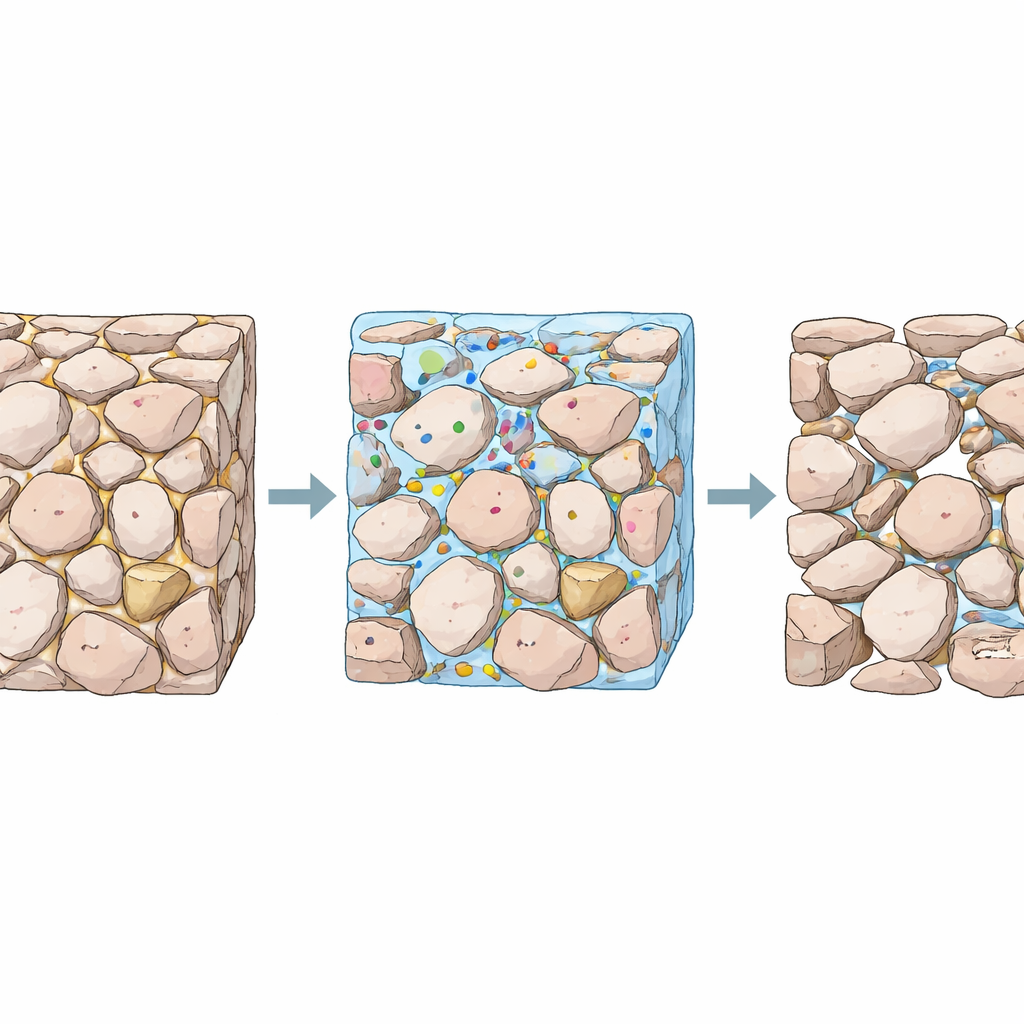
What happens inside the rock
On the mineral level, alkaline water triggers a chain of chemical and physical changes. Feldspar and mica grains undergo hydrolysis and ion exchange, transforming into softer clay minerals such as kaolinite, while some quartz and feldspar dissolve under strong alkali attack. Chemical tests show rising concentrations of aluminum and silicate species in the water, confirming that solid grains are being broken down. These reactions loosen the cement that binds particles, increase porosity, and make the rock more plastic. Electron microscope images reveal that, in dry rock, cracks tend to cut through grains; after alkaline attack, cracks instead snake along grain boundaries, where the cement has been weakened. The rock shifts from a compact skeleton of hard minerals to a looser framework riddled with pores and intergranular fractures.
A model for predicting damage before it happens
To turn these observations into a practical tool, the authors built a mathematical damage model that couples chemical attack with mechanical loading. The model tracks how much reactive mineral mass is lost as hydroxide ions in the water consume feldspar and other components, and combines this “chemical damage” with the strain-induced damage from stress. When they compared the model’s predicted stress–strain curves with their laboratory measurements under different pH conditions, the match was good, particularly before peak failure. This suggests that mine planners can use such a framework to estimate how much strength a weak sandstone roof will lose after a given exposure to alkaline water and design support systems accordingly.
What this means for safer underground spaces
For non-specialists, the key message is that not all rock is equally reliable, and water chemistry matters as much as water quantity. In weakly cemented sandstone, strongly alkaline mine water can strip away the mineral “glue” in hours, turning firm rock into a fragile shell prone to sudden roof falls. By clarifying how and how fast this weakening occurs, and by offering a predictive model, the study provides a scientific basis for early waterproofing, reinforcement, and hazard control in mines and other underground projects that pass through such vulnerable strata.
Citation: Luo, T., Fan, G., Zhang, S. et al. Mechanical degradation induced by the alkaline water effects of weakly cemented fine-grained sandstone. Sci Rep 16, 9622 (2026). https://doi.org/10.1038/s41598-025-34061-9
Keywords: alkaline groundwater, weak sandstone, rock weakening, underground mining, water–rock interaction