Clear Sky Science · en
Wearable optomyography enables continuous neuroprosthetic control
Turning Muscle Signals into Seamless Control
Imagine steering a computer cursor or video game using only subtle movements of your wrist, without a mouse, joystick, or even fingers. For people who have lost a hand or struggle with fine motor control, such a tool could restore everyday abilities like pointing, clicking, and playing games. This study presents a new kind of wristband that “reads” muscles with light instead of wires, opening the door to more stable, comfortable, and precise control of computers and prosthetic devices.
Why Current Muscle-Control Devices Fall Short
Today’s muscle-based controllers mostly rely on surface electromyography, which uses electrodes on the skin to pick up tiny electrical signals when muscles contract. These systems have enabled robotic prosthetic hands and hands-free computer control, but they come with serious drawbacks. The signals are weak and easily polluted by electrical noise and movement of the sensors. Neighboring muscles can interfere with each other, and deeper muscles are hard to read. For many amputees, these systems feel effortful, unreliable, and tiring, which contributes to people abandoning advanced prosthetic limbs altogether.
Reading Muscles with Light Instead of Wires
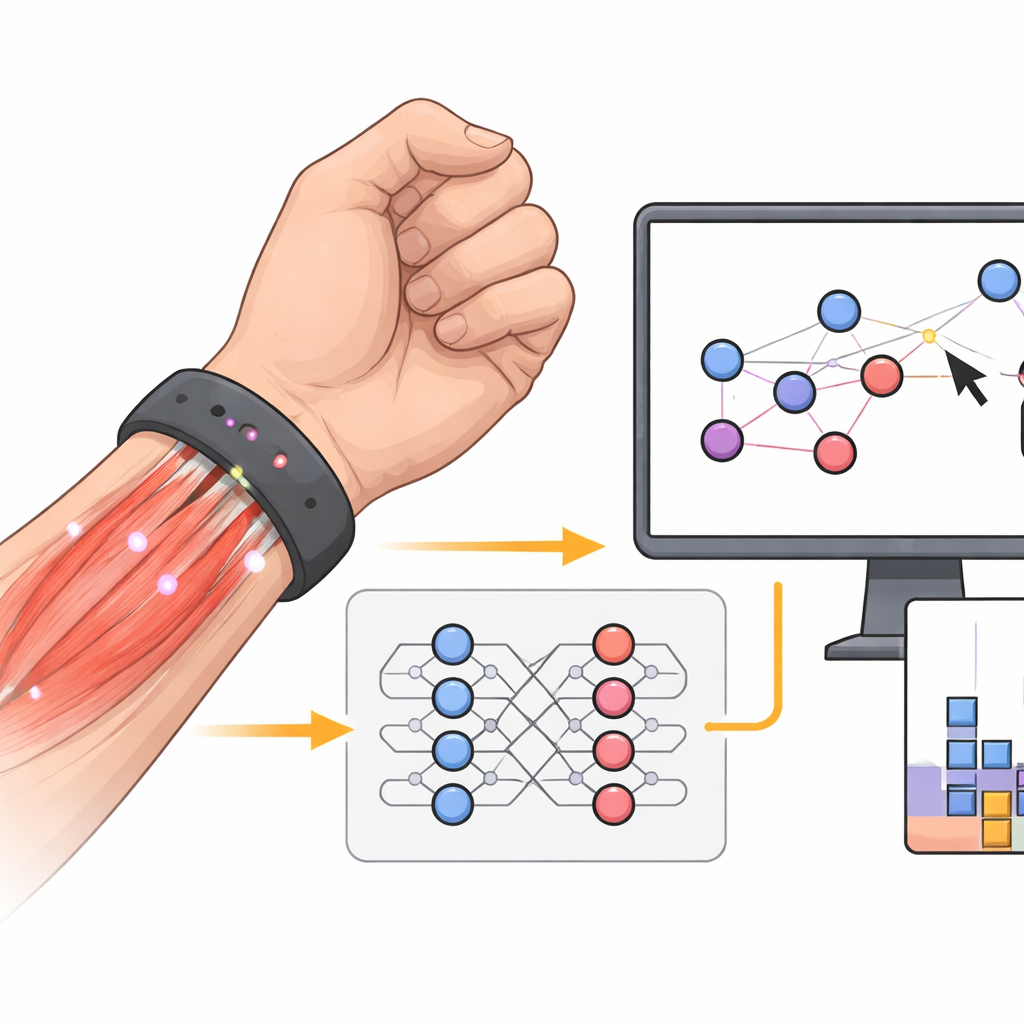
The researchers explored an alternative called optomyography, which uses near-infrared light to track how muscles change as blood volume and tissue properties shift during contraction. A flexible wristband contains light-emitting diodes that shine harmless light into the forearm and tiny detectors that sense the scattered light returning from under the skin. Because biological tissue is relatively transparent in this wavelength range, the signals tend to be cleaner and less sensitive to electrical interference than traditional electrode-based measurements. The team’s wristband records 50 channels of data around the wrist and sends them to a computer in real time.
Teaching a Wristband to Behave Like a Mouse
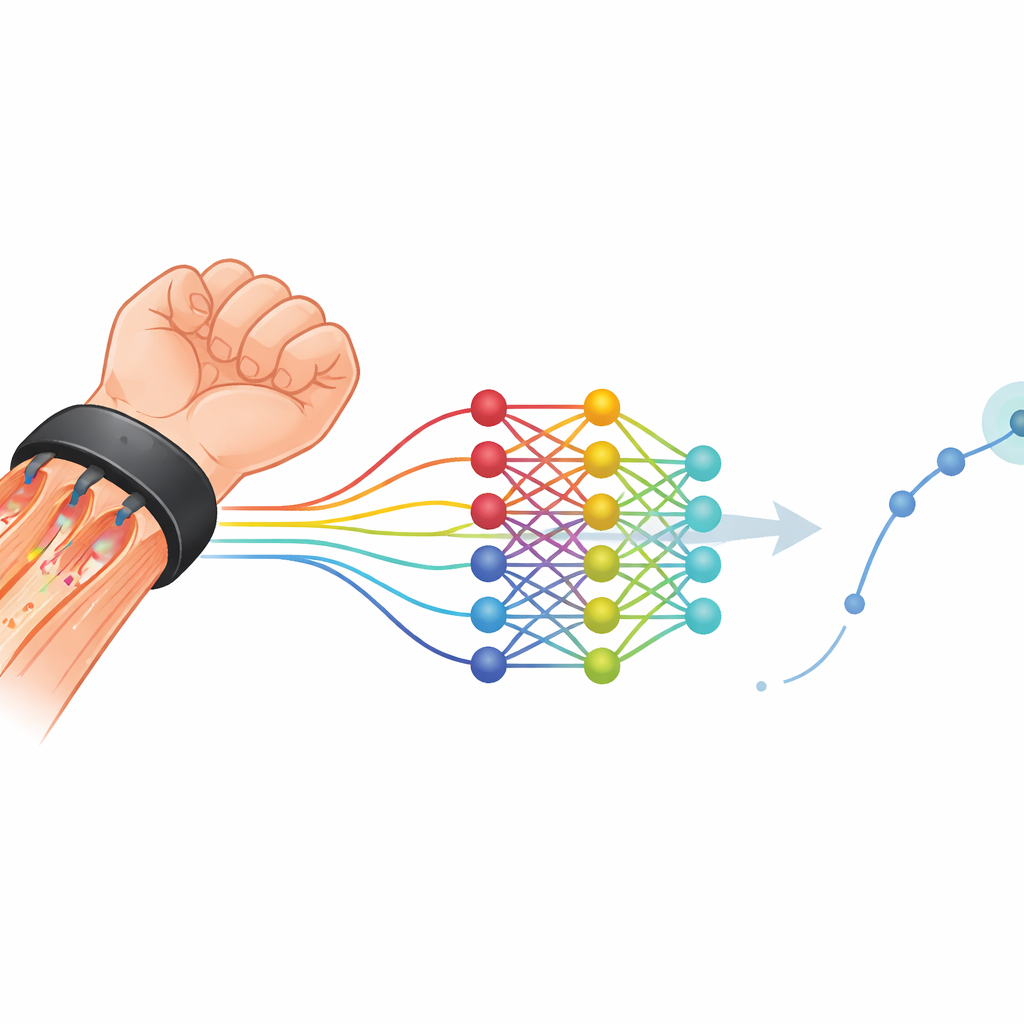
To turn raw light signals into control, the authors trained a compact neural network—essentially a small, efficient pattern-recognition program. Participants wore the wristband and performed a “center-out” task: a dot appeared in the middle of a screen, then jumped to one of 12 positions arranged like the hours on a clock. For each direction, people used a consistent wrist or hand gesture, plus two extra gestures for a neutral posture and a fist clench to mimic clicking. The network learned to translate each snapshot of wristband data into two values describing movement direction and a third value reflecting the likelihood of a “click.” Crucially, it produced output for every new sample, enabling continuous, smooth cursor motion instead of choppy, step-by-step jumps.
Learning to Point, Click, and Even Play Tetris
Eight young adults without motor disabilities and one person who had lost all fingers on both hands tested the system. After a short calibration and a few minutes of training, they used gestures to move a cursor from the center of the screen to randomly placed targets and then “capture” them with a fist-clench click. Over multiple sessions, most participants improved on measures such as how closely their cursor followed an ideal straight path, how quickly they reached targets, and how much extra movement they made near the goal. Performance gains were most noticeable in the first half of the sessions, with some decline later, likely due to fatigue or wristband shifting. In a separate test, one able-bodied participant and the amputee used the same control to play rounds of Tetris, successfully placing and rotating falling blocks using only wrist and hand motions.
How This New Approach Stacks Up
The team compared their results to standard performance models and past work with electrode-based systems. Using a well-known framework called Fitts’s law, which relates task difficulty to movement time, they showed that many participants— including the amputee—achieved performance levels similar to those seen with electrical muscle sensors. Their throughput (how efficiently they could complete pointing tasks) and path efficiency (how straight their movements were) approached that of established technologies, despite the more demanding continuous control and the added challenge of producing click gestures. The researchers argue that combining light-based and electrical measurements in future devices could further improve accuracy and robustness.
What This Could Mean for Everyday Life
For a layperson, the bottom line is that this light-based wristband can turn natural wrist and forearm movements into fluid, real-time control of a computer cursor and simple games, even for someone missing a hand. Although the study involved just one amputee and a small group of healthy volunteers, it demonstrates that optomyography can provide continuous, intuitive control that rivals current electrical approaches while avoiding some of their weaknesses. With further work on comfort, sensor placement, and long-term stability, such systems could eventually power more responsive prosthetic hands, rehabilitation tools, and wearable controllers that feel less like medical devices and more like everyday accessories.
Citation: Khalikov, R., Soghoyan, G., Sintsov, M. et al. Wearable optomyography enables continuous neuroprosthetic control. Sci Rep 16, 9604 (2026). https://doi.org/10.1038/s41598-025-32646-y
Keywords: wearable neuroprosthetics, muscle-computer interface, optical muscle sensing, gesture-based control, prosthetic rehabilitation