Clear Sky Science · en
MMU-STCNN-BDQ: a deep reinforcement learning framework for secure and energy-efficient beamforming in 6G mMIMO networks
Why your future phone signal needs smarter beams
As wireless networks race toward 6G, they must juggle three tough goals at once: ultra‑fast data, low power use, and strong protection against eavesdropping. This paper explores how advanced learning algorithms can steer radio waves more intelligently, so that signals reach the right devices, waste less energy, and are harder for attackers to exploit.

The challenge of packing more data into the air
Today’s mobile networks are running out of easy ways to squeeze more data into limited radio spectrum. One answer is to move up to millimeter‑wave and terahertz bands, where huge swaths of unused frequencies exist. At these high bands, base stations can use large arrays of antennas to form narrow beams that point directly at each user. This “massive MIMO” approach boosts signal strength and allows many people to share the same channel. But it also introduces new problems: hardware becomes complex and power‑hungry, the beams must constantly adapt to moving users and blocked paths, and the very learning systems that decide where to point the beams can themselves become a security weakness.
Why smarter beams must also be safer beams
In 6G, beamforming decisions are expected to rely heavily on machine learning models that digest measurements of the radio channel and predict how to aim and shape each beam. That makes the system agile but also vulnerable. Attackers can try to fool the models, inject bad data, or secretly tap into narrowly focused signals. The authors review these risks, from adversarial attacks on the learning algorithms to privacy leaks that reveal a user’s location or identity. They show that existing methods either focus on accuracy and speed or on security, but rarely on all three together, especially in crowded networks with many users and rapidly changing conditions.
A hybrid learning engine for 6G base stations
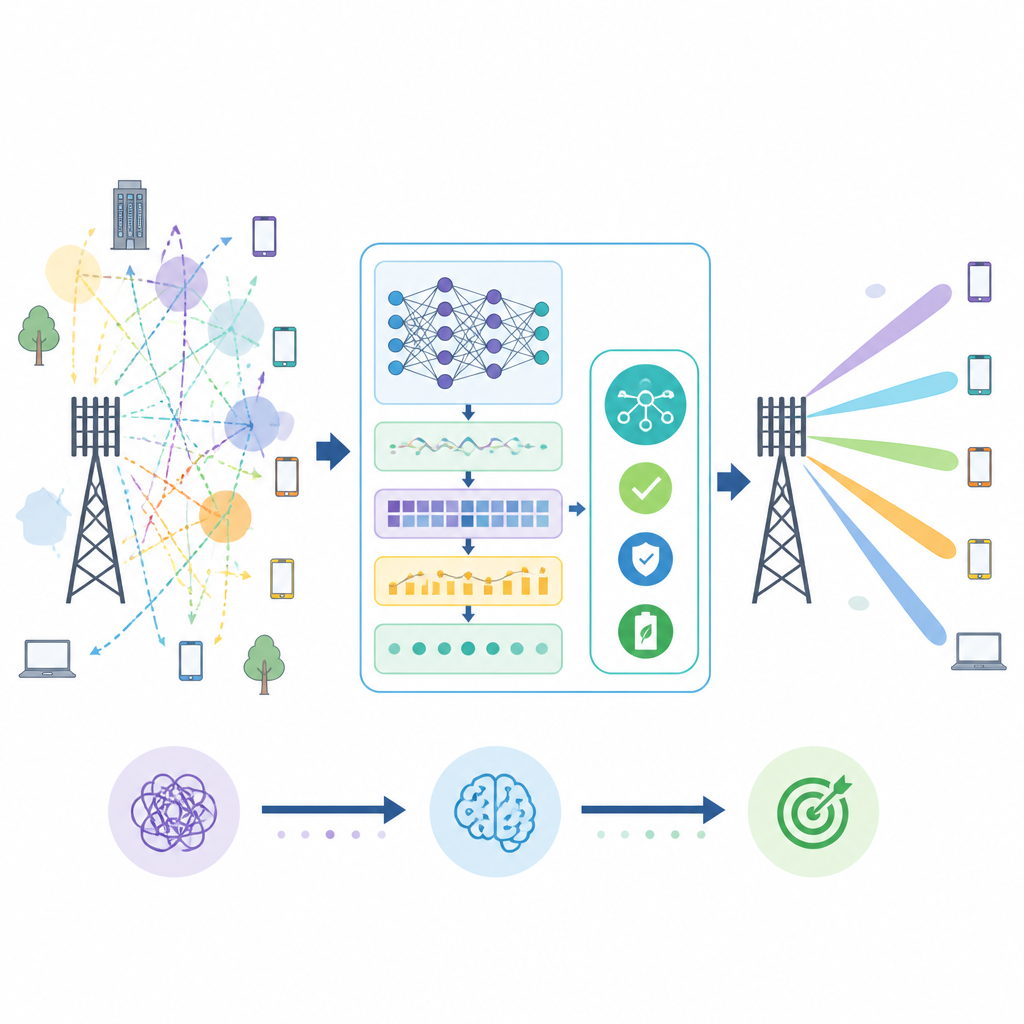
To tackle these issues, the paper proposes a combined learning framework called MMU‑STCNN‑BDQ. First, a spatiotemporal neural network looks at raw channel measurements over space and time and learns patterns that describe how signals bounce, fade, and change as users move. This front‑end produces an initial guess for how beams should be shaped and directed for many users at once. Then a second component, a reinforcement learning engine, treats each beamforming decision as an action in a game: it tries different strategies, observes the resulting data rate, power use, and error rate, and gradually learns which choices give the best long‑term trade‑off between speed, reliability, and secrecy.
How the new method performs in crowded airwaves
The authors test their approach using a realistic simulation dataset where a base station with 256 antennas serves up to 50 users at millimeter‑wave frequencies. They compare their framework to three strong baselines: a standard deep neural network, a conventional deep reinforcement learner, and an adversarially trained secure beamforming method. Across many scenarios and signal‑to‑noise levels, their system consistently predicts better beams, lowering the mismatch between desired and actual beams, cutting bit error rates, and raising throughput. It also uses energy more efficiently, delivering more data per unit of power. Importantly, when subjected to a variety of simulated attacks that try to perturb the learning process or the channel data, the proposed framework degrades gracefully and retains most of its performance.
What this means for everyday wireless users
For non‑experts, the key takeaway is that future 6G base stations may use a layered learning engine that both “sees” how the radio environment evolves and “acts” in a goal‑driven way to keep connections fast, frugal, and private. By uniting pattern recognition with trial‑and‑error learning, this approach helps beams lock onto users more accurately while wasting less energy and making life harder for eavesdroppers. The authors note that real‑world deployment will still require lighter versions of the algorithms and tests in true wideband and imperfect conditions, but their results suggest a promising path toward 6G networks that are not only quicker, but also smarter and safer.
Citation: Ramudu, K., Medasani, S., Addepalli, T. et al. MMU-STCNN-BDQ: a deep reinforcement learning framework for secure and energy-efficient beamforming in 6G mMIMO networks. Sci Rep 16, 15684 (2026). https://doi.org/10.1038/s41598-025-26572-2
Keywords: 6G beamforming, massive MIMO, wireless security, energy efficient networks, deep reinforcement learning