Clear Sky Science · en
Association between TNF-α polymorphisms and responsiveness to TNF-α blockers in ankylosing spondylitis and psoriatic arthritis: a meta-analysis
Why some people respond better to arthritis drugs
For people living with chronic back and joint pain from ankylosing spondylitis or psoriatic arthritis, modern drugs that block a molecule called TNF can be life-changing—but they do not work for everyone. This study asks a simple but powerful question: can differences in our genes help explain who benefits most from these expensive, heavy-duty medicines, and who is left still in pain?
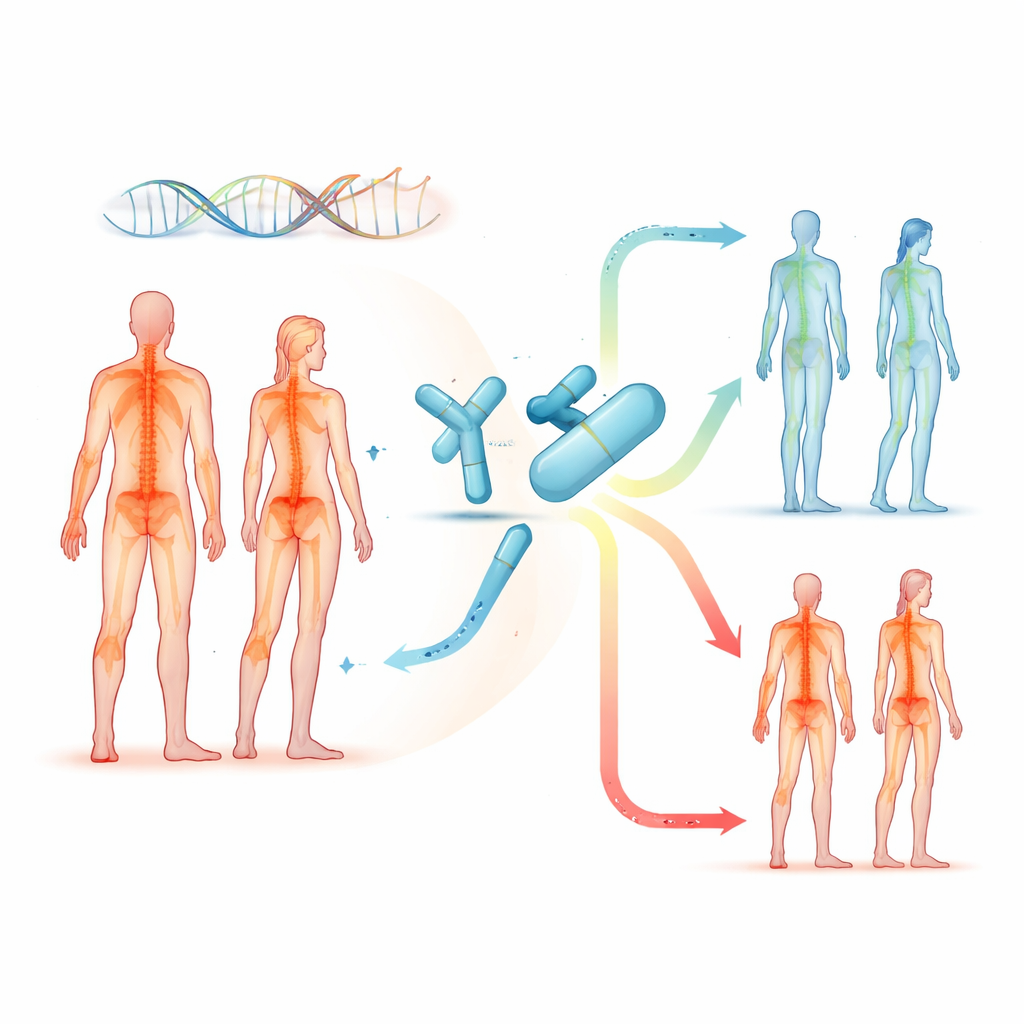
Common joint diseases with very different journeys
Ankylosing spondylitis and psoriatic arthritis are long-lasting inflammatory diseases that mainly attack the spine, joints, and places where tendons attach to bone. People with these conditions can struggle with severe stiffness, fatigue, and disability that disrupt work, family life, and sleep. TNF, a chemical messenger of the immune system, fuels much of this inflammation. Drugs that block TNF have transformed care, often easing pain and restoring movement when older treatments fail. Yet a sizeable share of patients—roughly a quarter to a third—do not improve enough, raising both personal frustration and major costs to health systems.
Looking to DNA for treatment clues
The authors focused on tiny natural differences in the TNF gene, known as polymorphisms. These are like single-letter spelling changes in DNA that can subtly alter how much TNF the body makes or how it is controlled. Earlier, small studies hinted that certain versions of the TNF gene might be linked to better or worse responses to TNF-blocking drugs, but the results were often inconsistent. To get a clearer picture, the researchers combined all suitable published data into a meta-analysis—a statistical approach that merges multiple studies to see patterns that single studies may be too small to detect.
Pooling evidence from around the world
The team searched major medical databases up to October 2023 and found nine eligible articles, which together provided 11 separate patient groups and 611 individuals treated with TNF blockers. These patients, from both European and Asian backgrounds, had either ankylosing spondylitis or psoriatic arthritis and were followed for several months after starting drugs such as etanercept, infliximab, or adalimumab. For each study, the authors compared the frequency of specific TNF gene variants in people who responded well to treatment versus those who did not, and then calculated combined odds across all studies. They also checked the quality of the underlying research and searched for signs that only “positive” studies had been published.
A key genetic variant that predicts better response
The strongest signal emerged from a particular change in the TNF gene at a position called −308. People carrying the G version of this variant were over four times more likely to respond well to TNF-blocking treatment than those without it. This association held up when the data were split by ethnic group: it appeared in both European and Asian patients. When the authors separated the two diseases, the −308 G variant remained linked to better outcomes in both ankylosing spondylitis and psoriatic arthritis, with especially large effects in ankylosing spondylitis. Other TNF gene positions played a more modest role. In psoriatic arthritis, variants called −857 C and −238 G also tracked with better drug response, while another, +489 GG, generally did not show a consistent link.
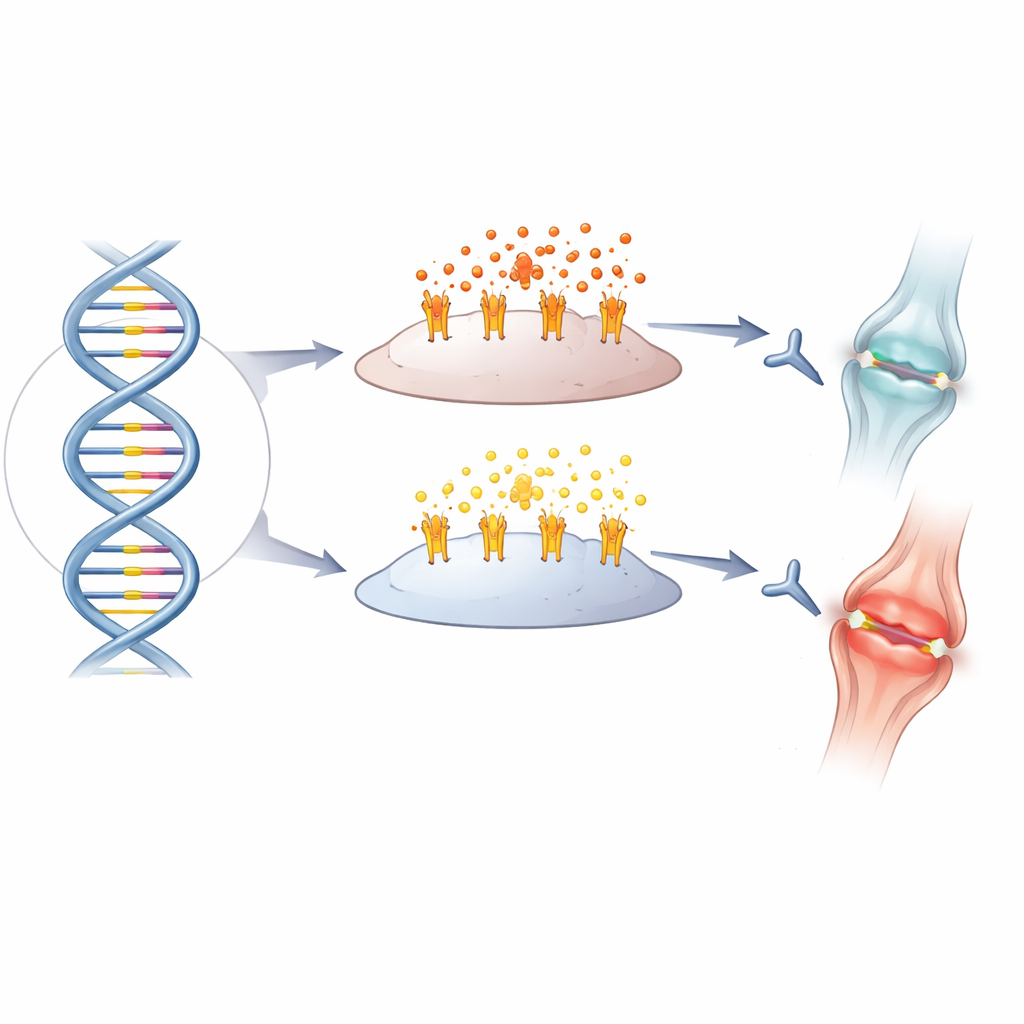
What this could mean for future care
These findings suggest that a simple genetic test targeting a small set of TNF gene variants might one day help doctors choose the right treatment faster. Because TNF-blocking drugs are costly and can carry risks, knowing in advance which patients are more likely to benefit could reduce trial-and-error prescribing and spare non-responders months of ineffective therapy. Still, the authors caution that the included studies varied in size, design, and how they measured improvement, and some of the genetic signals are based on relatively small numbers. Larger, well-designed studies in more diverse populations are needed to confirm just how reliable these DNA markers are.
A step toward more personalized arthritis treatment
In plain terms, this work shows that not all patients with ankylosing spondylitis or psoriatic arthritis are equal in how they respond to the same powerful drugs—and that part of the difference lies in their genes. A specific version of the TNF gene, known as the −308 G allele, stands out as a promising sign that TNF-blocking medicine is more likely to help. Other genetic clues may be important for psoriatic arthritis as well. While genetic testing is not yet routine for these decisions, studies like this move medicine closer to tailoring arthritis treatment to the individual, with the goal of getting the right drug to the right patient at the right time.
Citation: Lee, Y.H., Song, G.G. Association between TNF-α polymorphisms and responsiveness to TNF-α blockers in ankylosing spondylitis and psoriatic arthritis: a meta-analysis. Sci Rep 16, 9575 (2026). https://doi.org/10.1038/s41598-025-23987-9
Keywords: ankylosing spondylitis, psoriatic arthritis, TNF blockers, pharmacogenetics, treatment response