Clear Sky Science · en
A human EEG dataset to study cognitive flexibility during auditory discrimination under real-world distractors
Why everyday sounds can hijack your focus
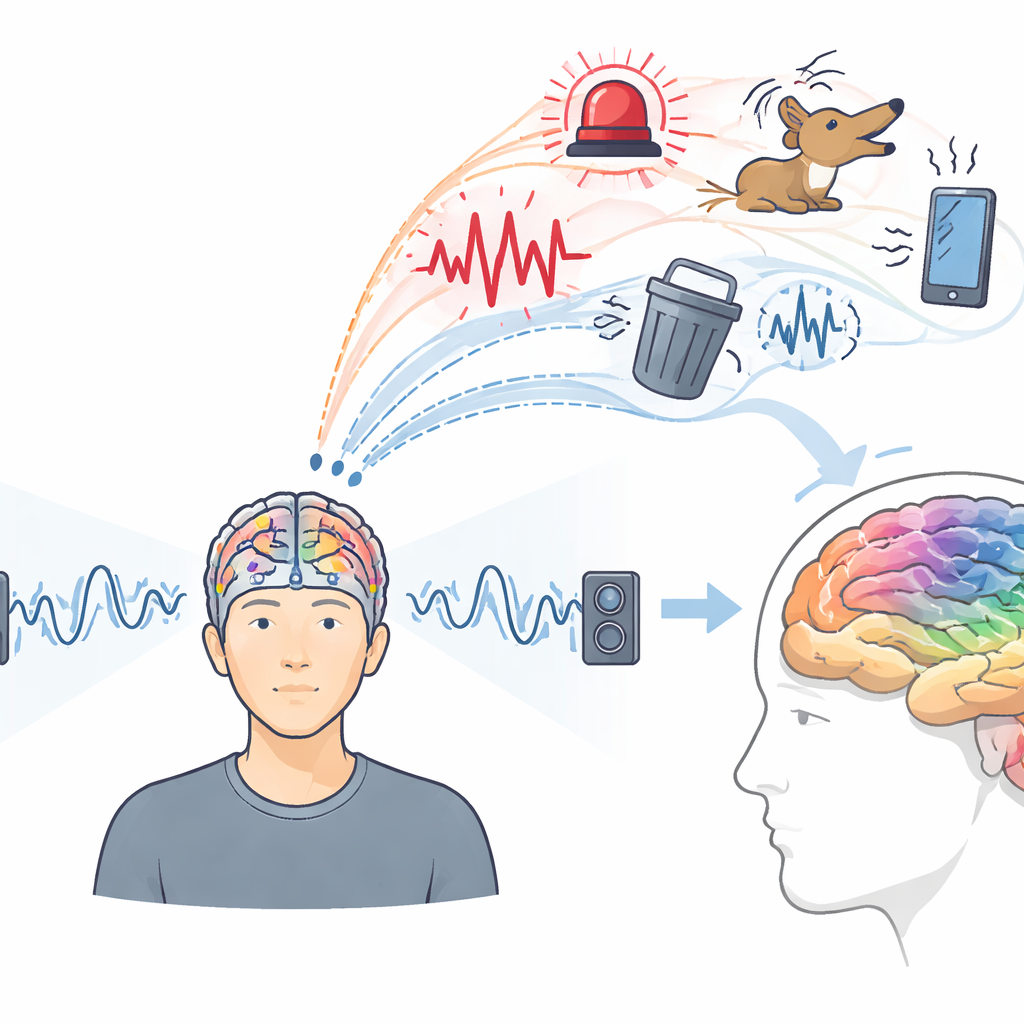
Imagine trying to follow a friend’s voice at a busy street corner when a siren, barking dog, and ringing phone erupt all at once. Your attention is yanked away, then somehow pulled back to the conversation. This rapid tug-of-war is called cognitive flexibility—the brain’s ability to re-focus on what matters—and it can break down in conditions like tinnitus, autism, or attention disorders. The article describes an open, richly detailed human brain dataset designed to help scientists understand how real-world sounds distract us and how the brain regains control.
Listening tasks that mimic noisy real life
To capture this process, the researchers asked 28 healthy adults to perform a simple listening game: on each trial they heard two very similar sounds in a row and had to decide which one was longer. This basic task was presented in three different sound worlds of increasing complexity. In the “tones” world, people heard pure beeps at fixed pitches. In the “sweeps” world, they heard pitches that rose or fell over time. In the “syllables” world, they listened to short speech-like sounds produced by synthetic male and female voices. Across all worlds, the structure of each trial was tightly controlled so that the timing of sounds—and of any interruptions—was precisely known.
Real-world noises invade the task
Crucially, on some trials an extra, highly noticeable sound—such as a phone ring, dog bark, siren, or door slam—burst in shortly after the first task sound and continued through the end of the trial. The team used a library of 60 such everyday noises and ensured that no single one was repeated too often, so it stayed surprising instead of becoming background. Other trials had no extra sound, and a third type used nearly impossible comparisons to keep people on their toes. This design let the researchers compare how people behaved and how their brains responded when they were undisturbed, clearly distracted, or simply challenged by a hard decision.
Tracking the brain’s struggle in millisecond detail
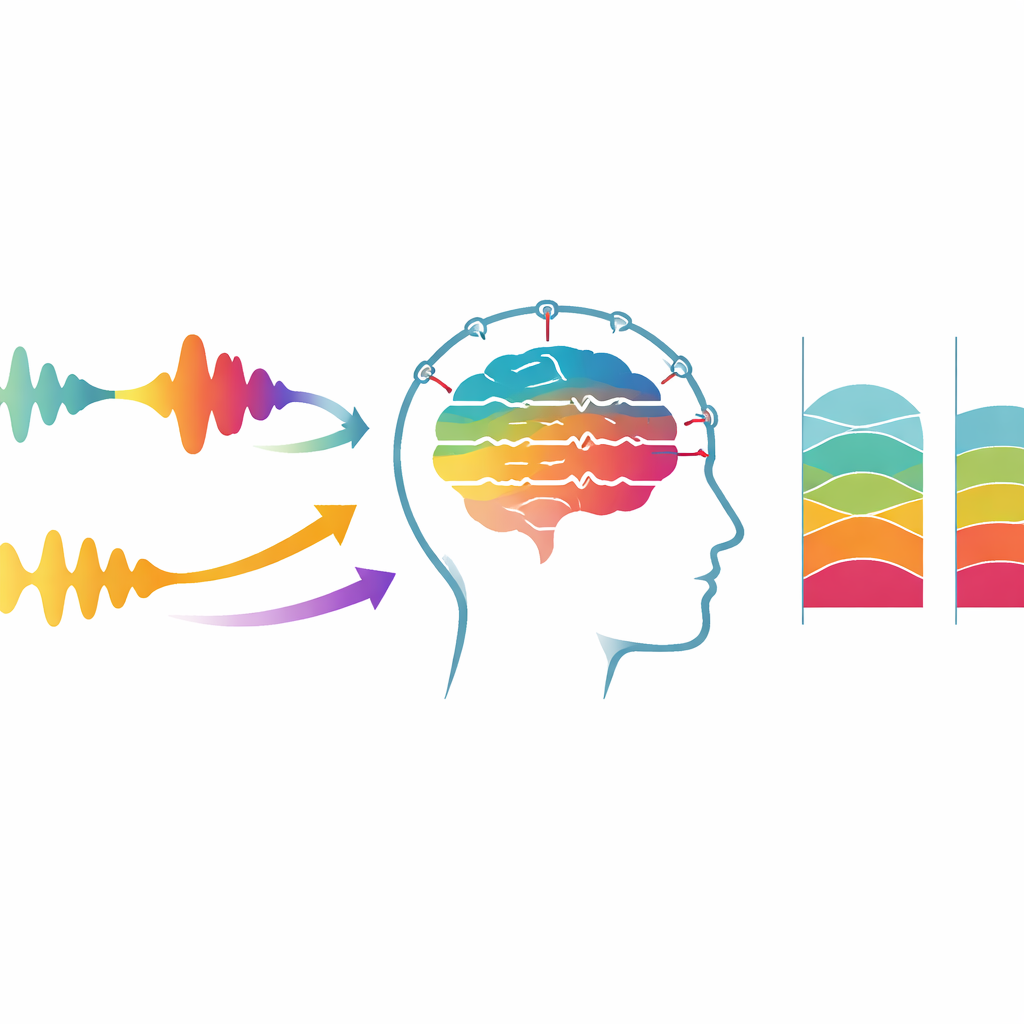
While participants listened and pressed keys to answer, the scientists recorded electrical activity from 63 electrodes on the scalp, a technique known as EEG. This method tracks brain rhythms with millisecond precision, making it ideal for studying the split-second stages of distraction: detecting a new sound, orienting toward it, and then reorienting back to the task. The team carefully cleaned the data to remove blinks and muscle noise, then carved it into short time windows aligned to each trial. For every trial, they also saved how quickly and accurately the person responded, creating a rich link between behavior and brain activity.
What happens to performance and brain rhythms
The behavioral results show that real-world noises reliably disrupt performance. When no extra sounds were present, participants were highly accurate, especially for simple tones. Accuracy fell whenever distracting noises appeared, and it dropped most sharply in the speech-like condition, where the listening scene was already complex. Reaction times told a similar story: people were slowest on the hardest trials and were consistently slower when a distractor sound intruded. In the brain data, the authors focused on rhythmic activity in the so-called alpha band, a range of brain waves often tied to filtering out distractions. They found that alpha power tended to be higher when trials were free of salient noises and lower when a distractor was present, echoing earlier work suggesting that strong alpha rhythms help shield us from interference.
A toolbox for future hearing and attention research
Beyond these initial findings, the real power of this work lies in the data it makes publicly available. For 27 participants, the authors share not only the cleaned EEG and detailed behavior for every trial, but also each person’s brain scan, exact electrode positions on the head, all sound files, and ready-to-run experiment scripts. This means researchers can model how attention shifts in real time, test new theories of brain rhythms, or explore why some people are more easily distracted than others. In the long run, such insights could guide smarter hearing aids, brain-computer interfaces, and personalized therapies that help people stay focused—even when the world around them is anything but quiet.
Citation: Ghosh, P., Saluja, K. & Banerjee, A. A human EEG dataset to study cognitive flexibility during auditory discrimination under real-world distractors. Sci Data 13, 683 (2026). https://doi.org/10.1038/s41597-026-07041-5
Keywords: auditory attention, EEG dataset, sound distraction, cognitive flexibility, hearing in noise