Clear Sky Science · en
Two hundred years of historical spawning and nursery data for coregonine fishes in the Laurentian Great Lakes
Why Old Fish Stories Still Matter Today
Imagine trying to protect a species of fish when you no longer know exactly where it used to lay its eggs. That is the challenge facing scientists and Indigenous communities around the Laurentian Great Lakes, one of the world’s largest freshwater systems. This paper describes a new open database called Coregonine Spawning History (CORHIST), which pulls together two centuries of scattered information about where key native fishes once spawned and raised their young. By turning old logbooks, interviews, maps, and surveys into a single digital resource, CORHIST helps today’s managers avoid “forgetting” how rich these lakes used to be.
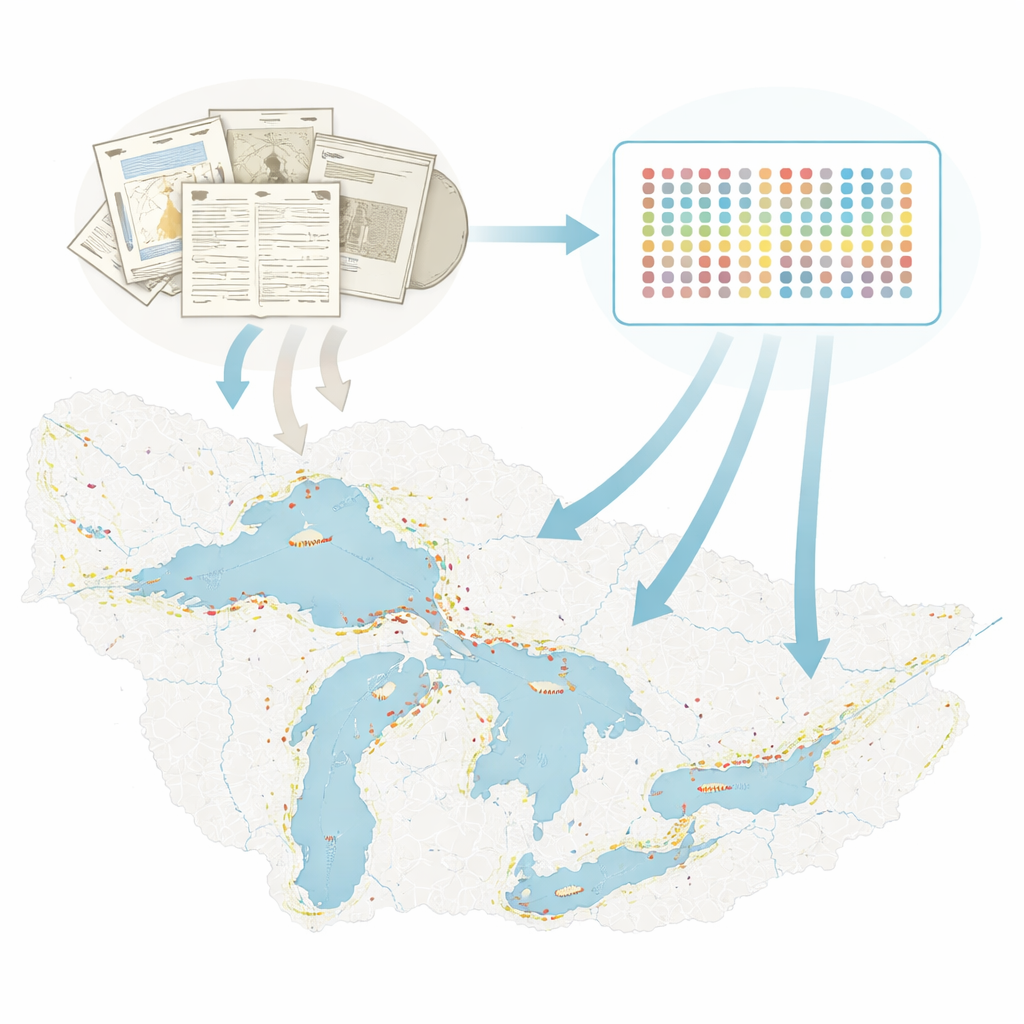
Bringing Together Two Hundred Years of Clues
For generations, ciscoes and whitefishes—members of the coregonine group within the salmon family—have been central to the food, culture, and economies of communities around the Great Lakes. Indigenous Peoples relied on them for millennia, and later commercial fisheries targeted huge spawning runs that surged into nearshore waters and tributaries each fall. Over the last 150 years, however, pollution, dams, invasive species, and heavy fishing drove some deepwater species to extinction and sharply reduced others. Written accounts of where these fishes once spawned do exist, but they are buried in ship logs, museum labels, government reports, and oral histories that are hard to search or compare. Without organizing these records, it is easy to underestimate how much has been lost.
From Dusty Archives to a Living Map
Beginning in 2020, a team of scientists, historians, and data specialists set out to systematically find and digitize everything they could about coregonine spawning and nursery areas across all five Great Lakes and their channels. They searched more than 500 primary sources, from old atlases and commercial catch ledgers to interview transcripts and photographs. Whenever they found a mention of ciscoes or whitefishes—especially in the context of spawning or young fish—they recorded the place, time, species, gear used, and any details about the fish’s life stage or condition. Through weekly virtual meetings, they refined a common set of data fields to make these highly varied records comparable, ultimately building a core table linked to reference tables for species names, sampling methods, life stages, and spawning evidence.
Turning Place Descriptions into Precise Locations
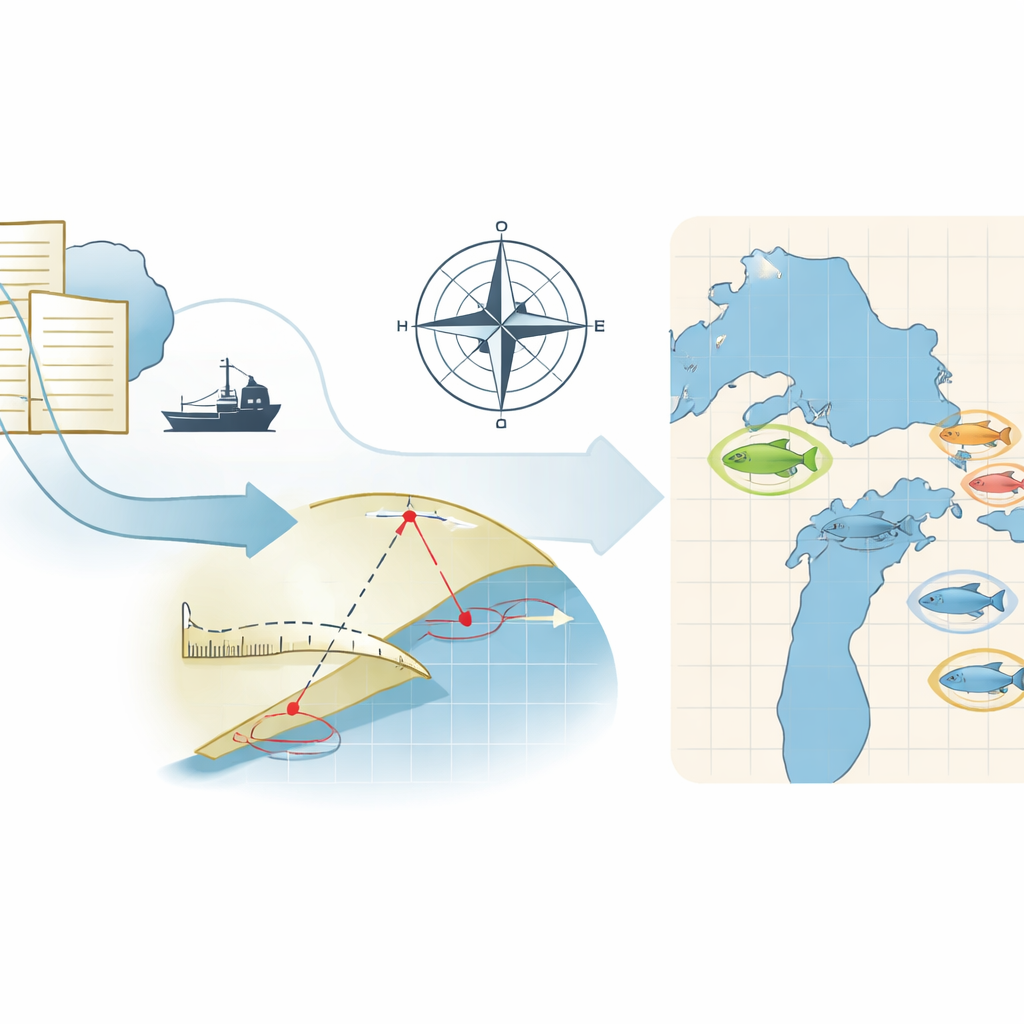
Much of the historical information described fishing grounds in words, not coordinates. To turn these descriptions into mappable points, the team used modern mapping software and careful detective work. They converted old navigation records—such as distances and compass directions from ports—into latitude and longitude, correcting for historical changes in magnetic north. When old charts showed fishing hotspots or spawning areas, the researchers digitally aligned those maps with modern shorelines and then clicked the center of each symbol to record a point. They checked depths against Great Lakes bathymetry, verified that points fell in water rather than on land, and discarded records that were too vague to place reliably. Each point in CORHIST includes not only coordinates but also notes on how precise that location is.
What the New Record Book Reveals
The finished CORHIST dataset contains 3,478 occurrence records from 1760 to 2007, with most observations between the 1920s and 1970s. More than 2,500 records have enough detail to classify them as spawning or nursery sites, based on explicit statements in the original source or on clear biological evidence such as ripe fish or captured larvae. Cisco and Lake Whitefish dominate the records, reflecting their historical importance to commercial fisheries and local communities. The database shows that many documented sites cluster near ports and cities where fishing and record‑keeping were intensive, while offshore and some tributary areas remain poorly documented. CORHIST has already been used to compare past and present spawning locations, to outline conservation units for restoration, and to help design new surveys that revisit historical spawning grounds.
How to Use the Data With Care
The authors emphasize that CORHIST is a powerful but imperfect window into the past. The presence of a point on the map means someone recorded coregonines there, not that it was the only or even the most important spawning site. Gaps in the map do not prove that fish were absent; they may simply mark places where nobody looked, or where documents have been lost. The team’s classifications of spawning and nursery status are informed judgments based on available evidence, and they encourage users to consult the linked original sources when making management decisions. Current records underrepresent Indigenous Ecological Knowledge, which the authors view as essential for a fuller picture of historical habitats and for future co‑management of fisheries.
Keeping the Past Alive to Guide the Future
By transforming scattered historical notes into an open, georeferenced database, CORHIST helps scientists, managers, and Indigenous communities see where coregonine fishes once thrived, how human actions altered those patterns, and where restoration might be most effective today. Rather than a final answer, the database is presented as a living resource that will grow as new records and partnerships emerge. For a layperson, the key message is straightforward: knowing where fish used to spawn and grow is essential if we hope to bring them back—and that knowledge lives not just in today’s surveys, but also in the memories and records of the past.
Citation: Brant, C.O., Silvis, S., Bennion, D.H. et al. Two hundred years of historical spawning and nursery data for coregonine fishes in the Laurentian Great Lakes. Sci Data 13, 711 (2026). https://doi.org/10.1038/s41597-026-06974-1
Keywords: Great Lakes fisheries, historical ecology, fish spawning habitats, cisco and whitefish, conservation data