Clear Sky Science · en
Proteomic profiling of human omental and subcutaneous adipose tissue in individuals with a broad range of BMI
Why This Matters for Our Waistlines
Obesity is often described in terms of pounds on a scale, but what truly matters for health is what is happening inside our fat tissue. Some fat stored under the skin may be relatively harmless, while fat packed deep in the abdomen is closely linked to diabetes and heart disease. This study maps thousands of proteins in two major fat depots from people across a wide range of body mass index (BMI), all before serious illnesses have developed. It offers a high‑resolution look at how different fat stores behave as people move from lean to obese, creating a resource that can help scientists pinpoint which molecular changes are harmful and which might be protective.
Two Kinds of Fat, Two Different Stories
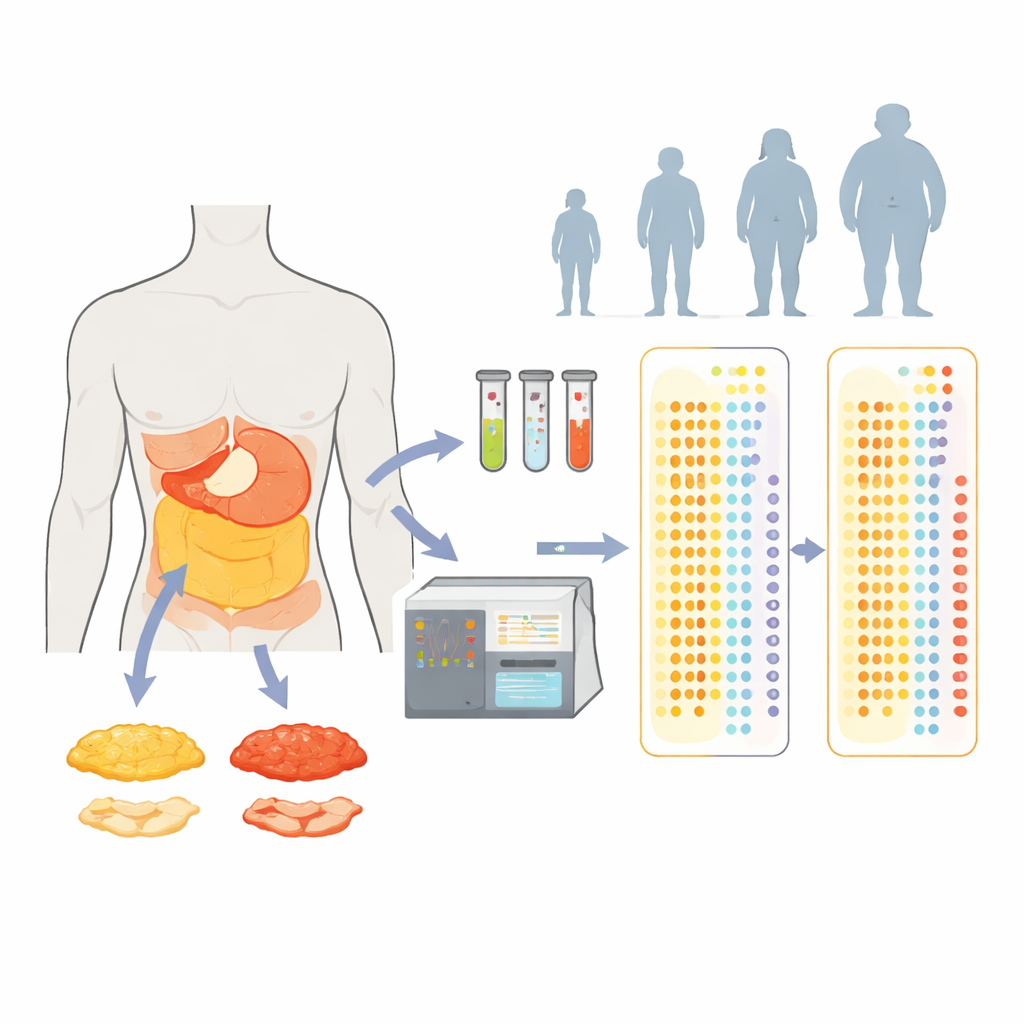
Our bodies contain multiple “neighborhoods” of fat. The researchers focused on subcutaneous fat, the layer just under the skin, and omental fat, a visceral depot that drapes around the intestines deep in the abdomen. Visceral fat has long been associated with higher risk of metabolic complications, whereas subcutaneous fat may sometimes buffer the body from harm. To separate the effects of fat itself from the effects of disease, the team enrolled 31 adults undergoing elective abdominal surgery who either had obesity or were lean, but who did not have diabetes, significant liver, kidney, or heart disease. From each participant, surgeons collected a small biopsy of both subcutaneous and omental fat whenever possible, creating carefully matched pairs from the same individual.
From Tissue to Molecular Fingerprints
Immediately after removal, the fat samples were either frozen for molecular analysis or fixed for standard tissue staining. Under the microscope, the investigators measured the size of individual fat cells, confirming that fat cell size increased with BMI and that subcutaneous fat cells were generally larger than omental ones. For the protein measurements, they used a technique called data‑independent acquisition mass spectrometry, which acts like a highly sensitive scanner that can detect and quantify tens of thousands of protein fragments in a sample without preselecting targets. Strict quality controls were added at every step—including reference proteins and synthetic peptides—to ensure that variation in the data mainly reflected biology rather than technical noise.
What the Proteins Reveal About Fat Depots
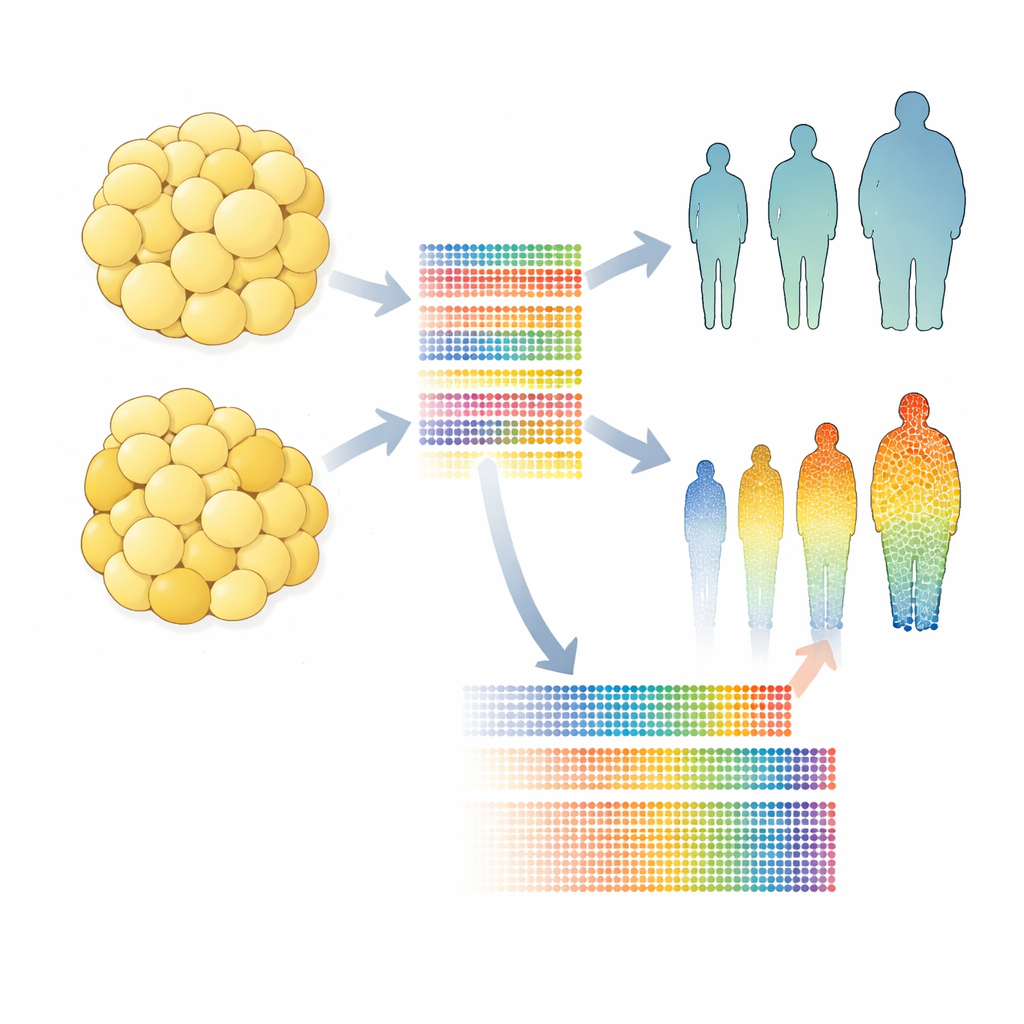
The resulting dataset is remarkably rich: nearly 48,000 distinct peptide fragments corresponding to more than 4,400 proteins were detected across all samples. Overall, the two fat depots shared many proteins, consistent with their common role as fat storage organs. Yet the analysis also revealed clear differences. Hundreds of proteins were more abundant in omental fat, and a separate set was enriched in subcutaneous fat, forming distinct molecular signatures for each depot. These differences held up in statistical tests and clustering analyses, which grouped samples cleanly into omental versus subcutaneous patterns. Previously known fat‑related proteins, such as those involved in handling fatty acids and producing hormones, were robustly detected, and prior targeted findings about vitamin A–processing enzymes being higher in omental fat were independently reproduced by this broader, unbiased survey.
How Fat Cell Size and BMI Shape the Proteome
Because the biopsies were paired and each participant was well characterized, the researchers could go beyond simple depot comparisons. They examined how protein levels tracked with BMI and with fat cell size in each depot. In omental fat, they found 33 proteins whose abundance rose or fell with cell size, whereas subcutaneous fat showed no proteins significantly tied to cell size using their criteria. When they looked at BMI—a surrogate for overall adiposity in this carefully screened cohort—19 proteins in omental fat and more than 100 in subcutaneous fat correlated with BMI. A small set of proteins changed with BMI in both depots, while others shifted only in one location, suggesting that gaining weight does not affect all fat in the same way. The accompanying clinical data, such as insulin levels and liver scores, further expand what can be explored.
A Resource for Understanding Healthy and Harmful Fat
This work does not claim to identify specific “good” or “bad” proteins on its own; instead, it delivers a curated, publicly available map of protein expression in human fat depots across the spectrum from lean to obese, but before major complications appear. Scientists can now use this map to ask targeted questions: Is a candidate drug target actually present in human fat, and in which depot? Do certain proteins rise only when fat cells in the abdomen enlarge, potentially signaling higher risk? By distinguishing how subcutaneous and omental fat change with increasing adiposity, this dataset lays groundwork for understanding why some people with obesity remain metabolically healthy while others develop serious disease—and may ultimately guide strategies that shift fat biology toward a safer state rather than focusing solely on weight loss.
Citation: Zelter, A., Wen, Y.W., Riffle, M. et al. Proteomic profiling of human omental and subcutaneous adipose tissue in individuals with a broad range of BMI. Sci Data 13, 601 (2026). https://doi.org/10.1038/s41597-026-06948-3
Keywords: adipose tissue proteomics, subcutaneous vs visceral fat, obesity and BMI, human fat cell biology, mass spectrometry dataset