Clear Sky Science · en
SYN-OCT:A synthetic dataset of ocular optical coherence tomography images from healthy and glaucoma eyes
Why Fake Eye Scans Matter for Real Patients
Glaucoma is a leading cause of blindness, and modern eye clinics rely on detailed scans of the back of the eye to catch it early. But developing smart computer programs to read these scans demands huge amounts of patient data that are hard to share because of privacy rules. This paper introduces SYN-OCT, a massive collection of entirely synthetic eye scans that look and behave like real ones, giving researchers a new way to build and test glaucoma-detecting algorithms without exposing anyone’s personal medical information.
Seeing the Eye in Cross-Section
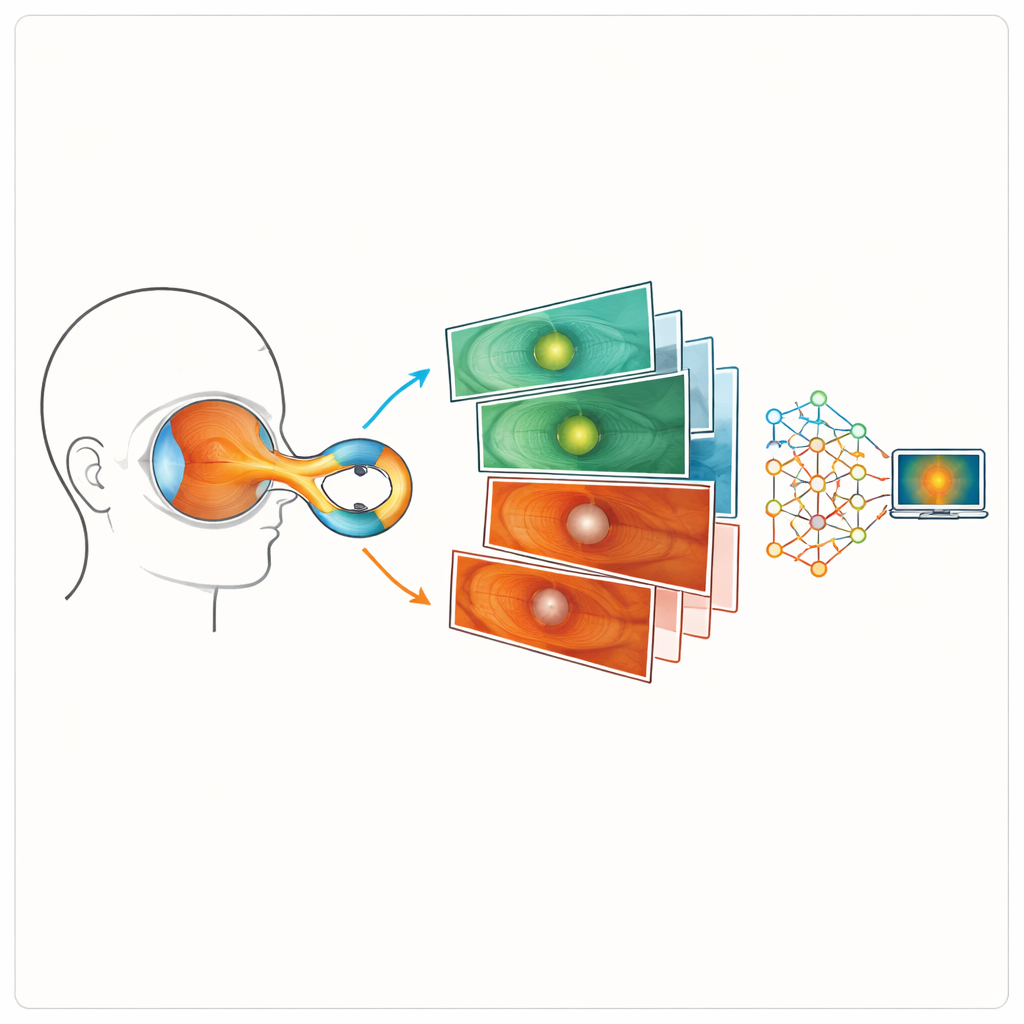
The work centers on a common eye imaging test called optical coherence tomography, or OCT, which captures cross-sectional “slices” of the retina. The authors focused on circumpapillary scans, thin rings taken around the optic nerve where the retinal nerve fiber layer (RNFL) is measured. This layer is vital because it thins as glaucoma damages the optic nerve. In everyday practice, doctors compare RNFL patterns from these scans between healthy and glaucoma patients to help diagnose the disease and monitor its progression.
Making Realistic Images Out of Thin Air
To build their synthetic dataset, the team first collected real OCT scans from nearly two thousand eyes seen at the Singapore Eye Research Institute between 2012 and 2021. One group included people with clinically confirmed glaucoma; another consisted of adults without major eye disease. Instead of sharing these real images, the researchers trained two separate image‑generating systems—one for healthy eyes and one for glaucoma eyes—using a technique called a generative adversarial network. In this setup, one network tries to create realistic images while another tries to tell fake from real, pushing both to improve until the generated images closely resemble genuine OCT scans.
Checking That the Fakes Behave Like the Real Thing
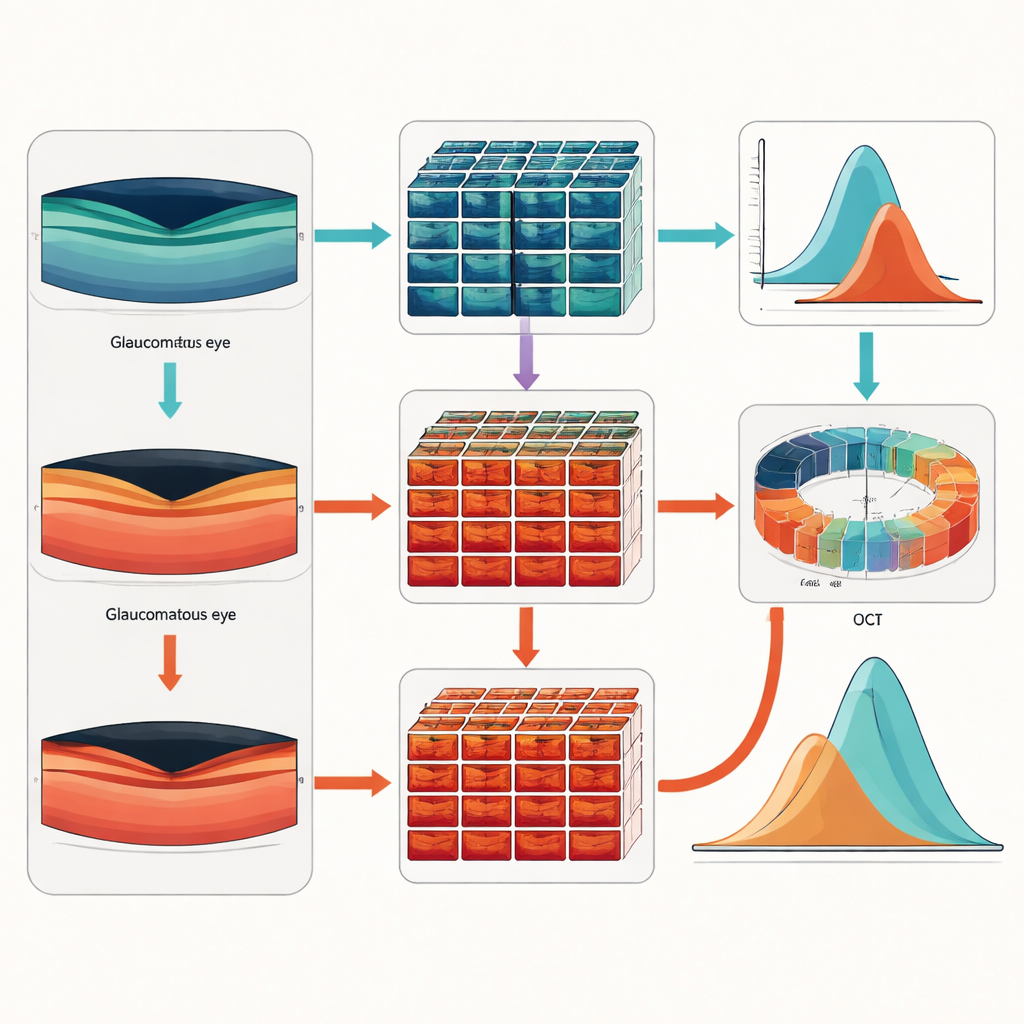
Creating convincing images is not enough; they must also carry the same medical meaning as real scans. The authors first used a standard image quality score to confirm the synthetic scans were close in appearance to the originals, and then asked experienced eye doctors to review a sample. The specialists could only tell real from synthetic slightly better than random guessing, showing that the fakes were visually very convincing. To probe deeper, the team ran all images—real and synthetic—through an automated tool that measures RNFL thickness around the optic nerve. The overall patterns and average thickness values from synthetic scans matched those from real scans, and they still preserved a key medical hallmark: glaucoma images consistently showed thinner nerve layers than healthy ones.
Putting Synthetic Data to the Test
The most demanding test was whether these artificial scans could stand in for real patient data when training diagnostic tools. The researchers trained one deep‑learning model to distinguish glaucoma from healthy eyes using only real images and another using only synthetic images. Both were then challenged with unseen data from local patients and from an independent hospital in Romania. The model trained purely on synthetic scans performed at least as well as the one trained on real data, and in some cases slightly better, suggesting that high‑quality synthetic images can help build robust tools that generalize across different clinical settings.
A Safe Shortcut to Smarter Eye Care
To a lay reader, the key message is that SYN-OCT offers a way to “borrow” the power of large medical datasets without borrowing the private details of real people. By showing that computer‑generated eye scans can mimic both the look and the medically important measurements of genuine images—and can successfully train glaucoma detection systems—this work points toward a future where hospitals and labs can share rich image resources freely. That could speed up development of better, fairer, and more widely tested tools for catching glaucoma before it steals sight, all while protecting patient privacy.
Citation: Wong, D., Sreejith Kumar, A.J., Chong, R.S. et al. SYN-OCT:A synthetic dataset of ocular optical coherence tomography images from healthy and glaucoma eyes. Sci Data 13, 637 (2026). https://doi.org/10.1038/s41597-026-06946-5
Keywords: glaucoma, synthetic medical data, optical coherence tomography, deep learning in ophthalmology, medical image privacy