Clear Sky Science · en
Chromosome-level genome assembly of masu salmon (Oncorhynchus masou masou)
Why This Salmon Story Matters
Salmon are famous for their epic journeys from river to sea and back again, but their DNA tells an equally dramatic story. Masu salmon, a species native to East Asia, carry an entire extra copy of their genome from an ancient doubling event. By building one of the most complete salmon genomes to date, this study gives scientists a powerful map for exploring how extra genetic material helps fish adapt to changing rivers, oceans, and climates—and may even explain why some salmon die after a single spawning while others breed many times.
Looking Inside a Doubled Genome
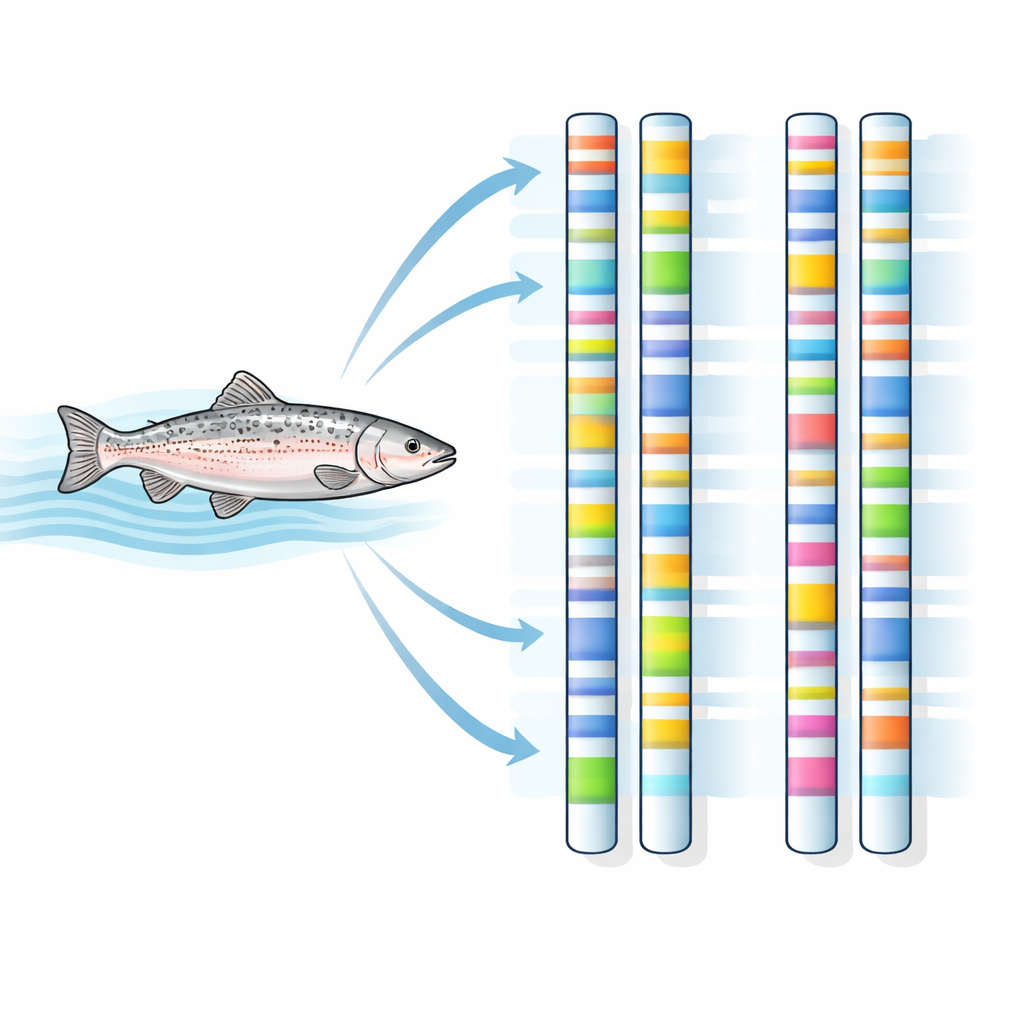
Long ago, the ancestors of today’s salmon experienced a rare event: their entire set of chromosomes was duplicated. Instead of having just one copy of each gene, they suddenly had two. Over millions of years, some of these duplicates were lost, while others took on new or more specialized roles. Because this duplication in salmon is relatively recent in evolutionary terms, it still leaves a clear imprint in their DNA. That makes salmon a natural laboratory for studying how new genes are born, how they change, and how they might drive the evolution of new traits. Masu salmon, with its mix of sea-going and freshwater lifestyles and its importance to fisheries in Japan, Korea, and Russia, is an especially valuable case.
Building a High-Resolution Genetic Map
To unlock the masu salmon genome, the researchers combined several cutting-edge DNA sequencing technologies. One type reads stretches of DNA very accurately, another produces extremely long fragments that help bridge repetitive regions, and a third captures how pieces of DNA are physically folded and packed inside chromosomes. By weaving these data together, the team produced two full “haplotypes”—essentially two versions of the genome, one for each parental set of chromosomes. Each haplotype spans about 2.4 to 2.5 billion DNA letters, and 33 large pieces in each set cover more than 99.6% of the total, approaching true chromosome-level resolution. Quality checks showed that almost all expected genes are present, and many of the gaps that remained in a previous reference genome were successfully filled.
Comparing Salmon Families
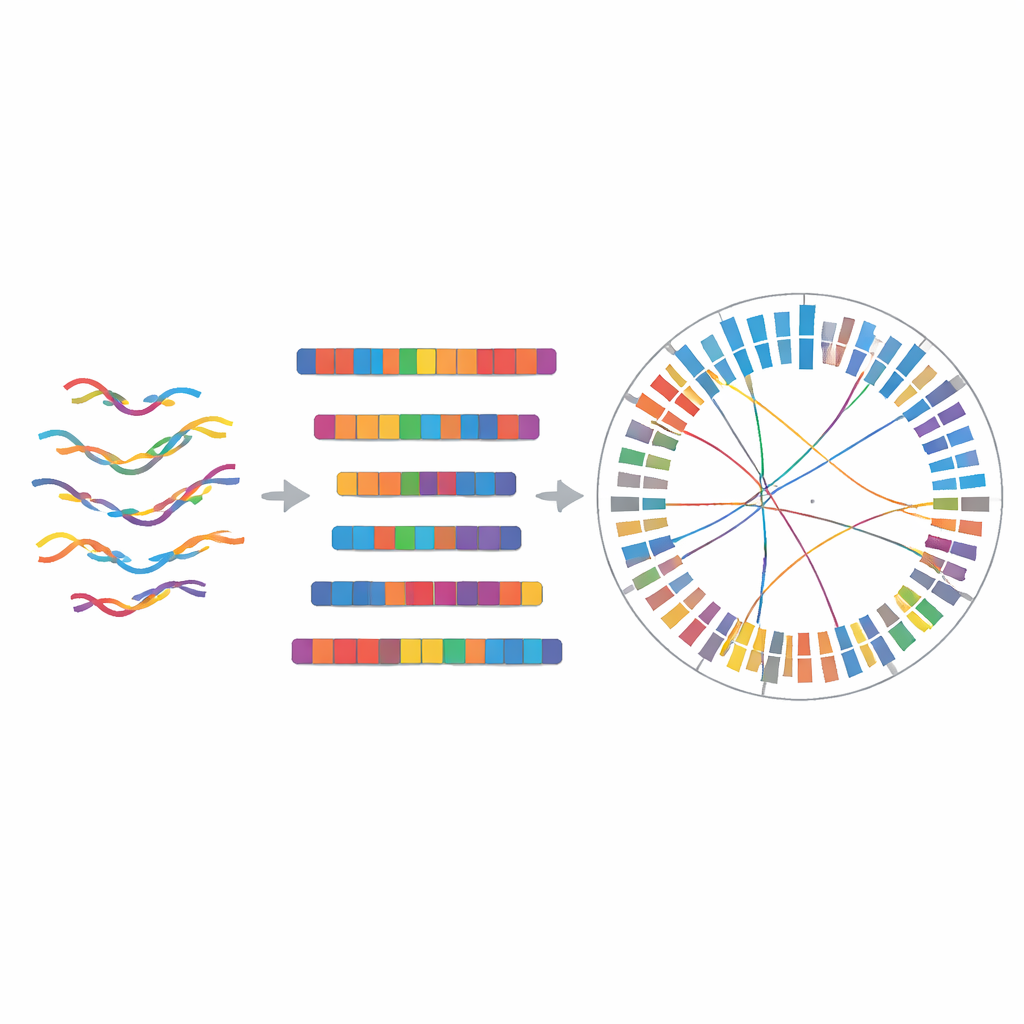
With this detailed map in hand, the team compared masu salmon DNA to that of related salmonids, including rainbow trout, Atlantic salmon, grayling, and whitefish, as well as more distant fish like zebrafish and spotted gar. They traced when different lineages branched off from one another and catalogued how various kinds of gene duplicates—those created by whole-genome doubling, by small local repeats, or by genes that jumped to new positions—are distributed across species. Masu salmon and its relatives retain a remarkably high number of genes from the original genome duplication, and earlier work suggests many of these have evolved new functions. Connections between chromosomes, especially on the Y chromosome, show strong conservation between masu salmon and rainbow trout, hinting at shared mechanisms of sex determination and reproduction.
From One-Time Breeders to Repeat Spawners
One of the most intriguing salmon mysteries is why some species, like Pacific salmon, typically die after a single, exhausting spawning run (a strategy known as semelparity), while others, like rainbow trout, can reproduce multiple times. To provide raw material for answering this question, the researchers didn’t stop at DNA. They also collected RNA—the molecules that reflect which genes are turned on or off—from ten different tissues in masu salmon at key moments before and after spawning, and from matching tissues and time points in rainbow trout, a multiple-spawning species. Across 150 RNA samples, this dataset captures the shifting activity of tens of thousands of genes in brains, hearts, livers, reproductive organs, and more, offering a rich resource for future studies of how reproduction, aging, and survival are programmed at the molecular level.
A New Toolkit for Salmon Science
Taken together, the chromosome-scale genome and extensive gene activity maps create a reference toolkit for anyone studying salmon biology. The new assembly closes tens of thousands of gaps, clarifies the structure of the Y chromosome, and ranks among the best genomes available for the salmon family. By tying this map to detailed snapshots of gene activity in both one-time and repeat-spawning species, the work paves the way for discoveries about how extra genes are repurposed, how salmon adapt to their environments, and why some pay for reproduction with their lives while others return to spawn again. For fisheries management, conservation, and basic evolutionary biology, this resource offers a much sharper lens on one of the planet’s most iconic fish.
Citation: Wu, B., Yu, Y., Zhang, X. et al. Chromosome-level genome assembly of masu salmon (Oncorhynchus masou masou). Sci Data 13, 534 (2026). https://doi.org/10.1038/s41597-026-06943-8
Keywords: masu salmon genome, whole genome duplication, salmonid evolution, reproductive strategies, comparative genomics