Clear Sky Science · en
Chromosome-level genome of the bank vole (Clethrionomys glareolus): a resource for eco-evo-disease research
A Tiny Forest Mammal with Big Scientific Potential
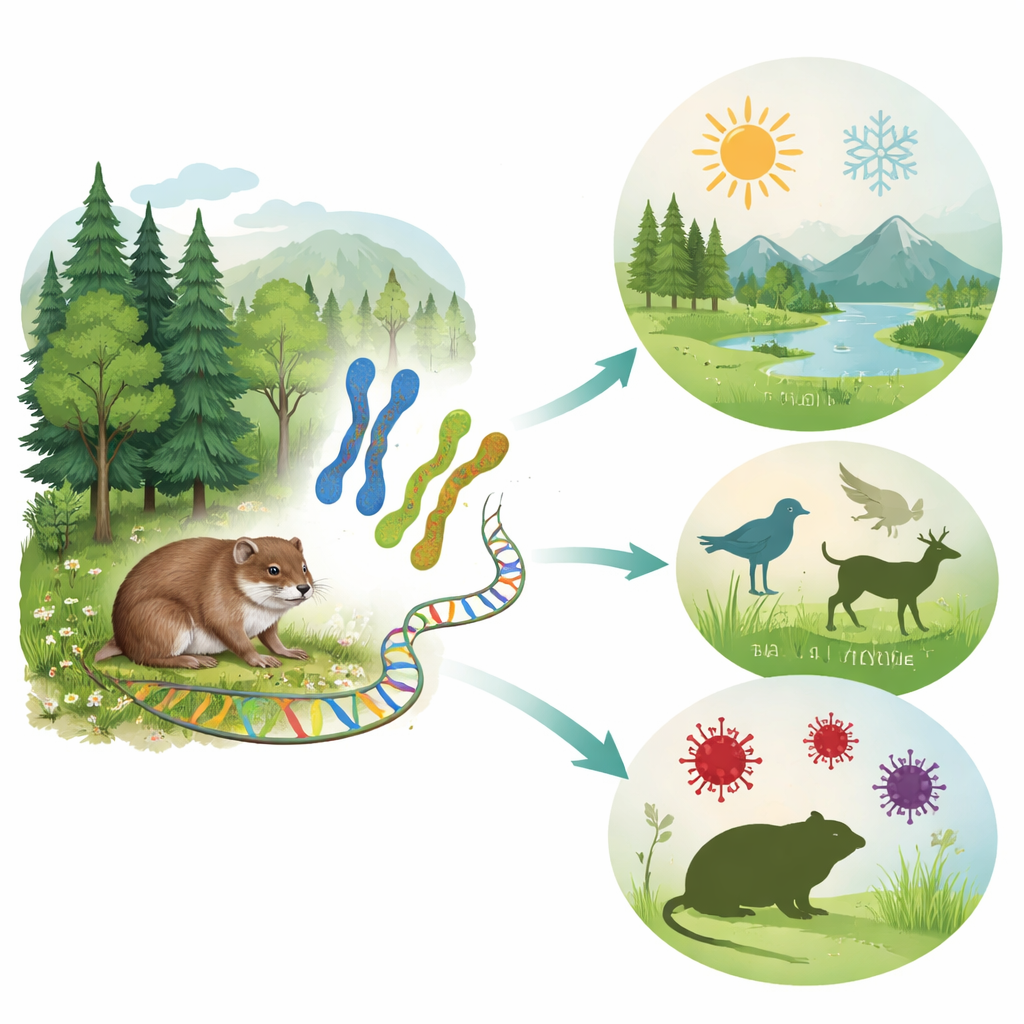
Imagine a common woodland rodent that quietly helps scientists answer questions about climate change, emerging diseases and how life adapts over time. That animal is the bank vole, a small mouse-like mammal found across Europe and western Asia. In this study, researchers have assembled the bank vole’s DNA into a complete, chromosome-level map. This detailed genetic blueprint turns an unassuming forest creature into a powerful reference species for studies ranging from evolution and ecology to virus infections and immune defenses.
Why Map the DNA of a Small Rodent?
For decades, most genetic research focused on a few classic “lab model” animals, such as mice and rats, chosen more for convenience than for ecological relevance. Falling DNA sequencing costs have changed that picture. Scientists can now build high-quality genomes for wild species that live in real, changing environments. The bank vole is a prime example: it is widespread, sensitive to climate, and already well-studied in terms of how its populations moved and adapted during and after the Ice Ages. It also naturally carries several rodent-borne viruses and parasites, making it useful for understanding how pathogens circulate in wildlife and sometimes spill over into humans.
Building a Complete Genetic Blueprint
The team set out to upgrade earlier, fragmented versions of the bank vole genome into a tidy, chromosome-by-chromosome assembly. They combined huge quantities of short DNA reads from standard sequencing with special “Chicago” and “Hi-C” data that capture how pieces of DNA are physically linked within the cell. Using a computational pipeline called HiRise, they stitched together hundreds of thousands of small fragments into just 28 long scaffolds—each corresponding to a chromosome, matching what was already known from microscopic studies of bank vole chromosomes.
Checking Quality and Finding the Genes
To test whether any important pieces were missing, the researchers used a widely adopted quality check that looks for a core set of essential genes expected in mammals. The final assembly recovered about 91% of these benchmark genes, indicating a high level of completeness. Next, they layered information from bank vole RNA and a carefully curated protein database to predict where genes lie in the genome and what they might do. They identified over 40,000 gene regions, including more than 21,000 likely protein-coding genes—numbers very similar to those found in mouse and rat. Most of these genes closely resemble genes already known from those classic lab rodents, which will make it easier to transfer knowledge between species.
Uncovering Repeated DNA and Hidden Pitfalls
Not all DNA encodes genes. A large fraction consists of repeated sequences and mobile elements that have copied and pasted themselves through the genome over evolutionary time. By using specialized software, the authors found that roughly 29% of the bank vole genome is made up of such repeats, mainly two major classes known as LINEs and SINEs, along with other mobile elements. This overall pattern closely matches what is seen in related rodent species. They also identified regions where short DNA reads are hard to place unambiguously, creating a “masked” version of the genome that helps other researchers avoid misleading signals when they map new data onto this reference.

A New Foundation for Climate and Disease Research
With this chromosome-level genome in hand, the bank vole becomes a far more powerful model species. Scientists can now link tiny DNA differences to traits such as tolerance to cold, changes in body function or resistance to infection, and see exactly where those differences sit along each chromosome. The new reference will support studies of how wild populations respond to shifting climates, how pathogens and hosts coevolve and how genetic variation is distributed across landscapes. In short, this tiny forest mammal now has a big, well-organized instruction manual, and that resource will help researchers tackle pressing questions about biodiversity, adaptation and the spread of disease.
Citation: Marková, S., White, T.A., Searle, J.B. et al. Chromosome-level genome of the bank vole (Clethrionomys glareolus): a resource for eco-evo-disease research. Sci Data 13, 536 (2026). https://doi.org/10.1038/s41597-026-06924-x
Keywords: bank vole genome, chromosome-level assembly, eco-evolutionary genomics, rodent-borne diseases, climate adaptation