Clear Sky Science · en
Chromosome-level haplotype-resolved genome assemblies and annotations of Apios americana and Apios priceana
Why Wild Beans and Their DNA Matter
Two little-known North American vines, Apios americana and Apios priceana, grow underground strings or single balls of edible tubers rich in protein. They can live for years, help fix nitrogen in the soil, and could one day join potatoes and beans as hardy, climate-friendly crops. Until now, however, scientists lacked a detailed map of their DNA, limiting efforts to breed better varieties or to understand how these unusual plants evolved. This study delivers the first complete, chromosome-by-chromosome views of both species’ genomes, opening the door to new food, conservation, and basic biology discoveries.
Two Underground Crops With Big Potential
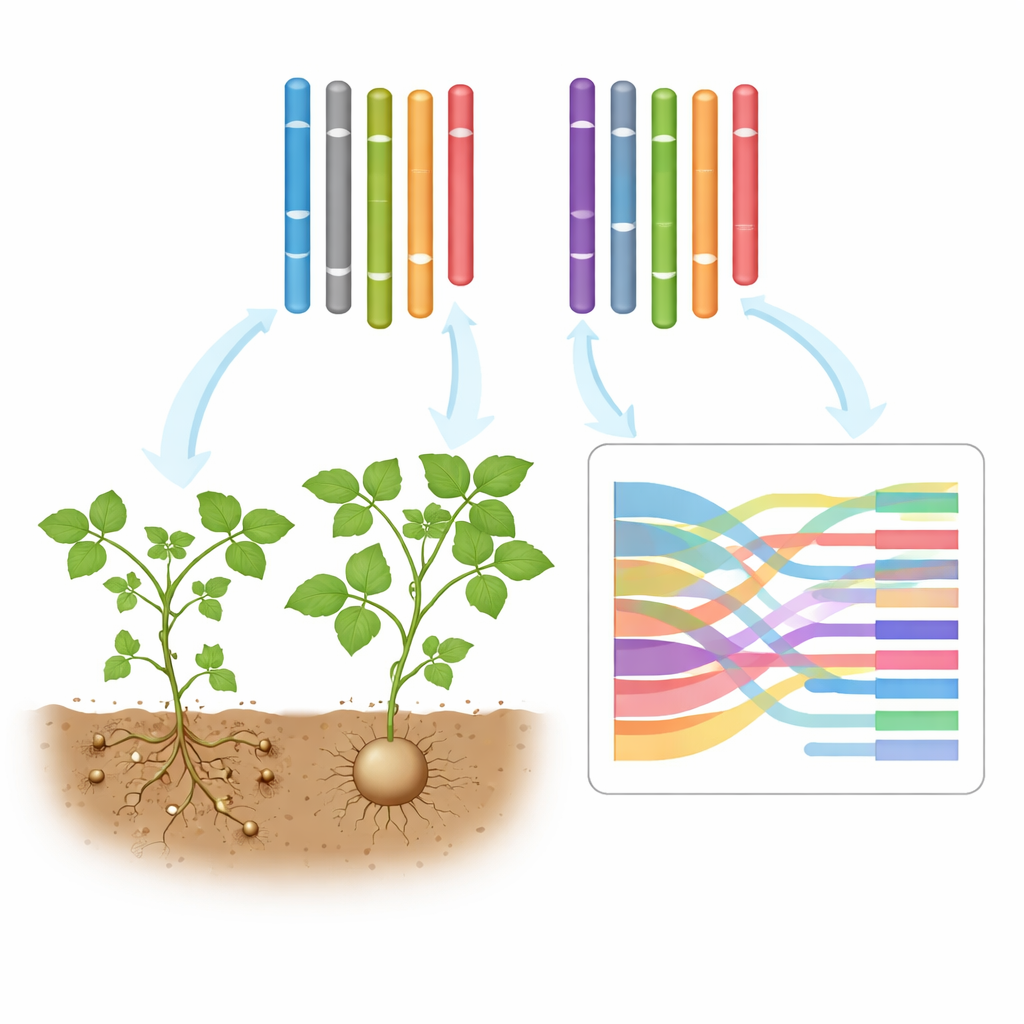
Apios plants belong to the legume family, alongside familiar crops such as soybeans and common beans. Unlike most of their relatives, they produce underground tubers that are both storage organs and food. Apios americana, sometimes called potato bean, tends to form chains of tubers along underground stems, while Apios priceana makes a single, larger tuber. Both are native to eastern North America, and their tubers have attracted interest because they are tasty, keep well, and contain as much as 11–14% protein by dry weight. These traits make Apios a promising candidate for development as a perennial crop that can be harvested year after year without replanting. Yet, without a full genetic blueprint, it has been difficult to systematically improve these plants or to compare them in detail with better-studied legumes.
Building High-Quality DNA Maps
The researchers set out to create reference genomes for both Apios species that are as complete and accurate as those available for major crops. They extracted very long pieces of DNA from carefully grown shoots and used a technology that reads each molecule multiple times to generate highly accurate long sequences. They then combined these long reads with a method that captures the way DNA folds and contacts itself inside the cell nucleus. This contact information helps assemble pieces into full chromosomes, much like using a 3D jigsaw puzzle to determine which fragments sit next to each other. For each species, the team reconstructed two full “haplotypes”—the two versions of the genome that plants carry, one from each parent—each packaged into 11 chromosome-length sequences.
What the Genomes Reveal
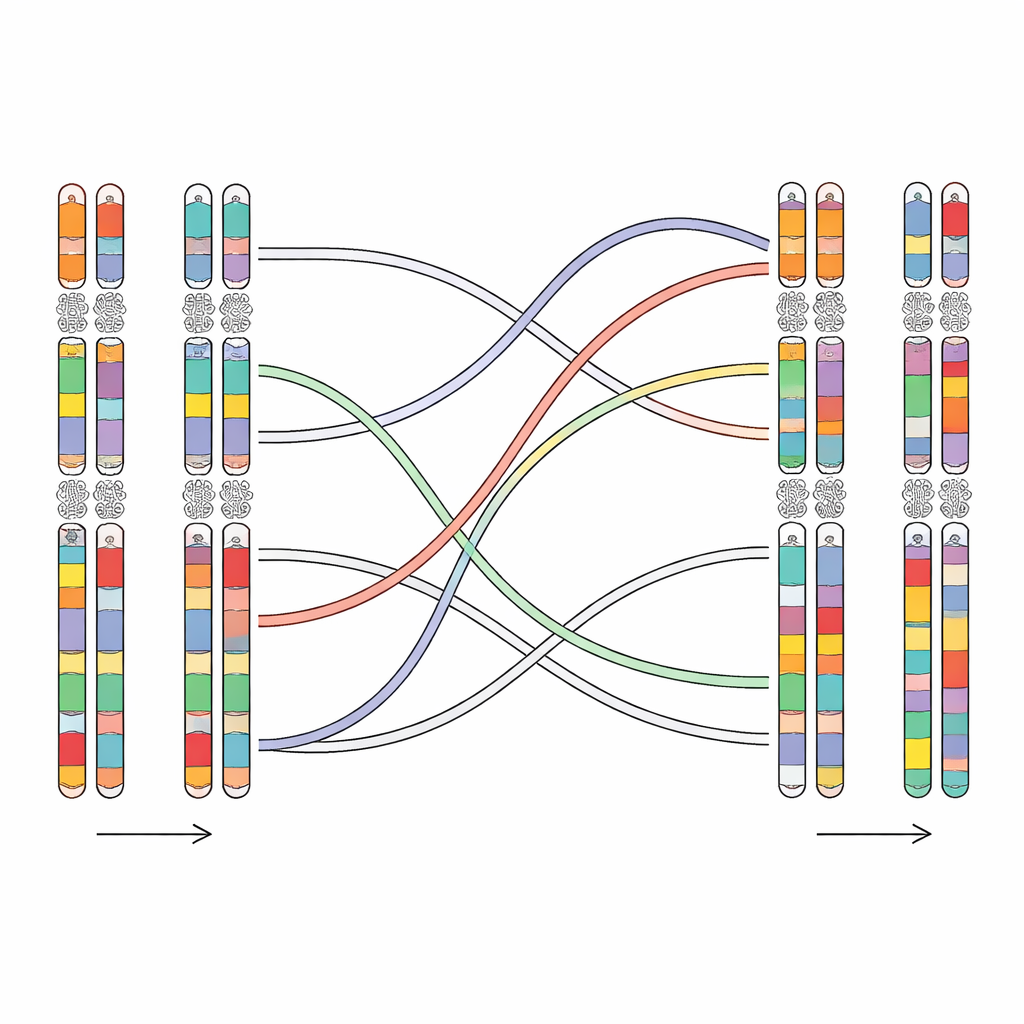
The finished DNA maps show that Apios americana’s genome is about 1.53 billion DNA letters long, while Apios priceana’s is about 1.85 billion. Roughly 26,000 protein-coding genes were predicted in each haplotype for both species, similar to counts in other legumes. Strikingly, more than 80% of each genome consists of repeated DNA, especially mobile elements called long terminal repeat retrotransposons. These repeated regions are more abundant in A. priceana, helping explain why its genome is roughly one-fifth larger. The assemblies passed strict quality checks: more than 98% of a standard set of expected plant genes were present and nearly all were complete, showing that very little information is missing. Detailed comparisons between the four haplotypes revealed that most chromosomes match closely, but several carry large inversions—segments flipped in orientation—spanning tens of millions of DNA letters.
Hidden Centers and Family History
Beyond the broad layout, the study also zoomed in on special regions known as centromeres, where chromosomes are pinched during cell division. Using tools that search for repeated short DNA patterns, the team identified families of about 193-letter repeats that cluster in centromere-like zones on all 11 chromosomes of both species. These clusters are larger and more numerous in A. priceana, again reflecting its greater load of repetitive DNA. When the scientists compared the overall DNA differences between the two species, they estimated that they split from a common ancestor a little over two million years ago—recent in evolutionary terms, and consistent with earlier work on the legume family tree.
What This Means for Future Food and Plant Science
By delivering complete, haplotype-resolved genomes for two wild tuber-forming legumes, this work turns Apios from an obscure oddity into a genetically tractable resource. Plant breeders can now use these DNA maps to track traits like tuber size, yield, or stress tolerance, and to design crosses more efficiently. Ecologists and evolutionary biologists gain a well-anchored reference for studying how perennial growth, storage roots, and nitrogen-fixing partnerships evolved within the broader legume clan. In practical terms, these genomes move us closer to domesticating new, nutritious, and resilient crops that could diversify our food systems while working gently with the soil.
Citation: Lee, Ho., Wright, H.C., Jordan, B.D. et al. Chromosome-level haplotype-resolved genome assemblies and annotations of Apios americana and Apios priceana. Sci Data 13, 544 (2026). https://doi.org/10.1038/s41597-026-06915-y
Keywords: Apios americana, tuberous legumes, plant genome assembly, comparative genomics, perennial crops