Clear Sky Science · en
A dynamic meshing transmission dataset for manufacturing quality inspection of electric vehicle reducer gears
Why Quiet Gears Matter for Electric Cars
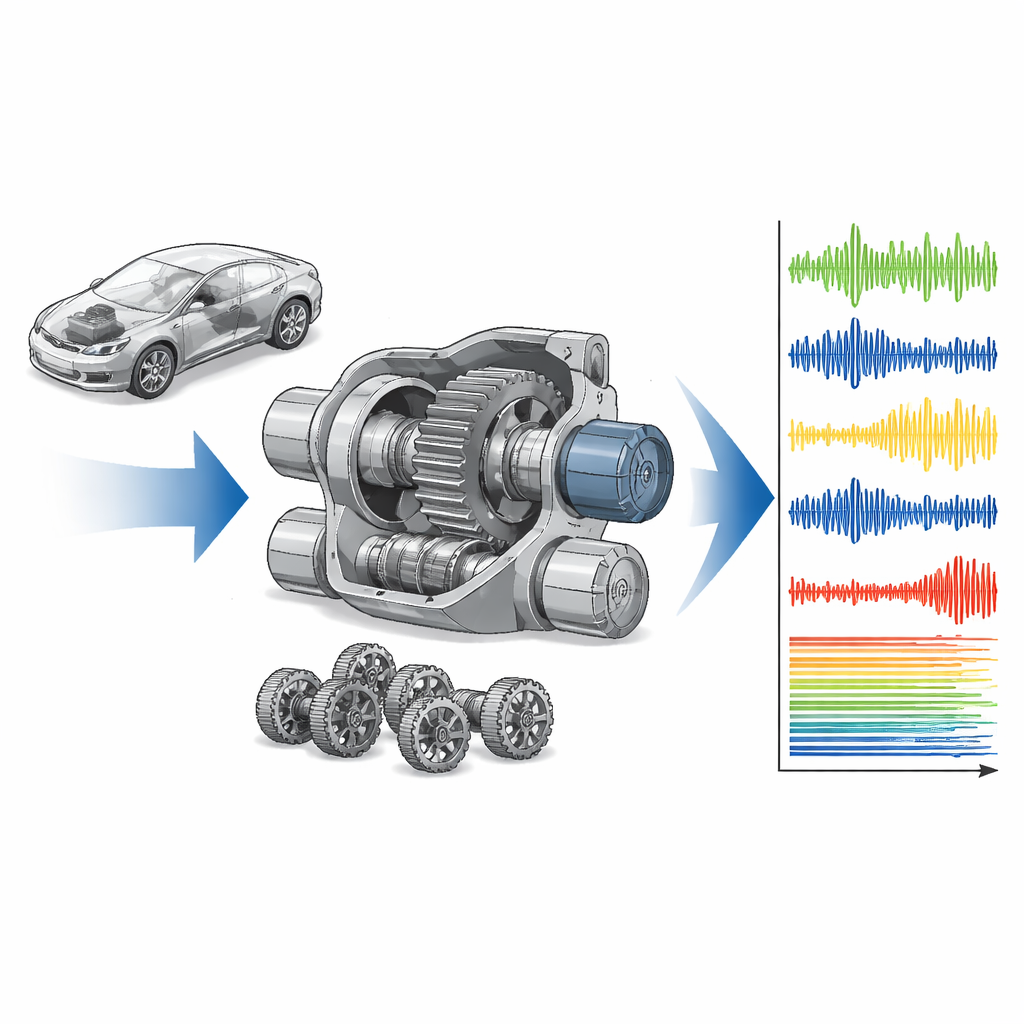
As electric cars become more common, the soft whir you hear inside the cabin is increasingly shaped not by an engine, but by the gears that connect the motor to the wheels. Tiny flaws on those gear teeth can turn into annoying whines or vibrations, hurting comfort and adding costs for manufacturers. This study presents a new, real-world dataset of how electric vehicle reducer gears actually behave while running, giving engineers and data scientists the raw material they need to build faster, more accurate quality checks that keep future electric cars quiet.
From Slow Inspection to Fast Listening
Today, many manufacturers inspect gears by carefully scanning the surface of each tooth and using a mathematical tool called Fourier analysis to look for unwanted ripples. While precise, this method is painfully slow: checking a single gear can take close to an hour, making it impossible to test every piece on a high-volume production line. Even worse, a gear that looks acceptable under this static test can still misbehave once it is installed and spinning at high speed, leading to harsh noise and costly repairs after the car is built.
A New Way to Judge Gears in Motion
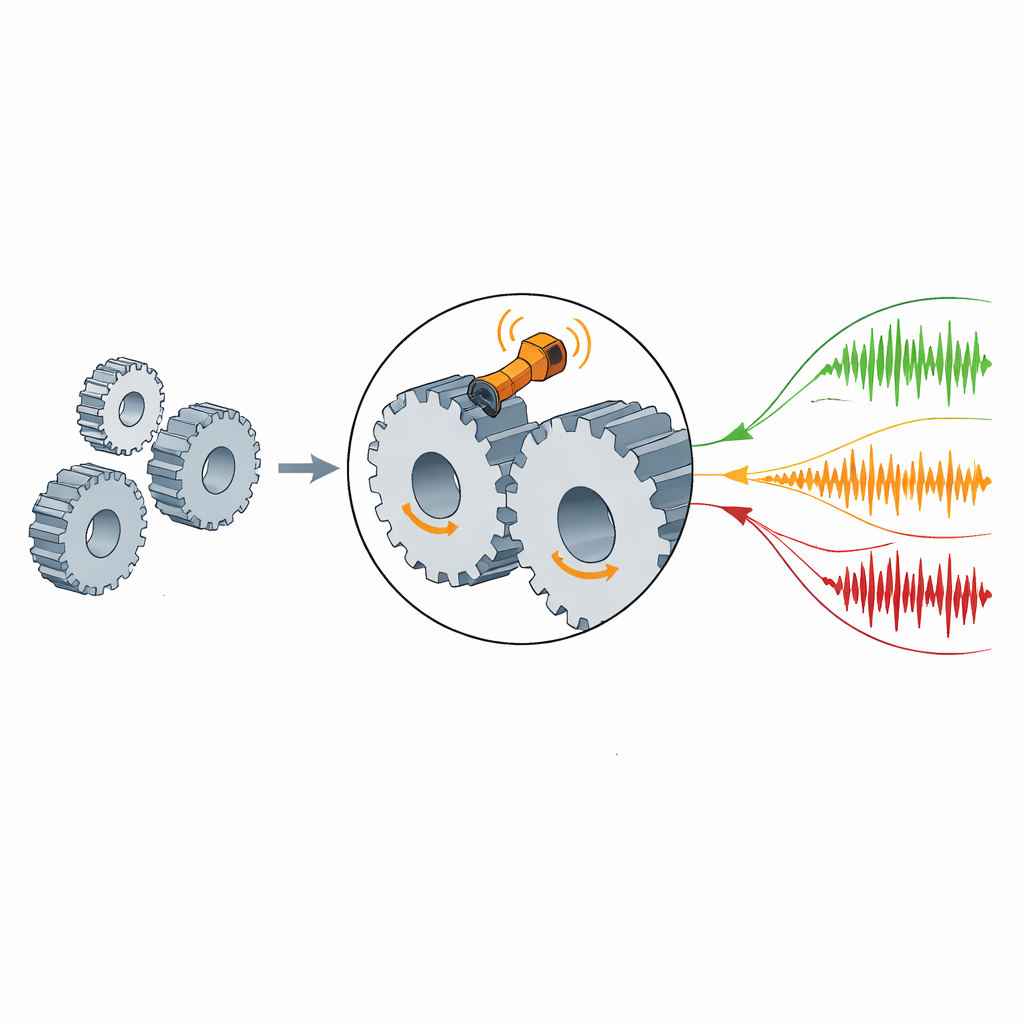
The authors propose a more practical approach: instead of just examining the tooth surface, they directly measure how a pair of gears behaves while meshing under changing speed and load, much closer to real driving. They built a test setup with a drive motor, a loading motor, and a sensitive vibration sensor placed near the shaft. Each gear pair is run through controlled acceleration and deceleration from about idle-like speeds up to several thousand revolutions per minute, while both vibration and speed signals are recorded in detail. Afterward, the very same gears undergo high-precision surface measurements and end-of-line tests at the vehicle maker, which are used to label each gear as healthy or belonging to a specific problem type.
What Makes This Dataset Different
The resulting resource, called the Dynamic Meshing Transmission Dataset (DMTD), focuses on five realistic gear states that arise in production: healthy gears, gears with subtle periodic ripples that cause a characteristic whine, gears with small bumps that produce a ticking sound, and gears that show signs of poor grinding and surface damage. Unlike earlier gear datasets created in laboratories—where teeth were deliberately cracked, chipped, or worn under simple operating conditions—these data come from actual manufacturing lines, with all their messy variation in machine tools, batches, and control settings. The tests cover speeds from about 100 to 2,450 rotations per minute and include both speeding up and slowing down, capturing how noise behavior changes across the driving range.
Turning Raw Noise into Clear Patterns
Because these vibration signals change with speed, the team processes them into an “order” view that aligns the data with how often gear teeth mesh, rather than just with time. In this view, each gear type shows a distinct pattern: healthy gears have clean, regular signatures; slight bumps add repeating impact spikes; and the ghost whine types reveal strong peaks at specific multiples of the mesh frequency, matching the tones that drivers would hear as a whine. Gears with leaky grinding stand out with much stronger overall vibration and a sharply marked fault band. Using these processed signals, the researchers trained a one-dimensional convolutional neural network—a modern pattern-recognition model—which could reliably tell the five states apart. When they compared performance against three widely used laboratory datasets, the new DMTD supported at least as good, and often better, classification, despite being more complex and closer to real-world conditions.
How This Helps Future Electric Cars
DMTD is more than a collection of signals; it is a benchmark that lets researchers test new algorithms for gear quality inspection and noise prediction under conditions that mirror true factory practice. By capturing how small manufacturing imperfections translate directly into vibration and sound, this dataset can guide improvements in both gear making and automatic fault diagnosis. In everyday terms, that means helping automakers spot troublesome gears in about a minute instead of an hour, reduce costly noise issues before cars leave the plant, and deliver quieter, more comfortable electric vehicles to drivers.
Citation: Guo, D., Yang, J., Li, H. et al. A dynamic meshing transmission dataset for manufacturing quality inspection of electric vehicle reducer gears. Sci Data 13, 510 (2026). https://doi.org/10.1038/s41597-026-06885-1
Keywords: electric vehicle gears, vibration data, gear noise, manufacturing quality, fault diagnosis