Clear Sky Science · en
A dataset of measured machining deviations of compressor rotor blades
Why tiny blade flaws matter
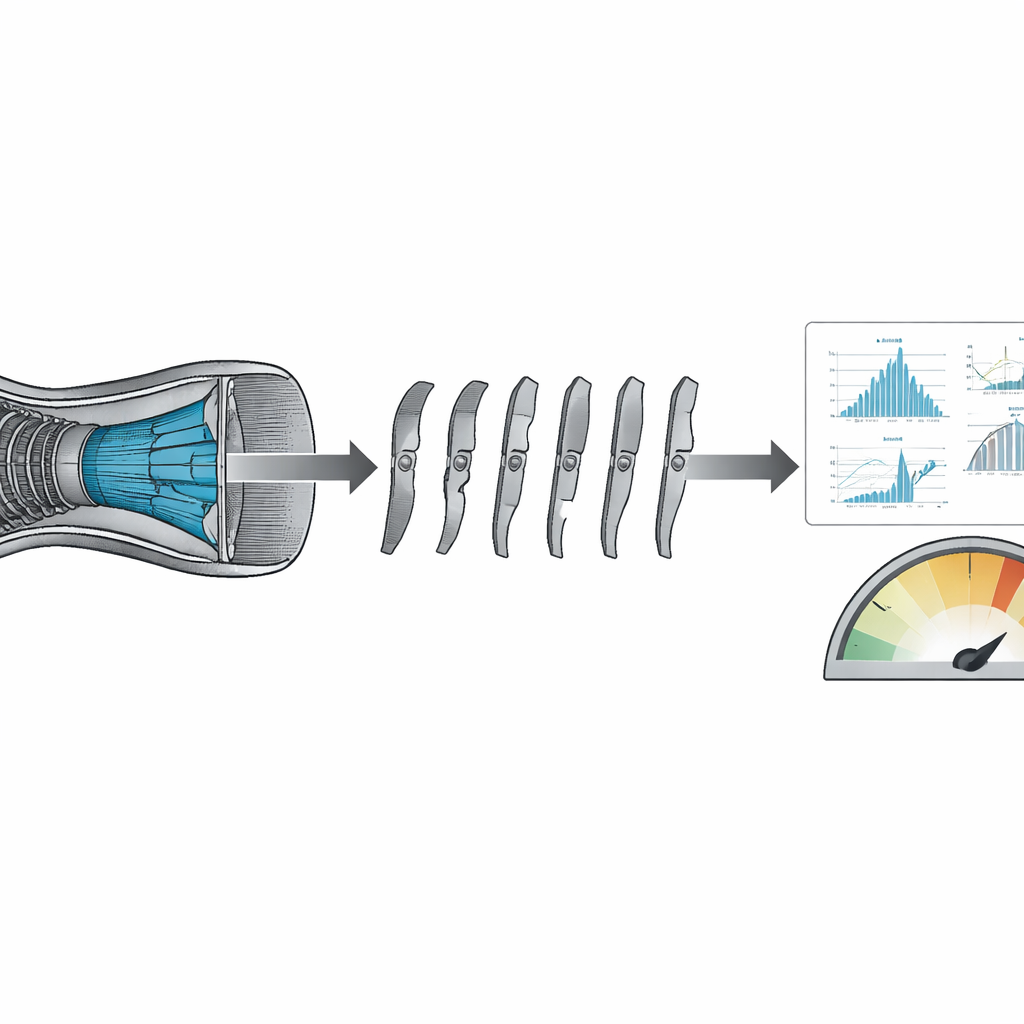
A modern jet engine depends on rows of intricately shaped metal blades that squeeze incoming air in its compressor. Even with advanced machining, each blade comes out slightly different from the design. These tiny geometric imperfections can nudge an engine’s efficiency and safety margins, yet engineers have had surprisingly little real-world data on how blades actually differ from one another. This paper presents a rare, openly shared dataset that captures those deviations in detail, giving designers a firmer factual basis for predicting engine performance and risk.
From ideal shapes to real parts
In theory, every compressor blade has a carefully drawn shape that dictates how it should guide the air. In practice, cutting hard titanium alloys into these complex three-dimensional forms on five‑axis machines is difficult. Cutting forces, vibration and tool wear all leave small errors in blade thickness, edge sharpness and twist. When hundreds of almost‑identical blades are assembled, these small differences add up, shifting the average performance of the compressor and widening the spread between its best and worst behavior. That spread, or performance scatter, is crucial for safety because it affects how close an engine can run to stall or surge limits.
Why assumptions are not enough
To estimate how such variations influence flow, engineers use uncertainty quantification, in which they assign a probability distribution to each geometric deviation and then simulate how those random inputs propagate through the compressor. Up to now, most studies have simply assumed that blade errors follow the familiar bell-shaped, or Gaussian, curve. A growing body of scattered measurements has already hinted that this is often wrong: some deviations skew to one side, others show two peaks or more complex patterns. When the assumed mathematical shape of the variation does not match reality, predictions of efficiency, pressure rise and stability margins can be misleading, especially when judging rare but critical extremes.
What this dataset contains
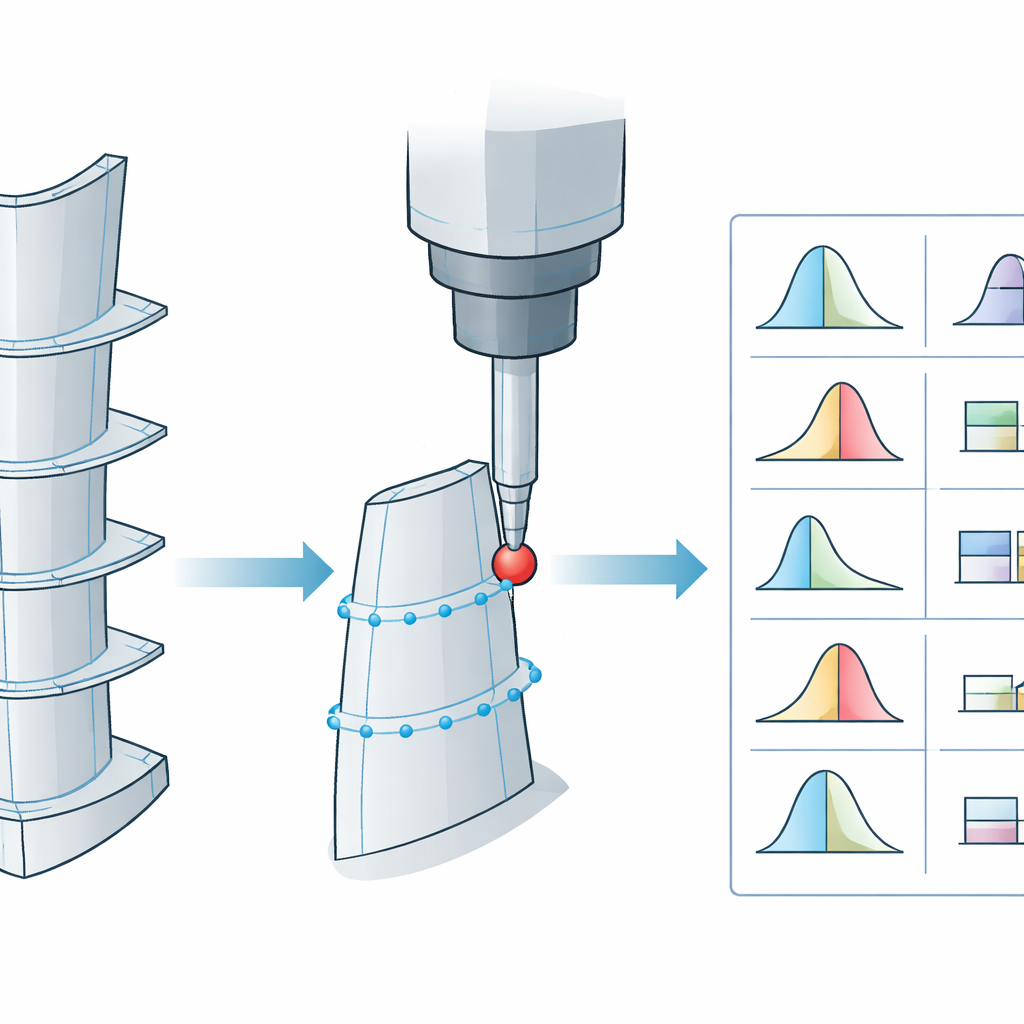
The authors close a key gap by measuring 100 real compressor rotor blades, each sliced virtually into 13 evenly spaced sections from hub to tip. For every section they extract seven practical measures of how the actual blade differs from its design: the curvature of the front and back edges, the maximum thickness, the chord length from front to back, the detailed pressure‑side and suction‑side profile deviations, and the twist angle that sets how the blade meets the incoming flow. In total, the dataset holds 9,100 numerical values, all gathered with a coordinate measuring machine that records three‑dimensional point clouds along the blade surface, then processes them into the engineering parameters used on manufacturing drawings.
Patterns hidden in the numbers
Using this trove, the team examines both how deviations change from root to tip and how their probability shapes behave. Some trends are intuitive: certain errors grow where the blade is thicker or harder to machine, and the root and tip regions tend to show greater difficulty and scatter. But the probability distributions themselves are strikingly diverse. Only some trailing‑edge radius measurements resemble a Gaussian curve. Maximum thickness often shows skewed or even two‑peaked patterns. Surface profile deviations can be bell‑shaped, skewed, or multimodal in different sections, and overall twist errors mostly depart from a Gaussian picture. The authors also confirm that a sample of 100 blades is more than enough for robust statistics: beyond about 40 blades, the estimated averages and spreads change very little, matching earlier studies on the minimum data needed for dependable uncertainty analysis.
A new factual baseline for safer engines
In accessible terms, this work replaces guesswork about blade imperfections with evidence. By making detailed measurements from root to tip on a sizeable batch of real compressor blades, and sharing the data openly, the authors show that many machining deviations do not behave like the simple bell curves often assumed in design tools. Future simulations and design optimizations can now build their uncertainty models directly on these measured distributions, leading to more realistic predictions of how compressors will perform across a fleet. Ultimately, that makes it easier to design blades and tolerance rules that keep engines efficient, robust and safely away from their limits.
Citation: Gao, L., Dan, Y., Wang, H. et al. A dataset of measured machining deviations of compressor rotor blades. Sci Data 13, 462 (2026). https://doi.org/10.1038/s41597-026-06846-8
Keywords: compressor blades, manufacturing deviations, uncertainty quantification, aero-engines, geometric tolerances