Clear Sky Science · en
Chromosome-level genome assembly of the deep-sea solemyid bivalve Acharax haimaensis
Life in the Dark Ocean Floor
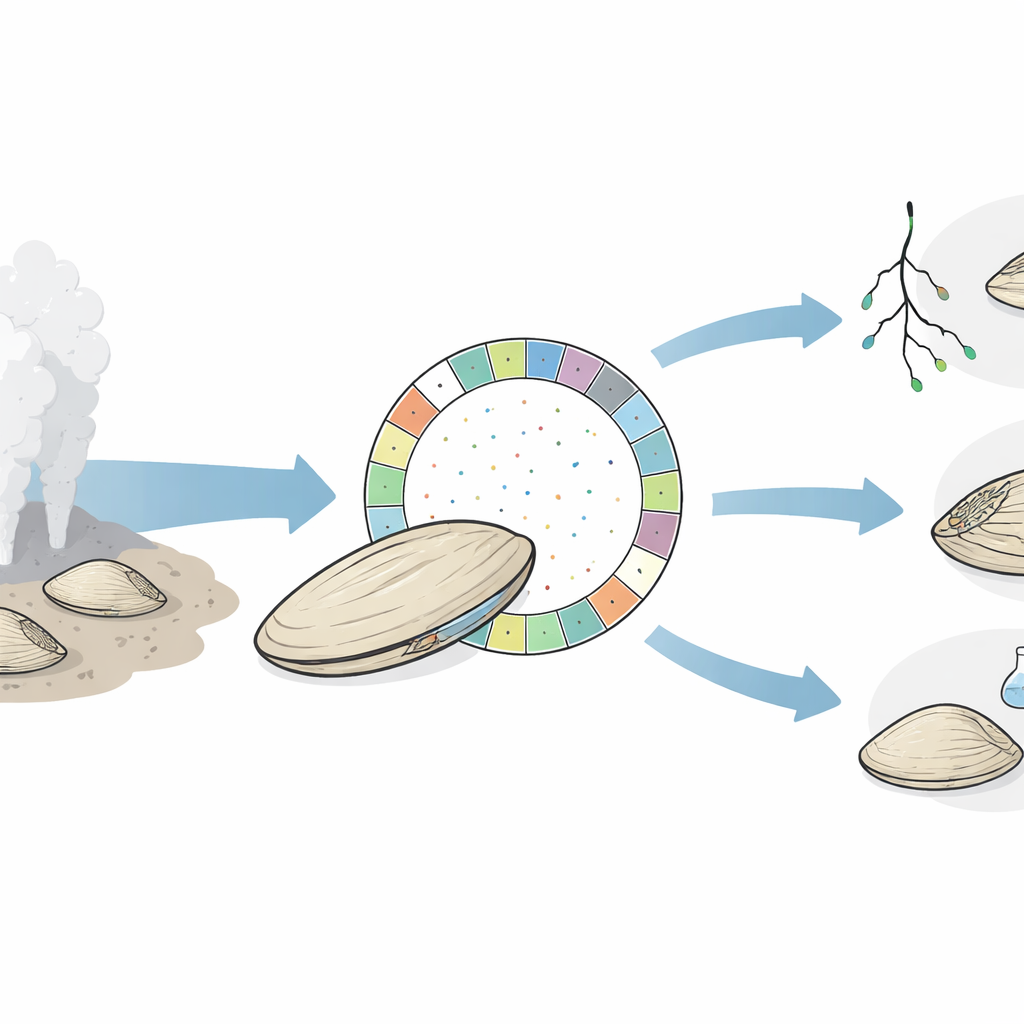
Far below the sunlit surface, in the cold, high‑pressure darkness of the deep sea, some clams have struck an unusual bargain with bacteria. These bivalves live around chemical seeps on the seafloor, where toxic, sulfur‑rich fluids seep from the Earth’s crust. Instead of relying on sunlight‑powered food webs, they host bacteria inside their bodies that turn these chemicals into energy. This study decodes, in unprecedented detail, the complete genetic blueprint of one such deep‑sea clam, Acharax haimaensis, revealing how its DNA may support this hidden lifestyle and what it can teach us about the early evolution of shellfish.
An Ancient Clam with Hidden Partners
Acharax haimaensis belongs to a very old branch of the bivalve family tree called solemyids, whose fossil record stretches back over 450 million years. Modern members of this group are split between shallow coastal muds and the deep ocean. Acharax species, including A. haimaensis from the Haima cold seep in the South China Sea, are specialists of extreme deep‑sea habitats. They burrow into oxygen‑poor, sulfide‑rich sediments and depend on an intimate partnership with sulfur‑oxidizing bacteria housed in their gills. These microbes act both as food producers and detoxifiers, turning noxious chemicals into usable nutrients while helping the clam cope with its harsh surroundings. Because these animals are rarely collected alive and their DNA had not been fully cataloged, scientists knew little about how their genomes support such extreme living conditions.
Building a Complete Genetic Blueprint
To change that, the researchers assembled a high‑quality, chromosome‑level genome for A. haimaensis. They combined several state‑of‑the‑art DNA sequencing approaches: long, highly accurate reads to piece together large stretches of DNA, short reads to refine and correct them, and a special method that uses the three‑dimensional folding of chromosomes to stitch contigs into full chromosomes. The resulting genome is very large for an animal—about 4.27 billion DNA letters, comparable to or larger than the human genome—and was organized into 22 chromosomes with excellent continuity and accuracy. Tests that look for a standard set of core animal genes showed that over 98% are present, indicating that the assembly is both complete and reliable. In total, the team predicted more than 38,000 protein‑coding genes, most of which could be matched to known functions in public databases, along with tens of thousands of non‑coding RNA genes.
DNA Repeats and a Shuffled Chromosome Map
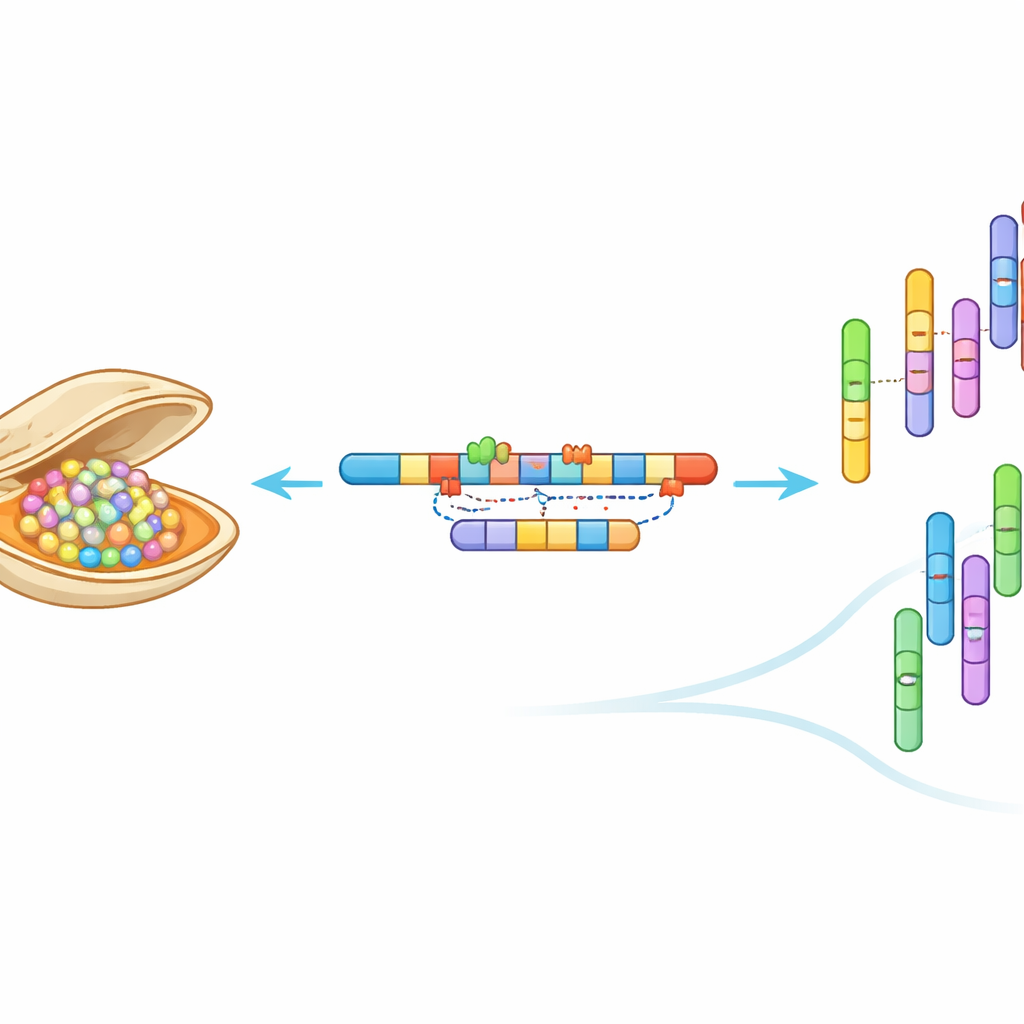
One of the striking findings is that more than half of the A. haimaensis genome is made up of repetitive sequences, many of them so‑called transposable elements—mobile DNA pieces that can copy or move themselves around. Long interspersed nuclear elements are especially abundant, and together with other repeat types they account for a huge fraction of the genome. Such repeats can drive genome expansion and rearrangement over evolutionary time. To see how the clam’s chromosomes relate to ancient animal genome structures, the team compared its genome to reconstructed ancestral linkage groups shared across distant animal lineages. They found that each A. haimaensis chromosome is a mosaic assembled from two to four ancestral segments, implying extensive breakage and fusion of chromosomes during its evolutionary history. This mosaic pattern suggests a long and dynamic process of genome reshaping in early bivalves.
Placing the Clam on the Tree of Life
Using thousands of shared single‑copy genes, the scientists then built a large family tree that included A. haimaensis and more than twenty other bivalve species. By combining this tree with fossil time points, they estimated when major lineages split. Their analysis indicates that A. haimaensis branched off from the main group of more derived bivalves roughly 550 million years ago, underscoring its status as a very early‑diverging, evolutionarily “primitive” clam. This makes A. haimaensis and its relatives particularly valuable for reconstructing how modern bivalves evolved their diverse body plans, habitats, and life strategies, including the onset of deep‑sea chemosynthetic lifestyles.
Why This Deep-Sea Genome Matters
By delivering the first chromosome‑level genome from a deep‑sea protobranch clam, this study provides a foundational resource for exploring how animals adapt to life without sunlight, in cold, high‑pressure, chemically harsh environments. The detailed genome offers a roadmap to the genes and DNA features that may underpin its partnership with sulfur‑eating bacteria, tolerance to toxic sulfide, and long‑term survival in the deep sea. More broadly, it helps scientists trace how the bivalve body plan and genome architecture have changed over hundreds of millions of years. For non‑specialists, the work opens a window onto a hidden world where life thrives on chemical energy, and where ancient genetic blueprints still shape the inhabitants of our planet’s most remote ecosystems.
Citation: Zhou, C., Zhong, Z., Guo, Y. et al. Chromosome-level genome assembly of the deep-sea solemyid bivalve Acharax haimaensis. Sci Data 13, 559 (2026). https://doi.org/10.1038/s41597-026-06755-w
Keywords: deep-sea clams, genome assembly, chemosynthetic symbiosis, bivalve evolution, cold seep ecosystems