Clear Sky Science · en
Epigenetic fingerprints link early-onset colon and rectal cancer to pesticide exposure
Why this research matters to you
Colon and rectal cancer are often thought of as diseases of older adults, yet more people under 50 are being diagnosed worldwide. This study asks a pressing question for families, patients and policymakers alike: could everyday environmental exposures, including farm chemicals in our food and water, be quietly shaping cancer risk in young adults? By reading patterns written on our DNA, the researchers trace a surprising link between early-onset colorectal cancer and a widely used weed killer.

A rising cancer in younger adults
Colorectal cancer is one of the most common cancers and a leading cause of cancer death, mostly in people over 50. Over the last few decades, however, cancer registries have reported a steady rise in cases among younger adults. These early-onset tumors often appear in the rectum or left side of the colon, tend to be more aggressive and are frequently found at a later stage. Yet when scientists look at the main genetic mutations in these tumors, they mostly resemble cancers in older patients. This mismatch has fueled the idea that changing lifestyles and environmental exposures may be driving the trend.
Reading exposure history in DNA marks
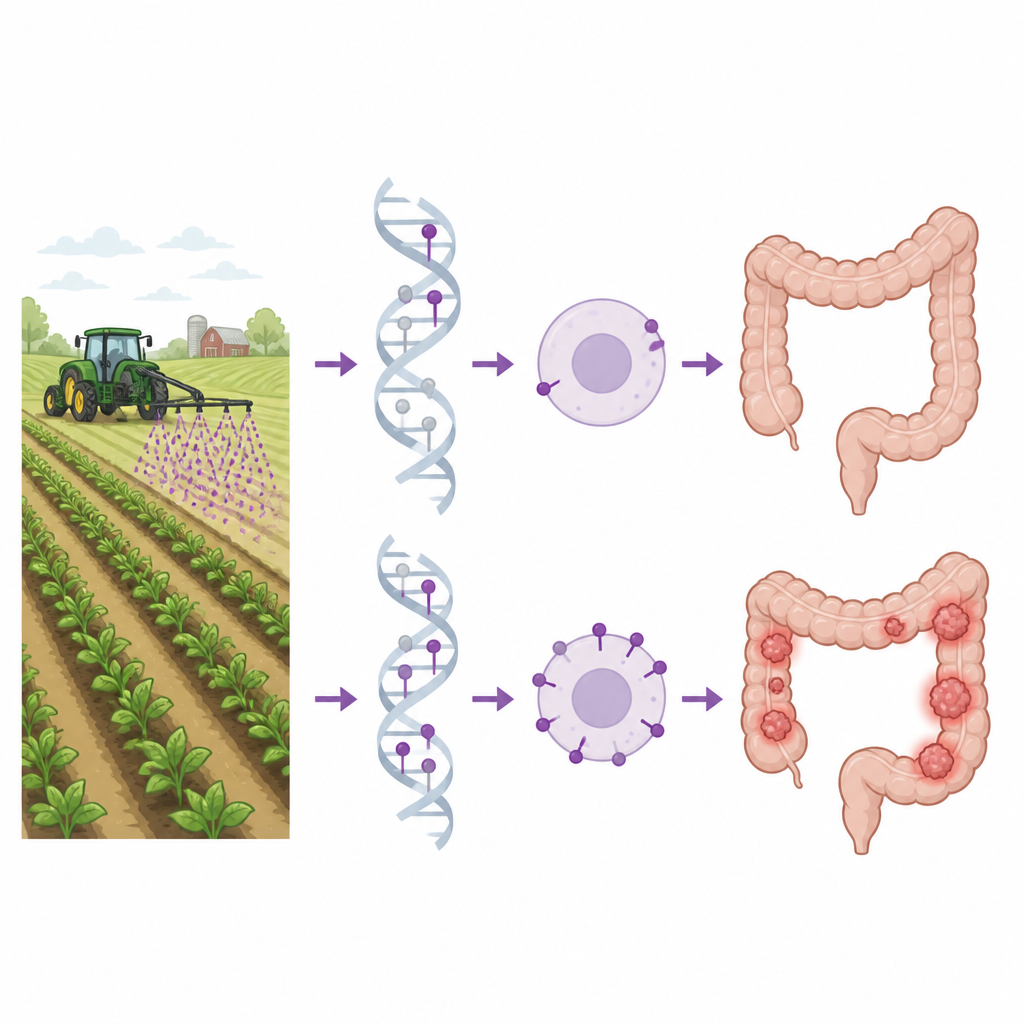
Most cancer studies do not track what people have breathed, eaten or touched across their lives, making it hard to connect specific exposures to disease. The team turned this problem on its head by using epigenetics, the chemical tags that sit on DNA and record how cells respond to the world. Prior large studies have shown that factors such as smoking, diet, air pollution and certain pesticides leave characteristic DNA methylation patterns. The authors combined these patterns into methylation risk scores, which act as biological fingerprints of past exposure, and calculated them in tumor samples from adults with early-onset and late-onset colorectal cancer across ten independent datasets.
Known lifestyle risks and a new suspect
The epigenetic fingerprints confirmed several familiar themes. Compared with patients diagnosed at age 70 or older, younger patients showed patterns consistent with lower adherence to a Mediterranean-style diet, lower educational attainment and higher exposure to tobacco. Intriguingly, early-onset patients were less likely to show the epigenetic imprint of obesity, hinting that body weight may play a different role in younger cases. Beyond lifestyle, the analysis covered air pollutants and 14 pesticides. Among these, one herbicide, picloram, stood out. Tumors from younger adults carried stronger DNA fingerprints of this chemical in both the main dataset and a replication meta-analysis of nine additional cohorts, even after accounting for other exposures.
From farm fields to tumor biology
To test whether the picloram fingerprint reflects more than a statistical fluke, the researchers probed how it relates to cell behavior and real-world pesticide use. Gene activity patterns linked to picloram exposure in laboratory-grown heart cells closely tracked the picloram fingerprint seen in colon tumors, suggesting that this score captures genuine biological effects. Within tumors, a higher picloram score went hand in hand with distinctive mutation patterns and altered activity of pathways involved in cell growth and immune responses, pointing to alternative routes to cancer compared with classic models. The team also examined pesticide usage data from 94 US counties over two decades and found that counties with more intensive picloram use had higher rates of early-onset colorectal cancer, even after adjusting for income, education and other pesticides.
Rethinking tumor age and exposure timing
Because tumors can grow silently for years, the age at which cancer is diagnosed may not reflect how long it has been developing. The researchers therefore looked at a mutational signature that accumulates with each cell division as a stand-in for the tumor’s true age. Tumors categorized as biologically “young” based on this signature were more strongly associated with the picloram fingerprint than those deemed “old,” suggesting that this herbicide may contribute specifically to cancers that arise earlier in the life of the tumor. This pattern remained even when adjusting for chronological age and overall mutation burden.
What this means for prevention and policy
The study does not prove that picloram causes colorectal cancer, and the authors stress the need for long-term and experimental research to test causality, dose effects and the reversibility of the DNA changes they observe. Still, the work demonstrates that epigenetic markers can serve as sensitive recorders of lifelong exposure, allowing scientists to zero in on potential hazards when direct measurements are missing. The convergence of tumor fingerprints and county-level pesticide data flags picloram, and possibly other herbicides, as environmental factors that may contribute to the rising burden of colorectal cancer in younger adults. These findings point toward two fronts for action: empowering individuals with better knowledge of lifestyle risks and guiding regulators as they revisit how agricultural chemicals are evaluated and controlled.
Citation: Maas, S.C.E., Baraibar, I., Lemler, L. et al. Epigenetic fingerprints link early-onset colon and rectal cancer to pesticide exposure. Nat Med 32, 1827–1837 (2026). https://doi.org/10.1038/s41591-026-04342-5
Keywords: early-onset colorectal cancer, pesticide exposure, picloram, epigenetics, environmental risk factors