Clear Sky Science · en
Transposable elements shape stemness in normal and leukemic hematopoiesis
Hidden switches in our blood factory
Our blood is constantly renewed by rare stem cells tucked inside bone marrow. In acute myeloid leukemia, a related set of rogue stem cells can survive chemotherapy and spark the disease’s return. This study reveals that long-ignored stretches of repetitive DNA, called transposable elements, act as control switches that help decide whether blood cells stay in a primitive, stem-like state or mature. Understanding these hidden switches could open new ways to predict relapse and design treatments that target cancer stem cells while sparing healthy ones. 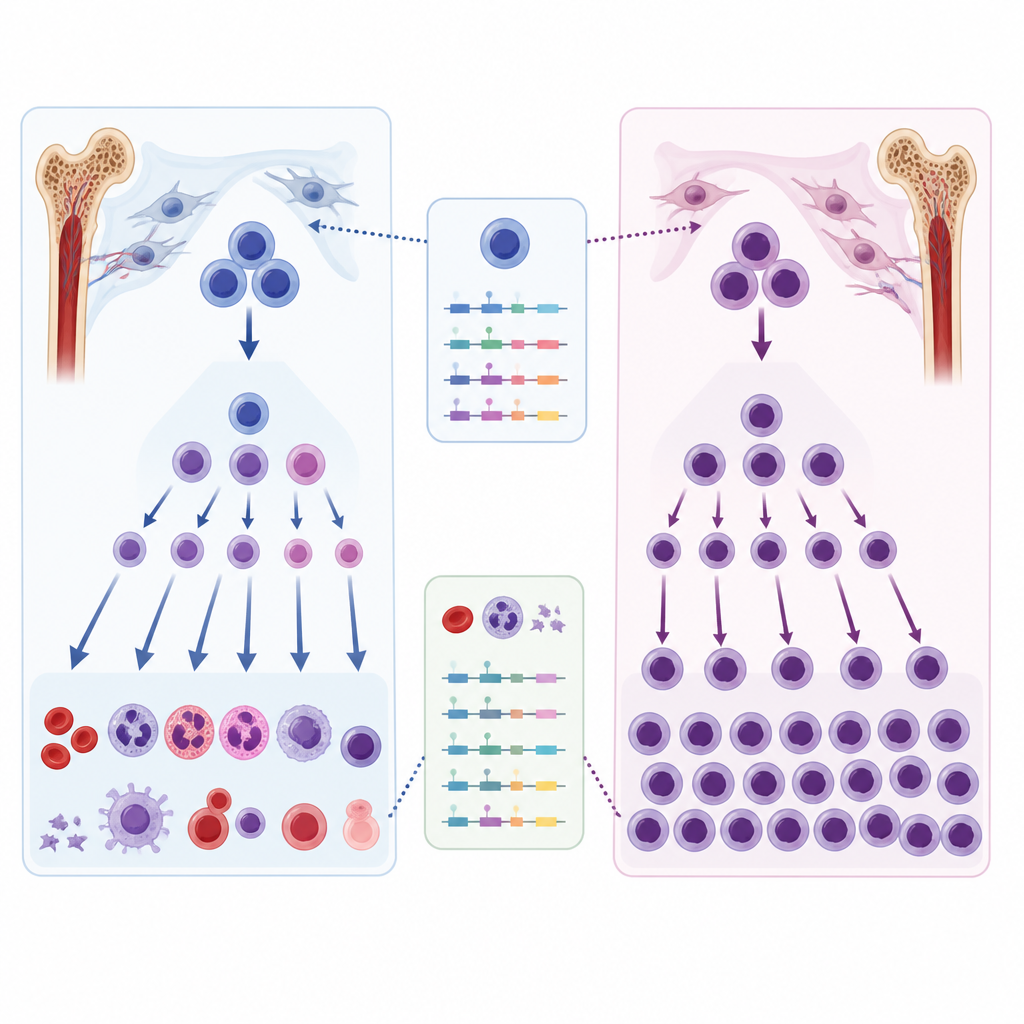
Normal blood stem cells and their DNA control panel
Healthy blood development relies on hematopoietic stem and progenitor cells, which sit at the top of a branching family tree and generate all types of blood cells. The authors mapped open regions of DNA in purified human blood stem cells and in many mature blood cell types. They focused on repetitive DNA pieces that have jumped around the genome over evolution. Although often dismissed as genetic clutter, these elements turned out to form distinct patterns: certain families were consistently accessible in stem and early progenitor cells, while others were favored in mature cells. These patterns were shared across many individuals, suggesting that particular groups of repeats help lock in whether a cell behaves like a stem cell or a fully specialized blood cell.
Leukemia stem cells reuse the stem cell wiring
The team then examined samples from people with acute myeloid leukemia, separating cell fractions that could regrow leukemia in mice from those that could not. When they compared DNA accessibility, leukemia stem cell fractions clustered together with normal blood stem and progenitor cells based on their repeat element patterns, while non–stem leukemia fractions resembled mature blood cells. In both normal and leukemic stem cells, related families of repeats were preferentially open, whereas other repeat families marked more committed cells. From this, the researchers built a 121–element “signature” of accessible repeats that tracks how stem-like a leukemia sample is, independent of simple measures like tumor cell count.
Repeat patterns linked to patient outcome
Applying this repeat-based signature to three independent groups of leukemia patients, the authors found that samples with a strong stem-like repeat pattern had shorter periods without disease and poorer overall survival. This signal did not simply mirror an existing 17–gene stemness score, and the two measures captured partly different aspects of the disease. While the gene-based score was more tightly associated with fast-cycling leukemia cells, the repeat-based score was linked to pathways, such as interleukin 10 signaling, that are thought to support long-lived leukemia stem cells. Together, these findings indicate that repetitive DNA accessibility encodes clinically relevant information about the “stemness” of a person’s leukemia. 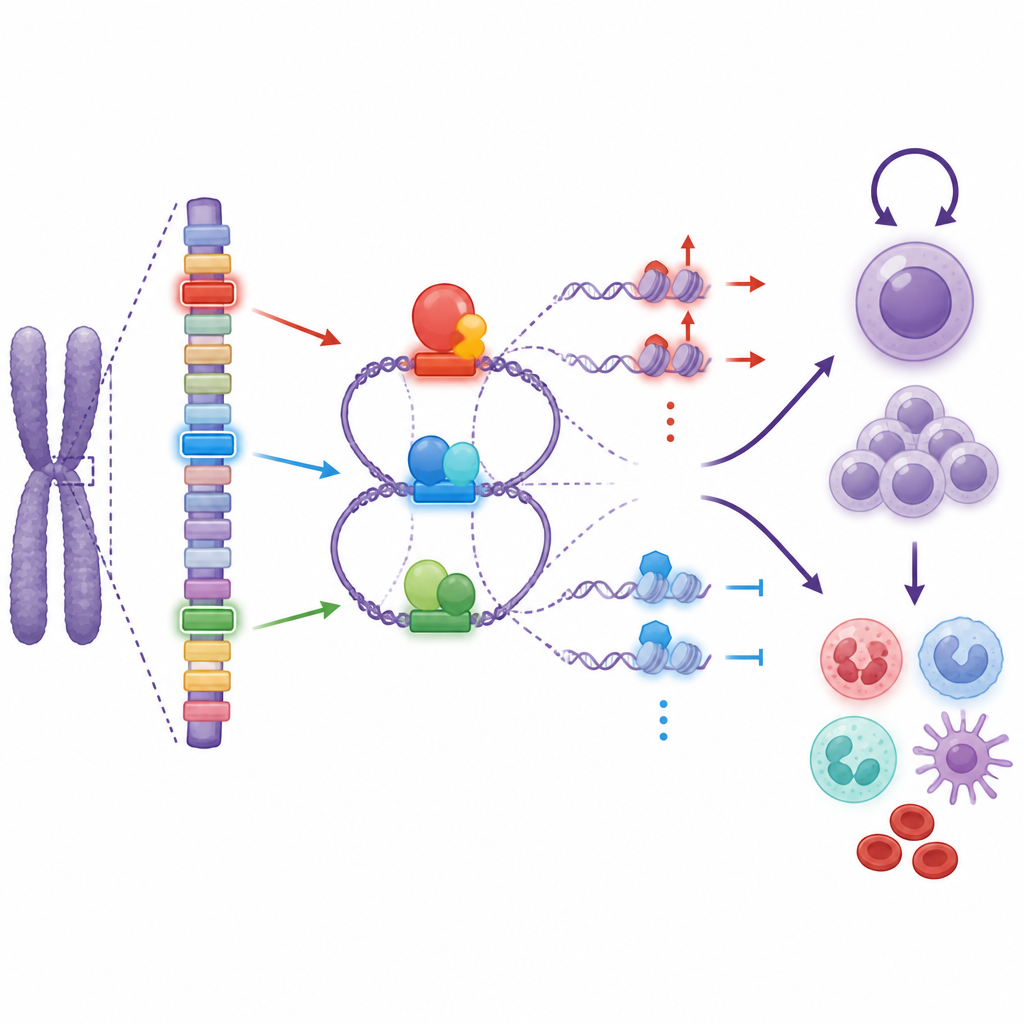
How mobile DNA pieces host key control proteins
Digging deeper, the researchers used public maps of protein binding across the genome to see which proteins land on these accessible repeats. In normal stem cells, many repeats hosted binding sites for regulators known to maintain stem cell identity or shape three-dimensional DNA folding. In leukemia stem cells, a partly overlapping but distinct set of repeats acted as docking platforms for proteins such as LYL1 and NFY factors, which genetic screens indicate are especially important for leukemia cell survival. This suggests that, rather than being passive passengers, repeat elements actively organize networks of control proteins that sustain both normal and malignant stem cell states.
Switching off a repeat family weakens leukemia stemness
To test whether these elements are causally important, the team used a CRISPR-based chromatin editing tool to “turn down” a specific repeat family called LTR12C across hundreds of sites in leukemia cell models, without cutting the DNA. This editing reduced chemical marks of active DNA at LTR12C, increased repressive marks, slowed cell growth in one leukemia line, and, crucially, shrank the fraction of highly stem-like leukemia cells while expanding more mature-like cells in a patient-derived model. Nearby genes included several previously linked to stem cell behavior, supporting the idea that LTR12C elements act as control hubs that help preserve the leukemia stem cell pool.
What this means for patients
This work shows that repetitive DNA, often viewed as junk, contains families of elements that act as genetic determinants of stemness in both normal blood and leukemia. Certain repeat patterns can help sort leukemia cases by risk, and some repeat families, such as LTR12C, are required to maintain leukemia stem cells in experimental models. In the long term, therapies that disrupt these repeat-based control hubs might selectively disarm leukemia-initiating cells while leaving healthy blood stem cells less affected, offering a new angle for tackling relapse-prone blood cancers.
Citation: Grillo, G., Nadorp, B., Qamra, A. et al. Transposable elements shape stemness in normal and leukemic hematopoiesis. Nat Genet 58, 1087–1099 (2026). https://doi.org/10.1038/s41588-026-02585-z
Keywords: acute myeloid leukemia, leukemia stem cells, transposable elements, chromatin accessibility, blood stem cells