Clear Sky Science · en
Cusp-singularity-enhanced Coriolis effect for sensitive chip-scale gyroscopes
Why shrinking gyroscopes matters
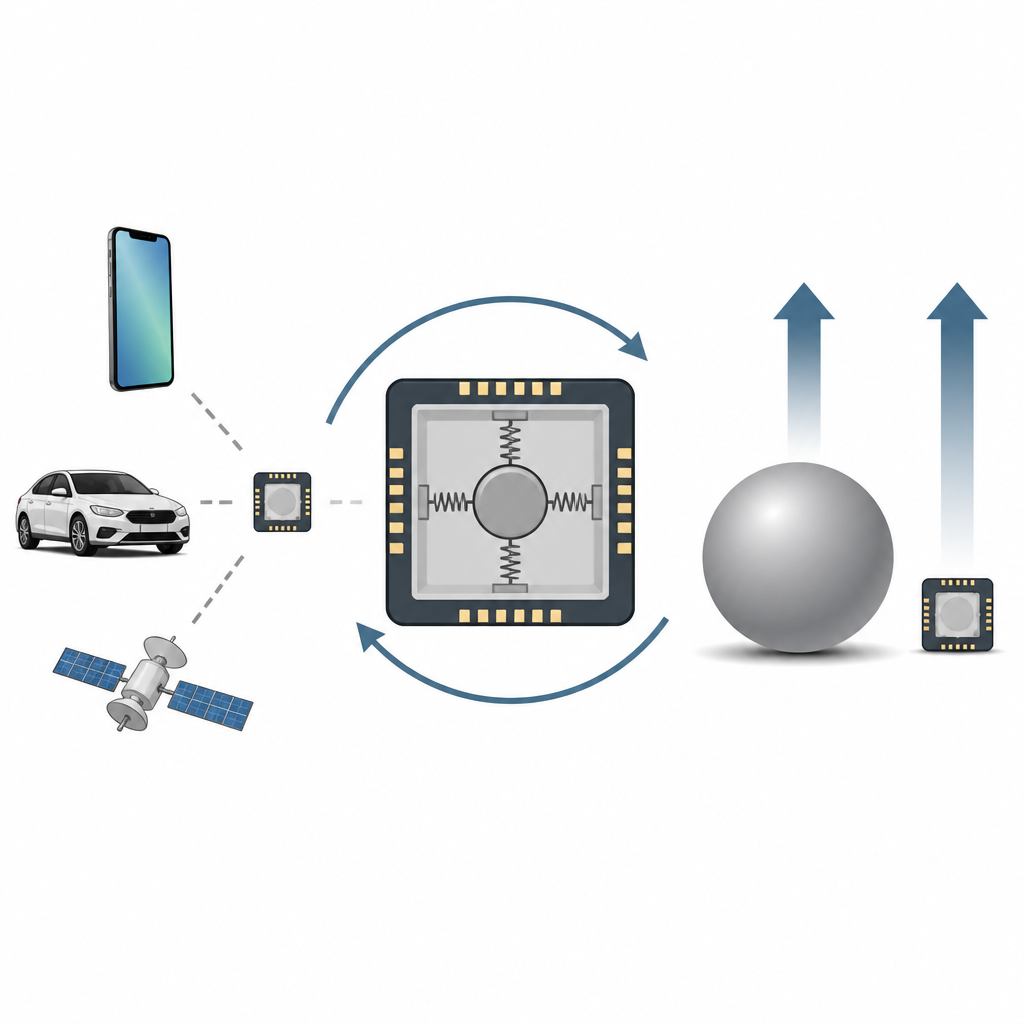
Gyroscopes quietly keep our phones, cars and spacecraft aware of how they are turning in space. The best versions are still bulky and costly, while the tiny chips inside everyday gadgets are far less accurate. This article reports a way to squeeze big-gyroscope performance into a millimetre scale silicon chip by rethinking how these sensors respond to rotation, potentially transforming navigation and stabilization in compact devices.
The challenge of tiny rotation sensors
Conventional chip gyroscopes measure rotation using the Coriolis effect, where motion in a rotating frame appears to bend. Inside these devices, a vibrating mass feels a sideways push when the chip turns, and electronics read out the resulting change in vibration. But as the device shrinks, random thermal jiggling in the structure grows relatively louder, while the useful Coriolis signal remains weak. A basic geometric factor limits how strongly the vibrating mass can feel rotation, so standard designs hit a wall where making the device smaller severely hurts its precision.
Using a subtle twist in motion
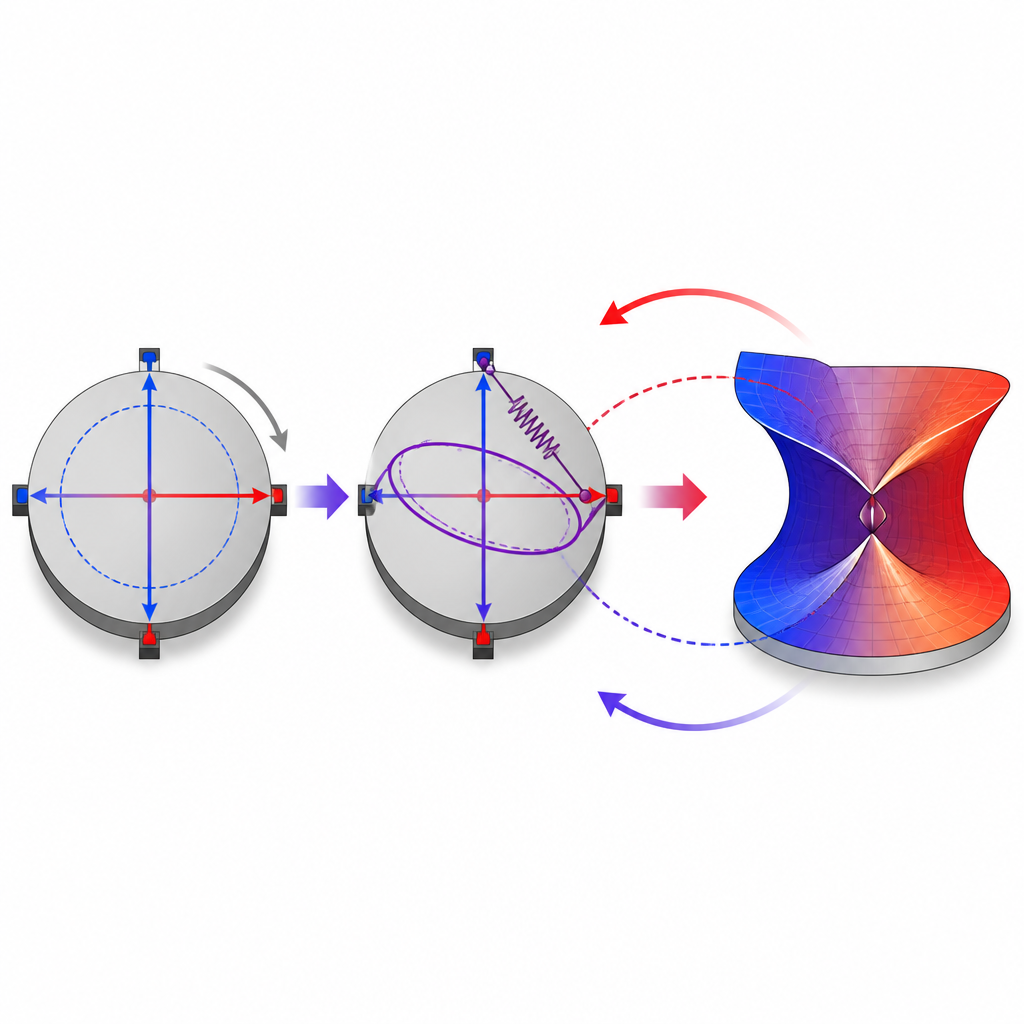
The researchers tackle this limit by steering the gyroscope into a special operating point where its behaviour changes abruptly with tiny nudges. Their silicon resonator is a circular disc that supports two equal vibration patterns at right angles. Normally, driving these in quadrature makes the mass trace a smooth circle, and rotation simply shifts the vibration frequency in direct proportion to the turn rate. The team adds a carefully tuned extra spring that links the two vibration patterns and uses a feedback loop to lock the phase of one mode. In the combined space of rotation rate and coupling strength, this creates folded surfaces called cusp catastrophes, with sharp points known as cusp singularities where small changes in rotation trigger outsized shifts in frequency.
Making small twists speak loudly
By tuning their chip right next to these cusp singularities, the authors show that the frequency of oscillation no longer varies linearly with rotation but instead follows a cube root law. In practice this means that for very small rotation inputs, the effective sensitivity soars: they measure more than a thousandfold increase in the Coriolis factor compared with the intrinsic geometric limit. Tests reveal that the signal-to-noise ratio improves by about 250 times and long term precision by nearly 300 times relative to a standard frequency based mode on the same device. Even when the chip spins faster, where the enhancement gradually wanes, it still outperforms the usual design over a broad range.
Listening to phase instead of pitch
The work goes a step further by shifting attention from frequency to phase, the relative timing between the two vibration patterns. Near the cusp singularities, this phase angle also changes with a cube root dependence on rotation, but it is naturally less affected by slow drifts in the resonant frequency. Measuring phase turns the device into a phase modulated gyroscope whose main noise now comes from random thermal motion, while the useful response is still boosted by the singular behaviour. In this mode, the chip reaches a level of short term noise and long term stability that rivals large, high end hemispherical resonator gyroscopes, yet in a compact silicon platform.
What this means for future devices
To a lay reader, the key message is that the authors have found a way to make a tiny vibrating chip “overreact” in a controlled way to very small rotations, without equally amplifying unwanted noise. By operating at the edge of cusp singularities and reading out phase, they push chip scale gyroscopes into a performance class previously reserved for much larger and more expensive instruments. This strategy of harnessing mathematical singularities could also sharpen other sensors, from devices that monitor environmental changes to tools for probing gravity, opening paths toward more precise yet affordable instruments.
Citation: Zhang, S., Xiao, D., Wang, F. et al. Cusp-singularity-enhanced Coriolis effect for sensitive chip-scale gyroscopes. Nature 653, 700–706 (2026). https://doi.org/10.1038/s41586-026-10565-w
Keywords: chip-scale gyroscope, Coriolis effect, singularity sensing, phase modulation, inertial navigation