Clear Sky Science · en
EBV strain interacts with host HLA to drive nasopharyngeal carcinoma risk
Why this matters to everyday health
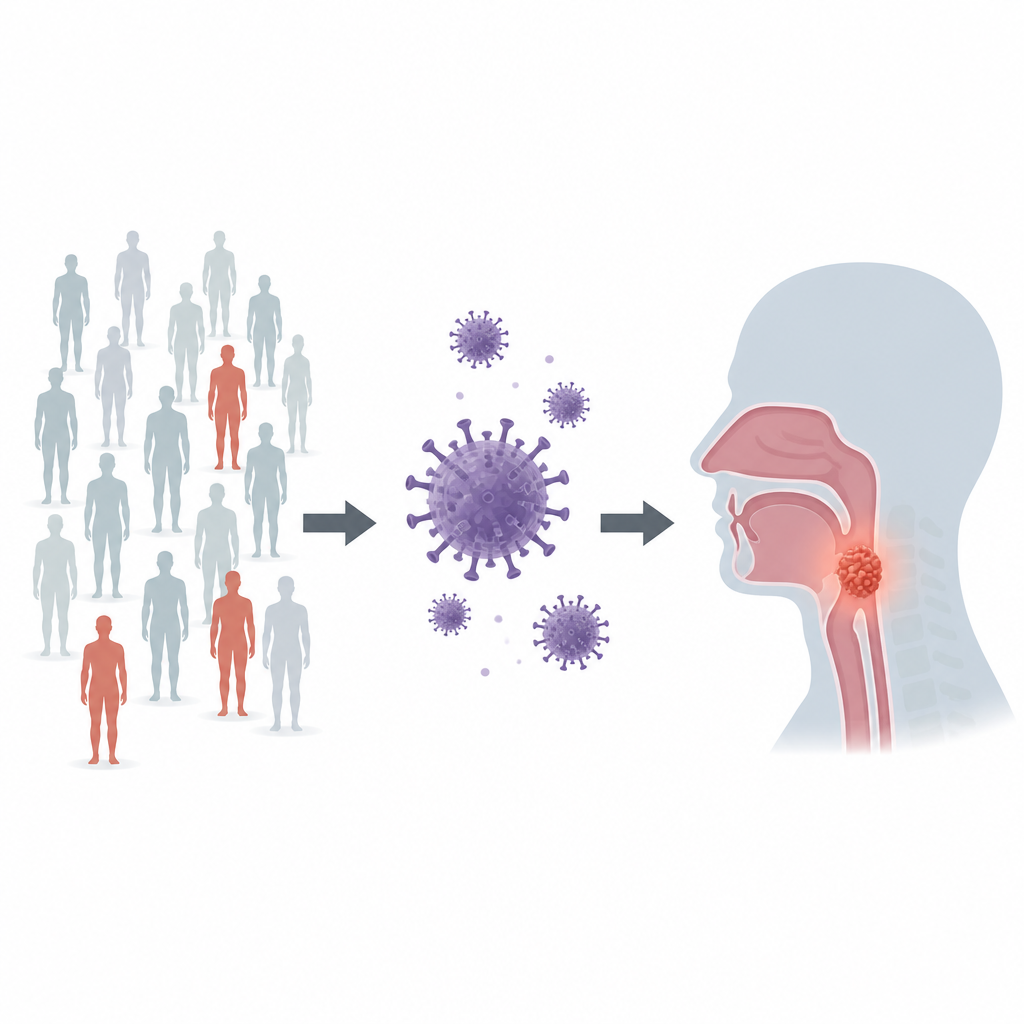
Most adults quietly carry Epstein–Barr virus, best known for causing mononucleosis, yet only a small fraction ever develop cancers linked to it. One of those cancers, nasopharyngeal carcinoma, strikes people in southern China far more often than elsewhere. This study asks a simple but vital question: why does the same common virus lead to cancer in some communities but not others, and can we pinpoint who is at highest risk?
Uneven cancer risk in a common infection
Nasopharyngeal carcinoma is a cancer that begins behind the nose and above the back of the throat. Although Epstein–Barr virus infects over 95% of adults worldwide, nearly half of all cases of this cancer arise in a small slice of the global population living in southern China. Past work suggested three ingredients are important: the virus itself, a person’s inherited genes, and environmental exposures. In particular, certain versions of the virus seem more dangerous, and certain versions of human immune genes called HLA are tied to higher or lower risk. This study set out to see whether these two pieces interact, rather than acting alone, to create pockets of very high risk.
Matching human genomes with viral genomes
The researchers combined large case–control studies of people with and without nasopharyngeal carcinoma in southern China and Singapore with detailed genetic readouts of both the human hosts and their Epstein–Barr virus strains. First they scanned the human genome to find variants whose effect on cancer risk changed depending on whether someone carried a previously defined high-risk viral subtype. Only one area of the human genome stood out: the HLA region, which helps immune cells recognize infected cells. Within this region, one particular HLA type, called HLA-A*11:01, emerged as the key player whose impact depended strongly on the kind of virus present.
A risky viral tweak meets a specific immune type
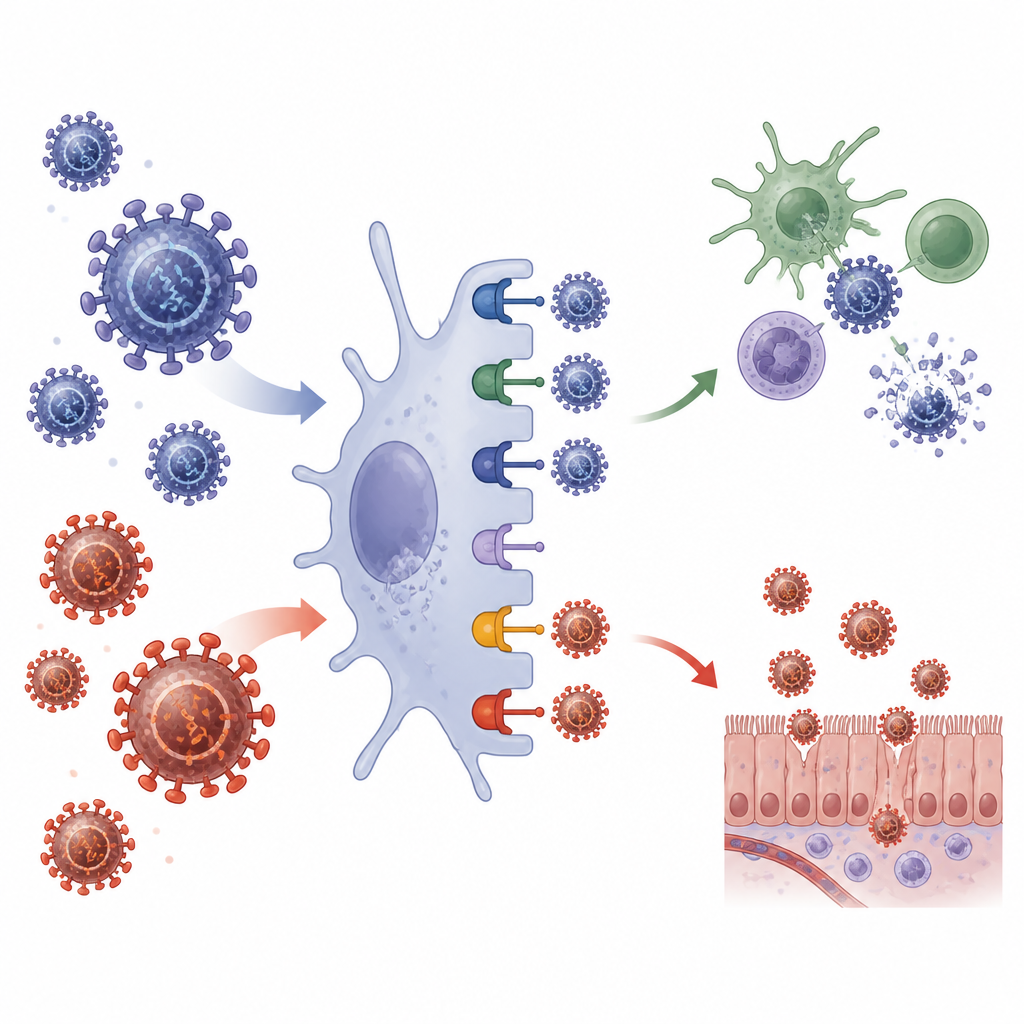
Next, the team flipped the question: across the viral genome, which viral changes mattered most in people with or without HLA-A*11:01? They found a single genetic change in an Epstein–Barr virus gene named EBNA3B, known as 85841G, that drove the interaction. People lacking HLA-A*11:01 and infected with high-risk virus carrying this 85841G change had far higher cancer risk than would be expected from adding the human and viral risks separately. Laboratory experiments showed why. The 85841G change creates a short viral protein fragment that binds tightly to HLA-A*11:01 and is recognized by killer T cells, which then destroy infected B cells. The alternative viral version does not bind well and fails to trigger strong immune attack.
How immunity shapes viral behavior in real people
These immune differences showed up not only in cell cultures but also in volunteers. Among healthy carriers infected with the 85841G virus, those with HLA-A*11:01 had lower levels of virus in their saliva, suggesting better immune control in the nose and throat. By contrast, another HLA type common in southern China, HLA-A*02:07, was linked to higher viral levels with the same strain, hinting at a less effective response. When the researchers grouped people by both their HLA-A background and the type of virus they carried, a sharply layered risk pattern emerged. Individuals with a protective HLA-A profile and low-risk virus had very low rates of cancer, while those with a susceptible HLA-A background and the high-risk 85841G strain faced dramatically higher odds.
An evolutionary story with public health impact
By building a family tree of more than 1,800 Epstein–Barr virus genomes, the team traced how the 85841G variant likely arose from past mixing between northern and southern viral lineages and then expanded in southern China. That expansion coincided geographically with higher frequencies of both HLA-A*11:01 and HLA-A*02:07 and with the known hotspot for nasopharyngeal carcinoma. The result is a striking “dual-risk” subgroup: about one in five people in southern China who both lack the protective HLA pattern and carry the high-risk 85841G virus, yet they account for nearly half of all local cases.
What this means for prevention
To a lay reader, the central message is that cancer risk here is not dictated by genes or virus in isolation, but by how a specific viral version and a person’s immune type fit together like mismatched puzzle pieces. When the match is good, immune cells can see and clear infected cells, keeping risk lower. When it is poor, the virus lingers, reactivates more often, and increases the chance that cells in the nose and throat turn cancerous. This interaction-based view suggests that future screening, vaccines, and T cell therapies could focus on the relatively small group of people and viral strains that together drive the bulk of disease.
Citation: Chen, Y., Liang, J., Zhang, W. et al. EBV strain interacts with host HLA to drive nasopharyngeal carcinoma risk. Nature 653, 786–795 (2026). https://doi.org/10.1038/s41586-026-10416-8
Keywords: Epstein–Barr virus, nasopharyngeal carcinoma, HLA genes, cancer risk, viral strains