Clear Sky Science · en
Imaging the flat bands of magic-angle graphene reshaped by interactions
Why twisted carbon sheets matter
Stack two atom-thin sheets of carbon, twist them by just the right tiny angle, and the electrons inside behave in startling ways, giving rise to insulation, magnetism and even superconductivity. This material, called magic-angle twisted bilayer graphene, has fascinated physicists for years—but they have not been able to directly see how the electrons’ allowed energies are arranged. This paper reports the first sharp “momentum-space” images of those energies, revealing that the same electrons can act both light and nimble and heavy and sluggish, depending on how they move. That dual personality helps explain many of the puzzling experiments on this material and points to new ways of engineering quantum phases of matter.
A new kind of quantum microscope
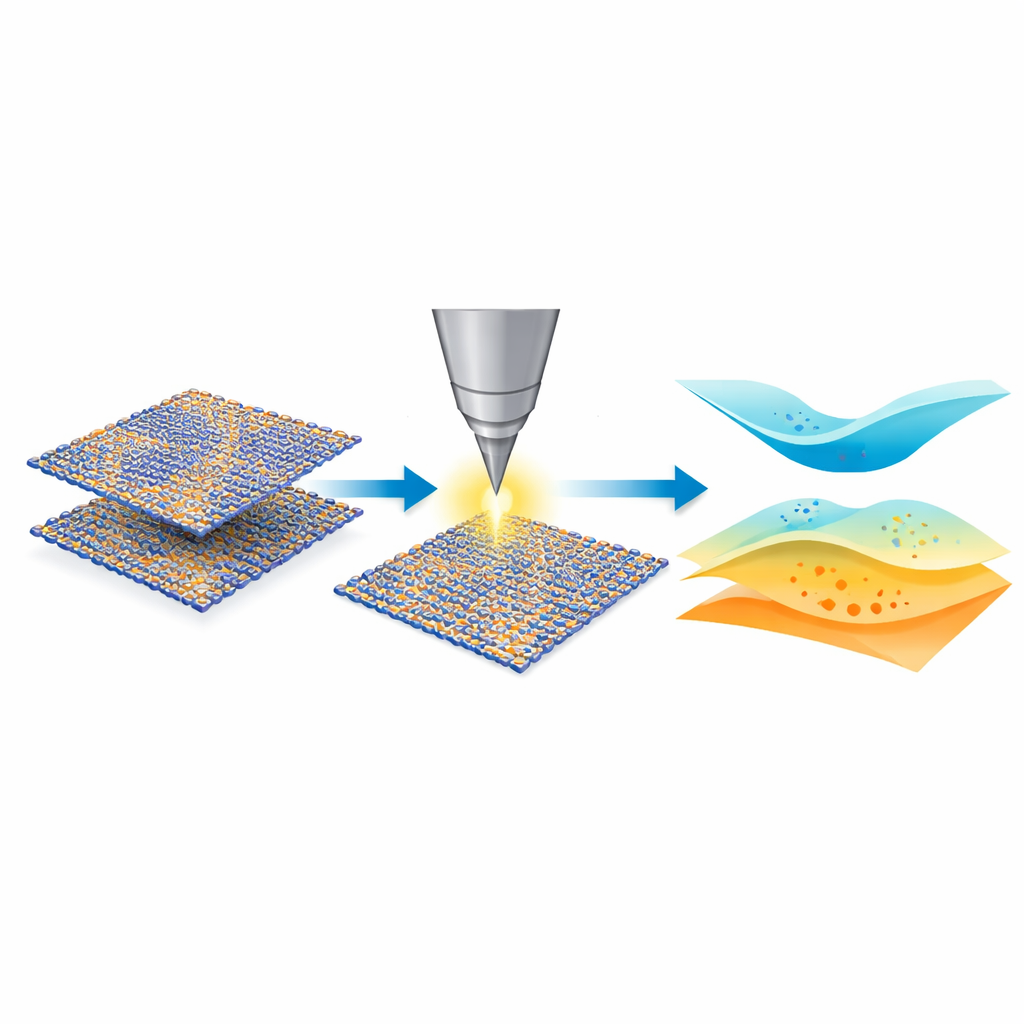
The researchers use a tool called a quantum twisting microscope, which combines ideas from tunneling microscopes and angle-resolved photoemission, but in a compact, cryogenic setup. A single layer of graphene is mounted on a movable tip and brought very close to a twisted bilayer graphene sample, separated by an ultra-thin insulating barrier. By gently rotating the tip, the team effectively scans through different electron momenta in the sample, while changing the voltage between tip and sample reveals the energies of available electronic states. This arrangement lets them build a detailed map of the energy “bands” that electrons can occupy, with extremely fine resolution in both energy and momentum—something conventional techniques have struggled to achieve in this system.
From ordinary flat bands to interaction-shaped bands
The authors first look at a sample twisted slightly away from the magic angle. There they find that the measured bands agree well with a standard, non-interacting theory: the bands show familiar cone-shaped crossings (Dirac points) and modestly flattened regions, as expected when two graphene layers are simply overlaid. When they move to the true magic angle region, however, the band structure changes dramatically. Across most of momentum space, the low-energy bands become extremely flat and separated by a sizeable gap, meaning electrons there behave as if they are very heavy and localized. Only near a special momentum called the center (Γ) do the bands remain strongly curved and gapless, signaling light, mobile electrons. In other words, instead of one uniform flat band, the material hosts a patchwork of heavy and light behavior tied to different ways electrons can move.
How filling the bands reshapes the landscape
Next, the team studies what happens as they add or remove electrons—effectively turning an invisible knob that tunes the band filling. At most fillings, two ultra-flat bands sit symmetrically around the Fermi energy, the level up to which electron states are occupied. As electrons are added or removed, these flat bands shift in energy in a nearly rigid fashion, but the states near the center of momentum space respond differently. Those central states, associated with light electrons, move in energy in a way that stretches the band structure around the center, because the added charge mainly piles up in localized regions elsewhere and changes the internal electric (Hartree) potential. The researchers also observe that the heavy, flat-band states undergo a series of step-like “cascades” as the filling passes through each integer value, while the light, center states repeatedly move away from and back toward the Fermi energy—a behavior known as Dirac revivals. Their measurements suggest these revivals come from charge being shuffled back and forth between light and heavy sectors, not just between internal “flavors” of electrons as previously thought.

A hidden mode in the heavy sector
Beyond reshaping the known bands, the data reveal an unexpected, persistent excitation roughly 15 milli–electron volts away from the Fermi level on either the electron or hole side. This feature appears only in the momentum regions where electrons are heavy and flat-band-like, and its energy barely changes as the material is doped. It shows up at widely separated spots across the device and in different samples, yet does not match expectations from simple strain or existing theoretical models. That robustness hints at a new collective mode or internal degree of freedom tied to the heavy electrons, which could be important for understanding the material’s strongly correlated and possibly superconducting states.
What this means for strange electrons
By directly imaging how energy bands depend on electron momentum and filling, this work clarifies the long-debated “dual nature” of electrons in magic-angle graphene. The same flat bands host both light, extended carriers and heavy, localized ones, but in different regions of momentum space. Their unequal response to internal electric forces and to added charge naturally produces band stretching, cascades and Dirac revivals seen in earlier experiments. The findings support theoretical pictures that treat the system as a kind of topological heavy-fermion or Mott-like semimetal, while exposing a new unexplained low-energy excitation. More broadly, the quantum twisting microscope demonstrated here opens a powerful window onto quantum materials whose delicate band structures have so far been hidden from view.
Citation: Xiao, J., Inbar, A., Birkbeck, J. et al. Imaging the flat bands of magic-angle graphene reshaped by interactions. Nature 653, 68–75 (2026). https://doi.org/10.1038/s41586-026-10378-x
Keywords: magic-angle graphene, flat bands, quantum twisting microscope, strongly correlated electrons, heavy fermions