Clear Sky Science · en
Linear RAG scanning mediates editing of Igκ variable region repertoires
How our immune system edits its own tools
Every day, our immune system must tell friend from foe. B cells, the white blood cells that make antibodies, sometimes build receptors that accidentally recognize the body’s own tissues. To stay healthy, these cells need a built-in way to quietly fix or discard such risky receptors. This study uncovers how mouse B cells use a precise “editing” process on one part of their antibody genes, reshaping their defensive tools while avoiding self-attack.
Building antibody parts from genetic pieces
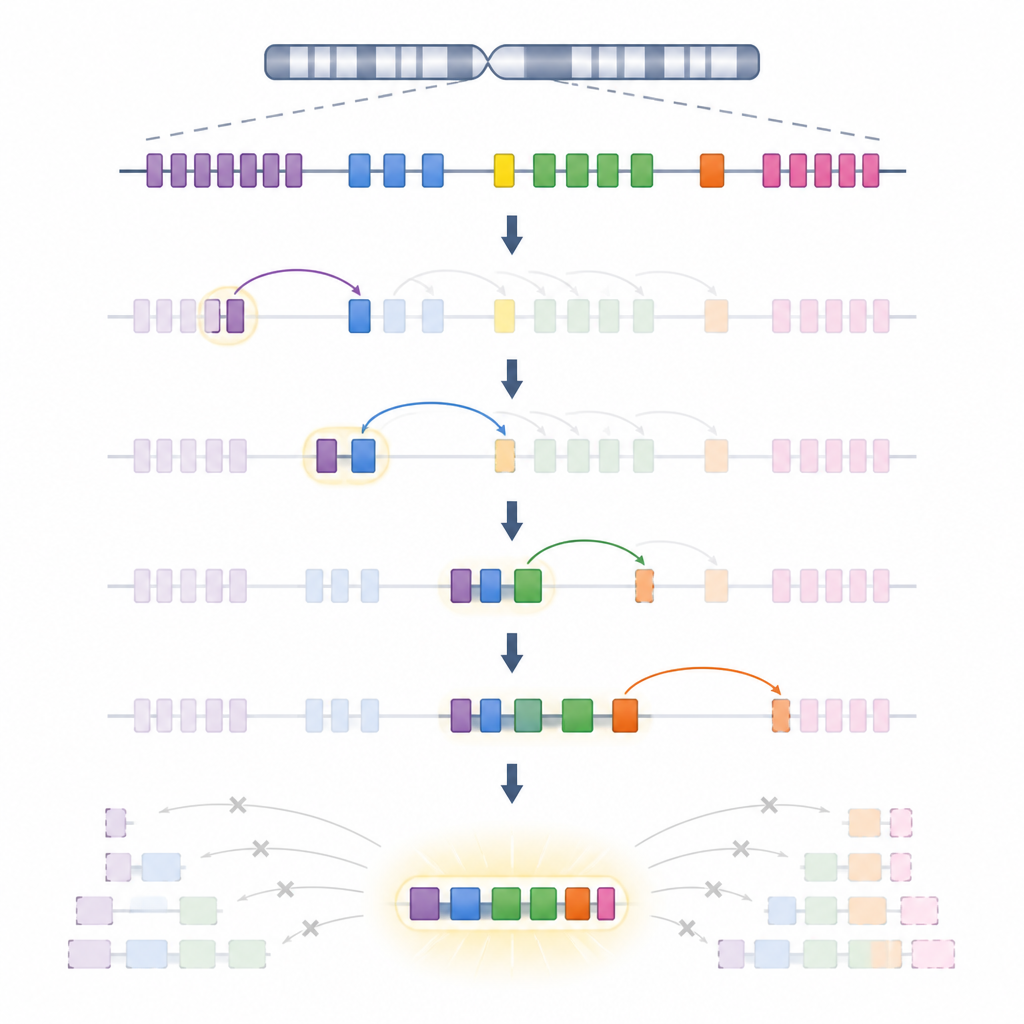
Antibodies are made from two main parts, heavy chains and light chains, each assembled from many small DNA pieces. In developing B cells, a cutting-and-pasting machine called RAG snips and joins these pieces to create a huge variety of receptors. The work here focuses on the kappa light chain, built from over a hundred variable pieces and a few joining pieces spread across more than three million DNA letters. The first round of assembly uses a layout in which distant variable pieces are brought near a central joining site through DNA loops. In this “primary” stage, both forward- and reverse-oriented pieces can be matched, helped by especially strong target sites that make cutting and joining efficient.
Switching from looping to scanning
If the first light chain is faulty or reacts to self, the B cell can try again in a “secondary” round of editing. The authors show that this shift is triggered when primary joining removes or moves a special DNA platform called Cer/Sis. Once this platform is gone, the RAG machine no longer relies on two DNA loops. Instead, it behaves more like a reader sliding along a line of text. From many new sites created by the first joins, RAG now scans along the chromosome in one direction, testing nearby variable pieces in order. Multiple such scanning centers are scattered across the light-chain region in a population of cells, so together they can still sample almost the entire repertoire, even though each center only searches a limited stretch.
Why nearby gene pieces dominate the edit
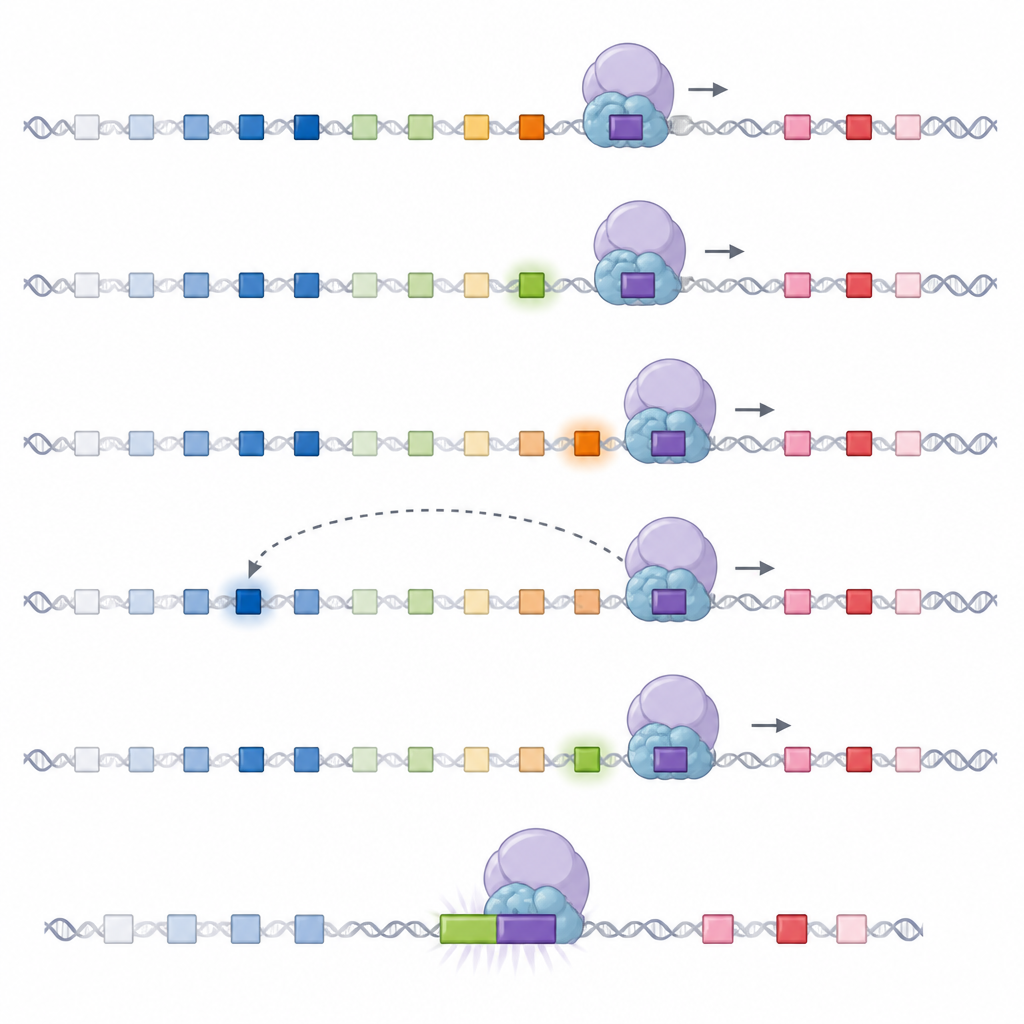
Using high-throughput DNA-join mapping and engineered mouse cell lines, the researchers found that secondary editing mostly uses variable pieces sitting just upstream of each new scanning center. Two main factors bias the process toward these neighbors. First, when a variable piece is actively copied into RNA, that local activity seems to slow the movement of the scanning machinery and bring RAG into closer contact with that piece. Second, some variable pieces carry unusually strong target sequences that are highly attractive to RAG. Together, local RNA production and strong signals cause nearby pieces to be used early and often, quickly “saturating” the possible joins and limiting how far the scanner typically travels.
Allowing limited backtracking and flips
The study also explores what happens when some variable pieces sit in the “wrong” orientation. In heavy-chain genes, such reversed pieces are almost never used during scanning. Here, however, the authors show that for light chains, strong target sequences can allow reversed pieces to join during the secondary phase, either by true inversion or by a flip-like deletion process. By carefully redesigning these signals in cell models, they demonstrate that only strong sequences support such unusual joins, and that this still fits within the same scanning-based framework, sometimes with a short burst of local motion to align the pieces.
What this means for immune balance
Together, the findings reveal that B cells edit their kappa light chains using a controlled, one-directional scanning process that arises only after an initial loop-based assembly step. This switch lets cells repair or replace risky receptors using a focused set of nearby gene pieces, yet ensures that, across many cells, the full diversity of the light-chain region can still be tapped. For a lay reader, the key message is that antibody genes are not fixed in a single shot: they come with an internal “find and replace” system that carefully tunes recognition of foreign targets while helping to prevent harmful reactions against the body itself.
Citation: Li, X., Hu, H., Zhang, Y. et al. Linear RAG scanning mediates editing of Igκ variable region repertoires. Nature 653, 870–878 (2026). https://doi.org/10.1038/s41586-026-10362-5
Keywords: B cell development, antibody gene recombination, receptor editing, immune tolerance, RAG scanning