Clear Sky Science · en
AhR inhibition promotes axon regeneration via a stress–growth switch
Repairing broken nerve wires
Nerve fibers in the brain and spinal cord are like long electrical wires, and once they break, they rarely grow back. This study explores a built-in braking system inside nerve cells that decides whether they focus on coping with stress or on rebuilding. By finding a way to release this brake, the researchers show that damaged nerves in mice can regrow farther and restore more movement and sensation, hinting at future strategies for treating spinal cord and nerve injuries.
A molecular brake inside nerve cells
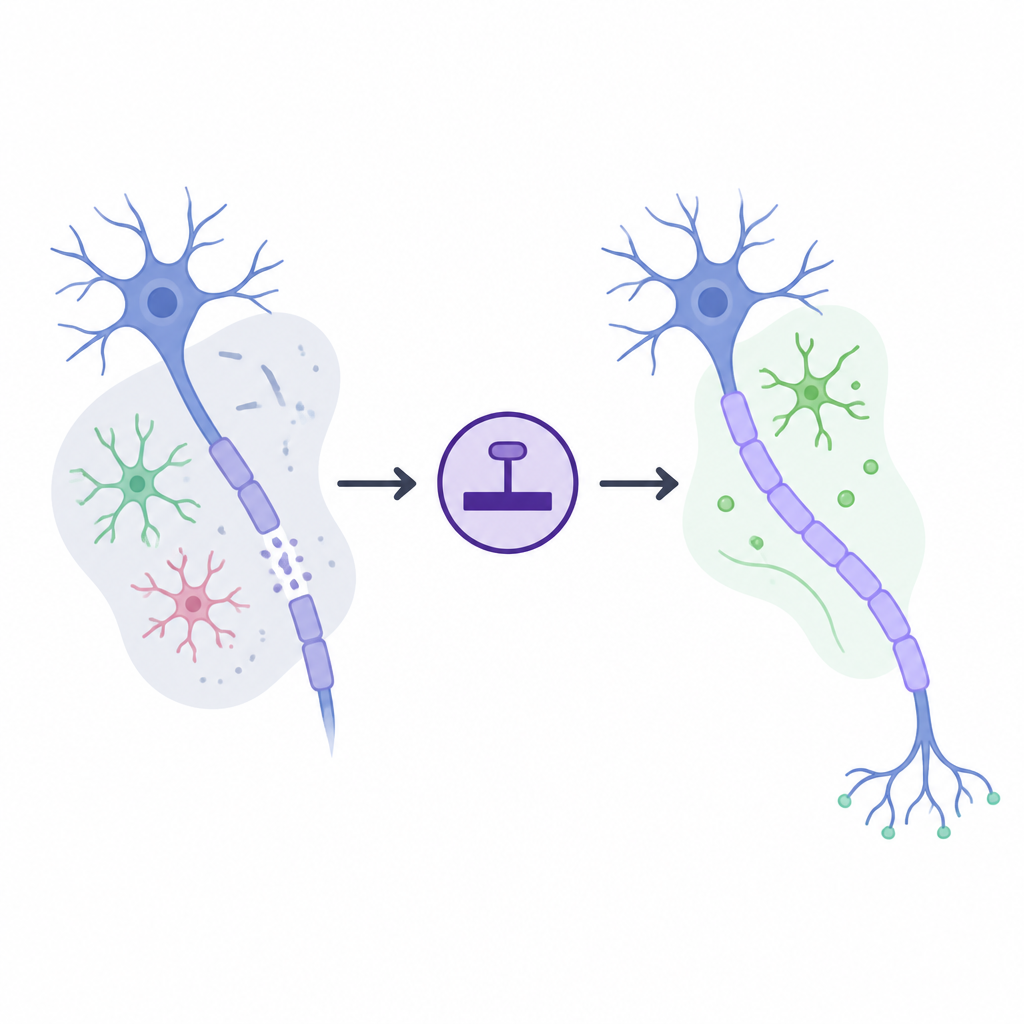
When a nerve fiber is cut, the surrounding tissue becomes inflamed and low in oxygen, creating a hostile environment. Nerve cells must choose between protecting themselves from this stress and investing energy in growth. The team focused on a protein called the aryl hydrocarbon receptor, or AhR, which normally senses environmental chemicals and internal byproducts. In mouse sensory nerve cells, they found that AhR becomes activated soon after injury and moves into the cell nucleus, where it turns on genes that help clean up toxins and damaged proteins but at the same time restrict the extension of new nerve branches.
Turning off the brake to boost regrowth
To find out what happens when this brake is released, the researchers blocked AhR in several ways. They used genetic tricks to remove the Ahr gene only from neurons in adult mice, and they also tested small molecules that either activate or block AhR. In dishes, neurons lacking AhR grew much longer fibers than normal cells, and drug-based AhR blockers had similar growth-boosting effects, while AhR activators shortened the fibers. In living mice, removing AhR from neurons led to sensory axons that grew faster and farther after sciatic nerve crush, and these animals recovered walking ability and touch sensation better than their littermates.
Helping the injured spinal cord recover
The spinal cord is especially difficult to repair, so the team tested whether lifting the AhR brake could also help there. In a mouse model of spinal cord injury, animals lacking AhR in neurons showed more nerve fiber bundles sprouting through the damaged region and more sensory fibers reaching beyond it. These mice walked with better coordination on a rating scale, made fewer missteps on a ladder, and responded more normally to gentle touch after injury. Importantly, blocking AhR with a drug given after spinal cord damage improved movement and sensation as well, showing that chemical inhibitors can, in part, mimic the benefits of genetic removal.
Shifting from stress mode to growth mode
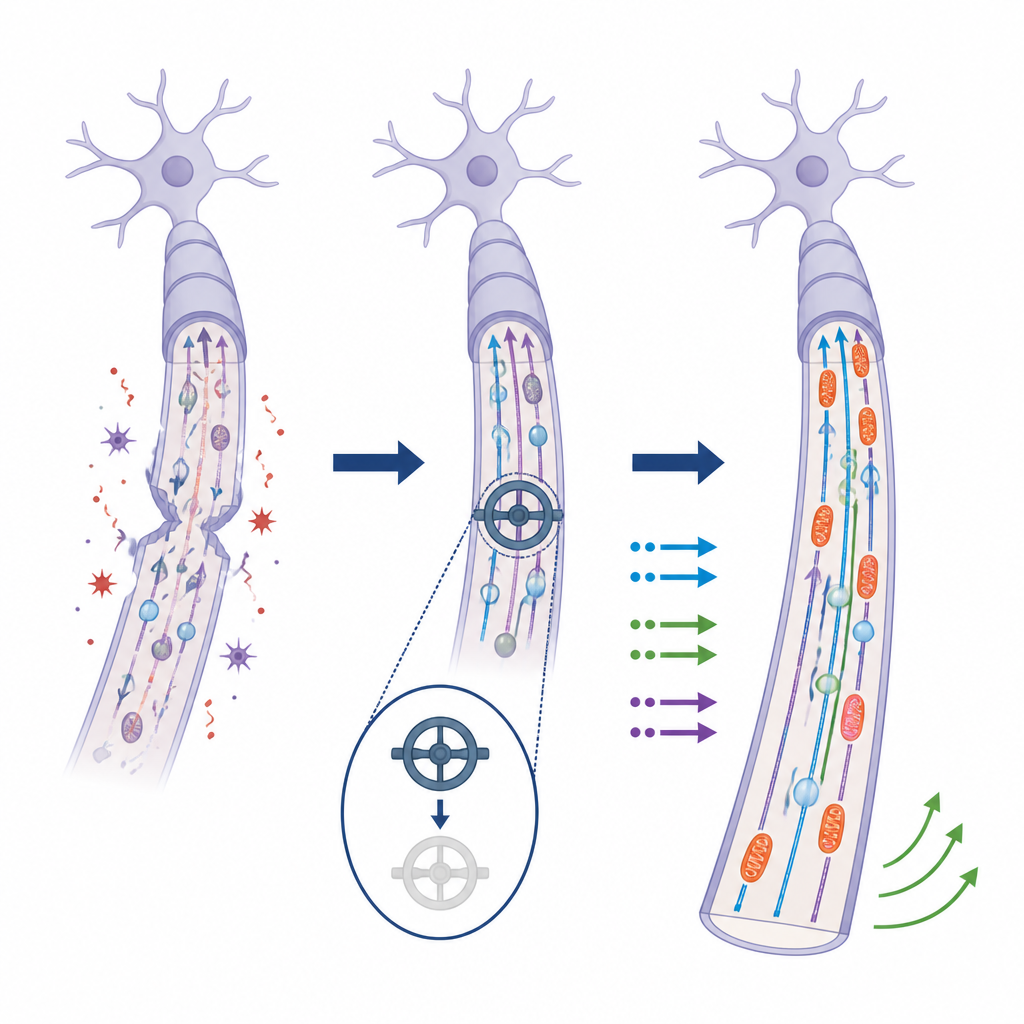
Digging deeper, the researchers examined which genes switched on and off when AhR was active or blocked. With AhR present, injured neurons favored programs that maintain protein quality control and limit new protein production, a response that protects cells but keeps them in a guarded state. When AhR was removed or inhibited, neurons increased overall protein making, changed their energy use, and activated many growth-supporting signals. This growth-friendly shift depended on another protein, HIF1α, which responds to low oxygen. When HIF1α or its partner ARNT were blocked, the extra growth seen without AhR disappeared, suggesting that AhR and HIF1α compete for control over the cell’s response to injury.
Balancing protection and repair
To a non-specialist, the key message is that nerve cells have a built-in switch that decides whether they stay in a protective stress mode or move into a repair mode. AhR pushes them toward protection, tightening control over protein quality and slowing growth, while its inhibition lets other signals drive energy use and rebuilding of damaged axons. In mice, releasing this brake helps both peripheral nerves and the injured spinal cord regrow and improves movement and feeling. Although much work remains before this can be translated into therapies, the study highlights AhR as a promising control knob for tilting the balance from damage control toward nerve repair.
Citation: Halawani, D., Wang, Y., Li, J. et al. AhR inhibition promotes axon regeneration via a stress–growth switch. Nature 653, 1119–1129 (2026). https://doi.org/10.1038/s41586-026-10295-z
Keywords: axon regeneration, spinal cord injury, neuronal stress response, aryl hydrocarbon receptor, nerve repair