Clear Sky Science · en
Biosynthesis of cinchona alkaloids
How a Famous Fever Remedy Grows Inside Trees
Cinchona trees, once harvested by the sackful to fight malaria, make a family of compounds that changed both medicine and chemistry. Quinine, quinidine and their cousins do everything from killing malaria parasites to helping chemists build complex drugs. Yet, despite two centuries of study, scientists still did not know exactly how the tree itself stitches these intricate molecules together. This paper finally opens that black box, tracing the molecular assembly line plants use to build cinchona alkaloids and showing how we might redirect it to make new medicines.
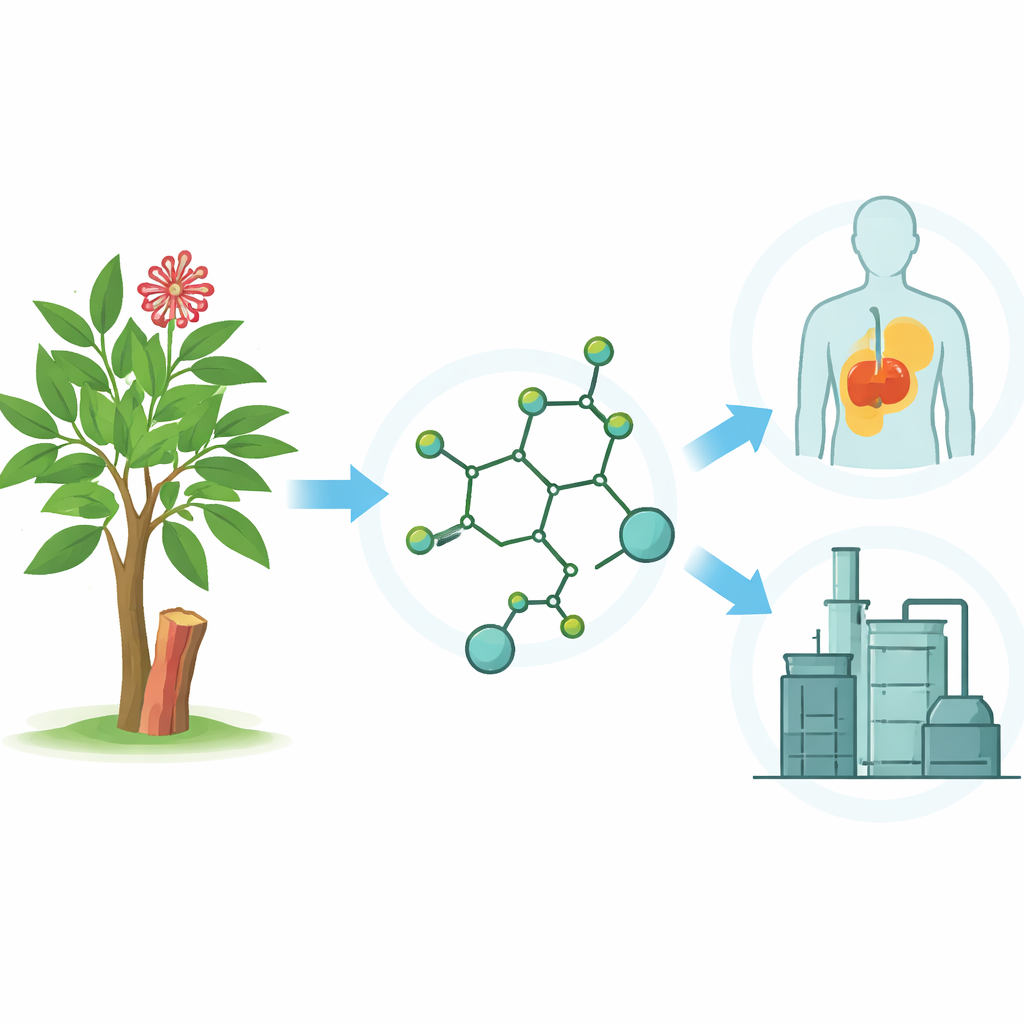
From Tree Bark to Powerful Molecules
Cinchona alkaloids are nitrogen-rich molecules that give cinchona bark its bitter taste and healing power. Quinine became an early frontline drug against malaria, and related molecules are still used to control irregular heartbeats and to steer delicate chemical reactions in the lab. All of these compounds share a distinctive two-ring framework that chemists call a quinoline–quinuclidine scaffold. Earlier work had revealed the first steps of their construction: the plant combines a building block from the amino acid tryptophan with another from a small terpene to make an early intermediate called strictosidine, then reshapes it into a simpler structure called corynantheal. But how the plant transformed corynantheal into the hallmark cinchona framework remained a major missing chapter.
Following Invisible Breadcrumbs Inside the Plant
To close this gap, the researchers fed cinchona tissues with slightly heavier, isotopically labeled versions of suspected intermediates and then tracked where those labels ended up using sensitive mass spectrometry. This chemical detective work uncovered three previously unconfirmed waypoints on the path to quinine-like molecules. First, the plant reduces corynantheal to an alcohol called corynantheol. Next, it temporarily attaches a small "handle" derived from malonic acid, creating malonyl-corynantheol. That handle is then used in an unusual ring-forming step to produce a positively charged, four-part nitrogen center—a quaternary ammonium compound the authors name cinchonium. Cinchonium, in turn, is reshaped into a long-sought intermediate called cinchonaminal, which carries the distinctive core found in all cinchona alkaloids.
Uncovering the Enzymes Behind the Steps
Finding these intermediates was only half the story; the team also wanted the genetic instructions that encode each step. They sifted through vast gene-expression datasets from cinchona leaves and roots, including single-nucleus RNA sequencing that maps which genes switch on in which cell types. By combining this with protein surveys and comparisons to related plants, they narrowed thousands of candidate genes down to a small set that closely track the presence of cinchona alkaloids. Functional tests then revealed the key players: an enzyme that adds a malonyl group to corynantheol, and an unexpected companion that no longer transfers that group but instead uses it to trigger ring closure, forging cinchonium. Additional enzymes then oxidize and reduce the structure in a choreographed sequence, converting the indole portion of the molecule into the final quinoline ring system and reducing a final ketone to yield quinine-like products.
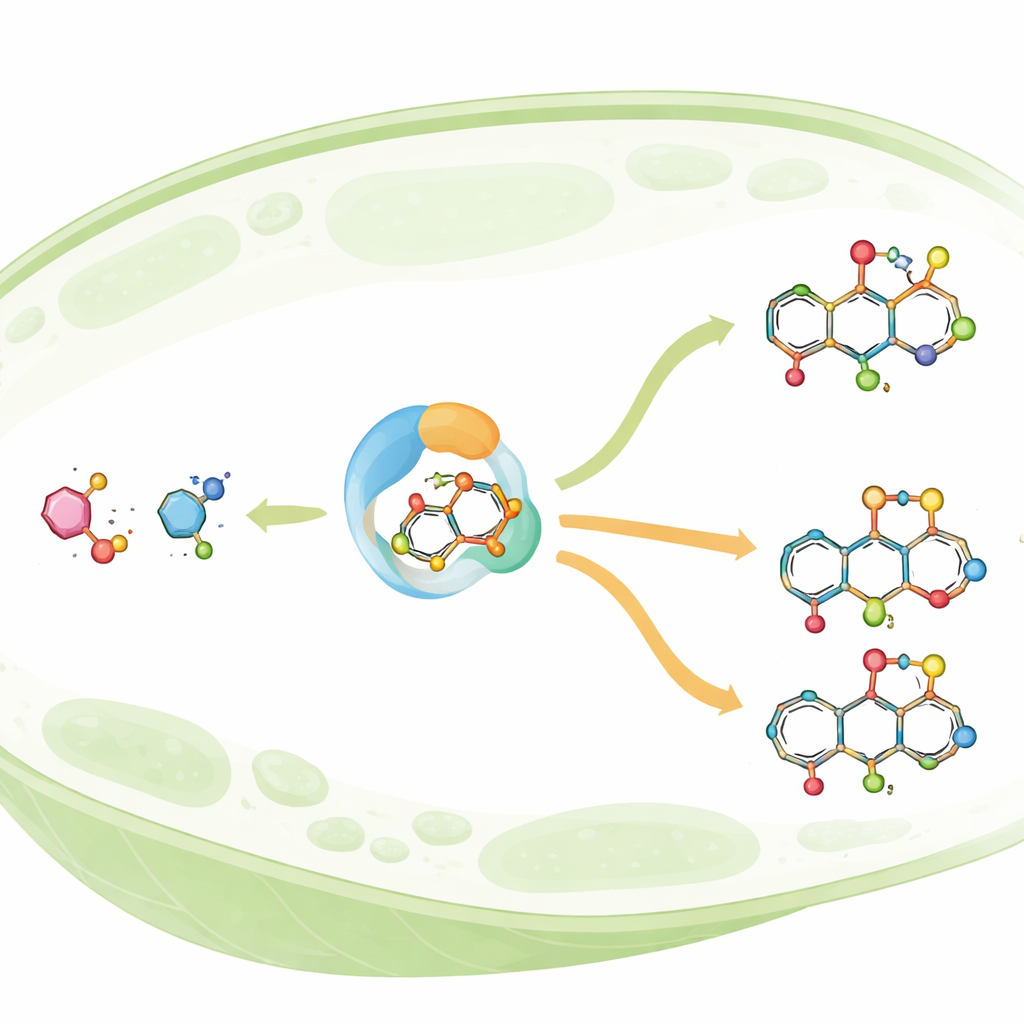
Rebuilding the Pathway in a Different Plant
Armed with this gene set, the researchers recreated much of the cinchona pathway in a different species altogether: Nicotiana benthamiana, a relative of tobacco often used as a laboratory workhorse. By transiently introducing the cinchona genes and feeding in early building blocks such as strictosidine or its methoxy variant, the team coaxed these leaves to produce advanced alkaloids that closely match those made in cinchona itself. Strikingly, the borrowed pathway was flexible enough to accept custom-built starting materials. When the scientists supplied artificial versions of tryptamine bearing fluorine or chlorine atoms at different positions, the reconstituted pathway converted them into new, halogenated cinchona-like molecules, the kinds of variants medicinal chemists prize for improved drug properties.
Why This Matters for Future Medicines
For non-specialists, the key takeaway is that we now have a detailed map—and the genetic toolkit—for how cinchona trees build their famous alkaloids. The work reveals a previously unknown chemical strategy in plants, where a temporary attachment of a small acid group is repurposed to close a complex nitrogen ring. It also shows that this natural assembly line can be transplanted into a fast-growing host plant and fed customized ingredients to make new-to-nature molecules. In practical terms, this opens the door to producing quinine-like compounds more sustainably, and to exploring a broader chemical space of analogues that could lead to improved antimalarials, heart medicines or entirely new drugs inspired by a centuries-old remedy hidden in tree bark.
Citation: Lombe, B.K., Zhou, T., Kang, G. et al. Biosynthesis of cinchona alkaloids. Nature 653, 306–314 (2026). https://doi.org/10.1038/s41586-026-10227-x
Keywords: cinchona alkaloids, quinine biosynthesis, plant natural products, metabolic engineering, synthetic biology