Clear Sky Science · en
Assembly of helper NLR resistosome clusters upon activation of a coiled-coil NLR
How Plants Turn Germ Detection into a Cellular Self-Destruct
Plants cannot run away from germs, so each cell carries its own emergency defense system. One of the most dramatic responses is a controlled form of cell suicide that sacrifices infected cells to save the rest of the plant. This article uncovers how a particular immune receptor, called SUMM2, stationed at the cell surface, marshals a team of helper proteins into striking ring-shaped clusters that may punch holes in the cell’s outer membrane to drive this life‑or‑death decision.
A Guard at the Cell’s Outer Fence
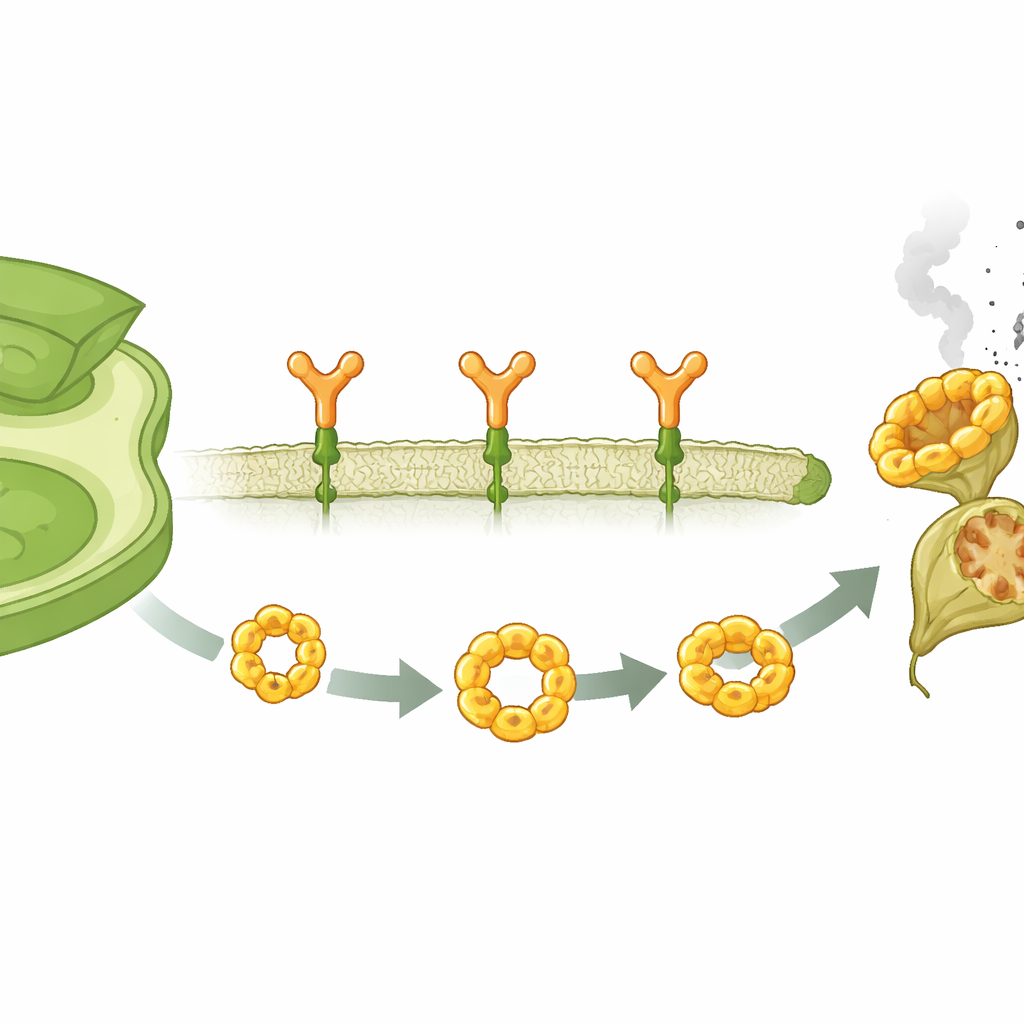
Plant cells are wrapped in a plasma membrane that acts as a frontline barrier against invading microbes. Inside this boundary sit many immune receptors that monitor for signs of attack. The study focuses on one such receptor, SUMM2, found in the model plant Arabidopsis. Unlike better-known receptors that burrow into the membrane to form simple pores, SUMM2 is anchored to the membrane by a small fatty tail, added through a chemical modification called N‑myristoylation. The authors show that this lipid tag is common among a class of immune receptors and is essential for placing SUMM2 at the membrane and keeping it stable there. When the tag is removed, SUMM2 drifts into the cell’s interior, becomes less abundant, and can no longer effectively trigger cell death.
Calling in a Specialized Rescue Squad
SUMM2 does not act alone. The team found that when SUMM2 is switched on—either by genetic tricks or by a bacterial effector protein that disables a separate signaling pathway—it recruits a trio of helper proteins known as EDS1, PAD4 and ADR1. These helpers are already famous for their role in plant immunity, but were thought mainly to work with a different class of immune sensors. By combining genetics and protein interaction tests, the researchers show that plants lacking EDS1, PAD4 or ADR1 largely lose the ability to undergo SUMM2‑driven cell death and display milder disease‑related symptoms. This places the EDS1–PAD4–ADR1 module firmly downstream of SUMM2 as a necessary relay that converts the initial alarm into a full defensive response.
From Mobile Helpers to Frozen Rings
To discover what actually happens at the membrane, the authors used high‑resolution live‑cell imaging. In resting cells, ADR1 molecules glide rapidly along the inner surface of the membrane as tiny, mobile specks. Once SUMM2 is activated, however, this behavior changes dramatically. ADR1 spots slow down, become immobile, and fuse into small groups of two to six units arranged in neat ring‑like patterns embedded in the membrane. These clusters appear before any obvious signs of cell death, suggesting they are part of the triggering mechanism rather than a by‑product. A similar clustering behavior was seen for related helper receptors in other plant species, hinting that such assemblies may be a widespread feature of plant immune signaling.
Building Higher-Order Death Machines
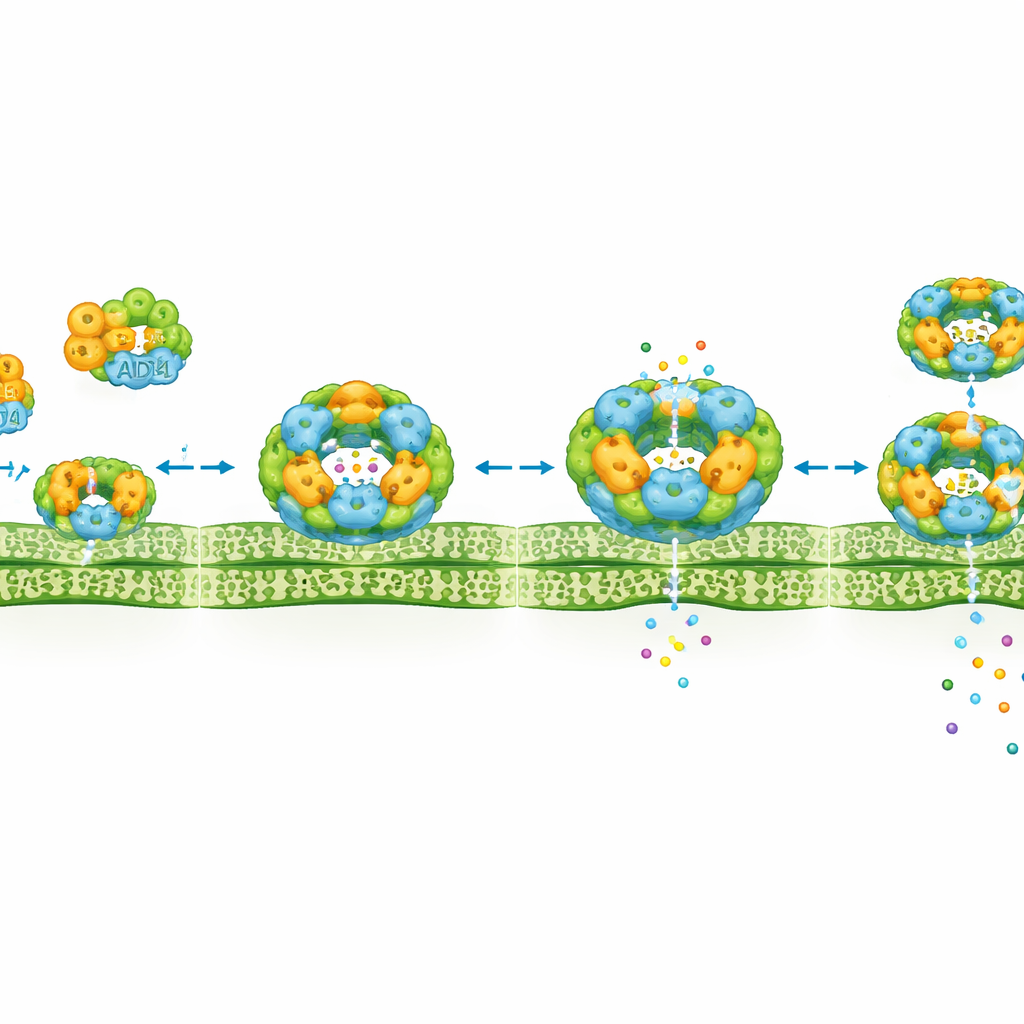
The story becomes even more intricate when EDS1 and PAD4 are tracked alongside ADR1. On their own, EDS1 and PAD4 move through the nucleus and cytoplasm. Upon SUMM2 activation, they are drawn to the membrane and accumulate at the same ring‑shaped sites where ADR1 has clustered. Detailed imaging shows that EDS1–PAD4 form a continuous ring, while multiple ADR1 assemblies dot this ring like beads. Biochemical experiments support this picture, revealing that SUMM2 activation promotes the formation of large complexes that contain EDS1, PAD4 and ADR1 together. Chemical inhibitors that block production of small signaling molecules made by yet another group of immune proteins prevent both cluster formation and cell death, suggesting that these clusters integrate signals from several layers of the plant’s defense network.
Why These Rings May Be Deadly
What do these striking structures actually do? Previous work showed that related immune complexes can form small channels that let calcium ions surge into the cell, a key step in defense signaling. The new study suggests that SUMM2 uses its lipid anchor not to make its own pores, but to choreograph clusters of helper complexes into larger rings that might disturb the membrane more profoundly. The authors speculate that, much like certain proteins in animal immune systems that carve out patches of membrane to rupture dying cells, these plant ring assemblies could locally weaken or remove bits of membrane, allowing contents to leak out and sealing the fate of the cell. In simple terms, SUMM2 acts as a tethered sentinel that, once convinced a pathogen is present, gathers a demolition crew at the cell’s surface and orders them to punch organized holes that turn a single infected cell into a protective sacrifice for the plant.
Citation: Ge, D., Ortiz-Morea, F.A., Xie, Y. et al. Assembly of helper NLR resistosome clusters upon activation of a coiled-coil NLR. Nature 652, 251–258 (2026). https://doi.org/10.1038/s41586-026-10215-1
Keywords: plant immunity, cell death, immune receptors, membrane protein clusters, Arabidopsis