Clear Sky Science · en
Facile induction of immune tolerance by an interleukin-2–TGFβ surrogate agonist
Turning the Immune System’s Brakes into Targeted Therapy
Our immune system walks a fine line between defending us from harm and mistakenly attacking our own tissues or harmless substances like pollen or food. This study explores a way to tip that balance back toward peace by coaxing the body to grow its own “peacemaker” immune cells on demand, potentially easing allergies, autoimmune disease, and gut inflammation without shutting down overall immunity.
A New Way to Grow Immune Peacemaker Cells
Among white blood cells, a small group called regulatory T cells act as peacekeepers, calming aggressive immune responses before they cause damage. Many chronic conditions, from asthma to multiple sclerosis, involve a shortage or failure of these cells at the right place and time. The researchers set out to design a drug-like protein that would reliably convert ordinary helper T cells into powerful, long-lasting peacemaker cells inside the body, and would do so only in cells that recognize a chosen target, such as an allergen or a self-protein. 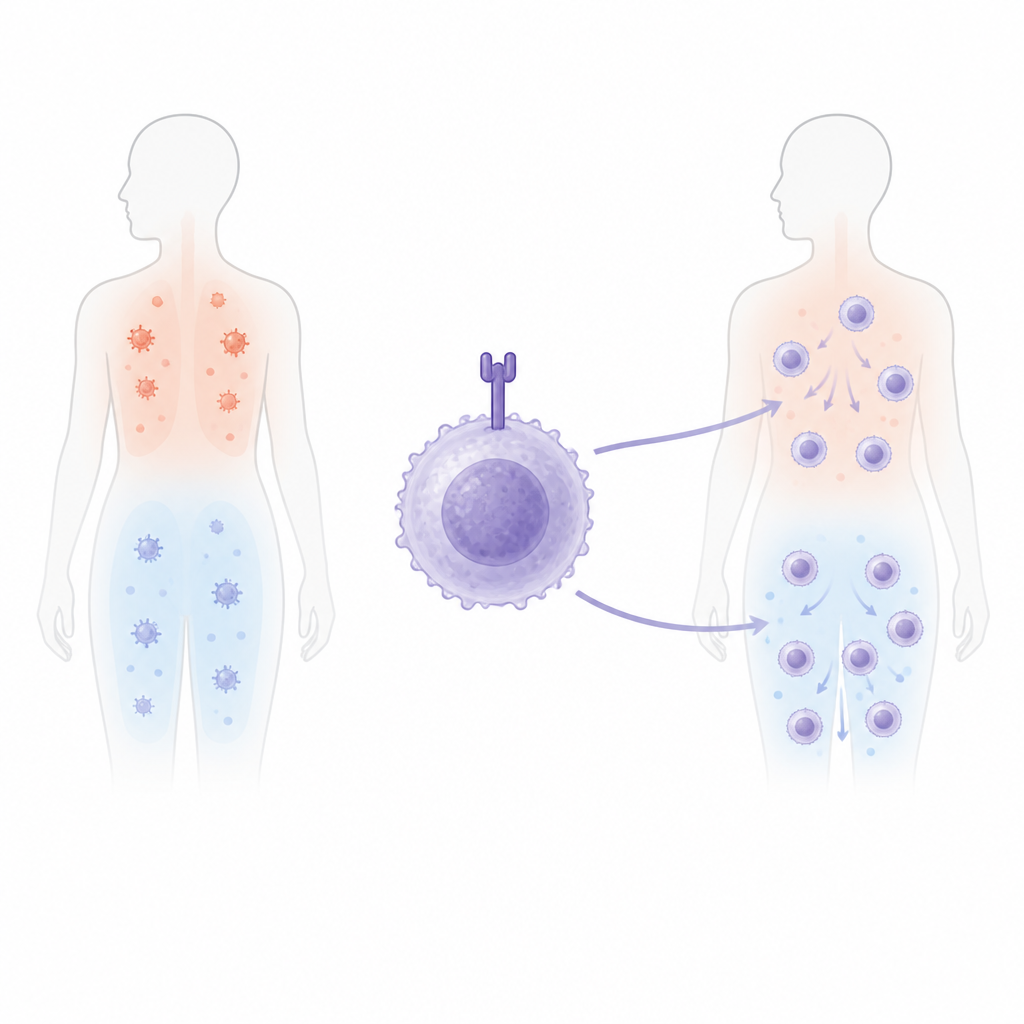
Fusing Two Key Signals into One Smart Molecule
Two natural messenger molecules, IL-2 and TGF-beta, are known to work together to nudge T cells into becoming regulators in the lab, but TGF-beta is difficult to use as a medicine because it can also drive scarring and tumor growth. The team built a single fusion protein that links IL-2 to a softened TGF-beta look-alike borrowed from a parasitic worm. This surrogate is weak on its own, but when it binds to IL-2 receptors on a T cell it brings both signals together in the same cell, like a logical “AND” gate. Experiments with mouse and human cells showed that this fused molecule strongly turned on both signaling routes at once, efficiently converting ordinary T cells into regulatory cells that could shut down the growth and activation of nearby T cells in culture.
Teaching Tolerance to Allergens and Self-Proteins in Mice
The researchers next asked whether this fusion protein could create antigen-specific tolerance in living animals. In mice given a model food protein or a brain protein associated with multiple sclerosis, plus the surrogate molecule, up to about four out of five responding T cells were converted into regulatory cells in nearby lymph nodes and spleen. These induced cells carried markers of active, traveling regulators and often expressed a factor called ROR-gamma-t that is linked to movement into the gut. When the mice were later challenged with protocols that normally trigger strong allergic airway inflammation, food allergy reactions, or a multiple-sclerosis-like disease, the pre-treated animals showed far milder symptoms, less tissue damage, and fewer aggressive immune cells in affected organs.
How the Dual Signal Shapes Potent, Mobile Regulators
To understand what made these induced cells so effective, the team profiled their genes one cell at a time. The regulatory cells generated by the full fusion molecule showed an activated, dividing state with high levels of genes tied to gut-homing, immune calming, and survival, and they resembled potent regulatory cells normally found in the colon. A comparison with a version of the fusion protein that could no longer send the IL-2 signal revealed that the TGF-beta-like part provided identity, while IL-2 was crucial for expansion, full strength, and stability. Mice treated with this weakened version produced fewer regulatory cells, which were less suppressive and offered much less protection from allergy and inflammation. 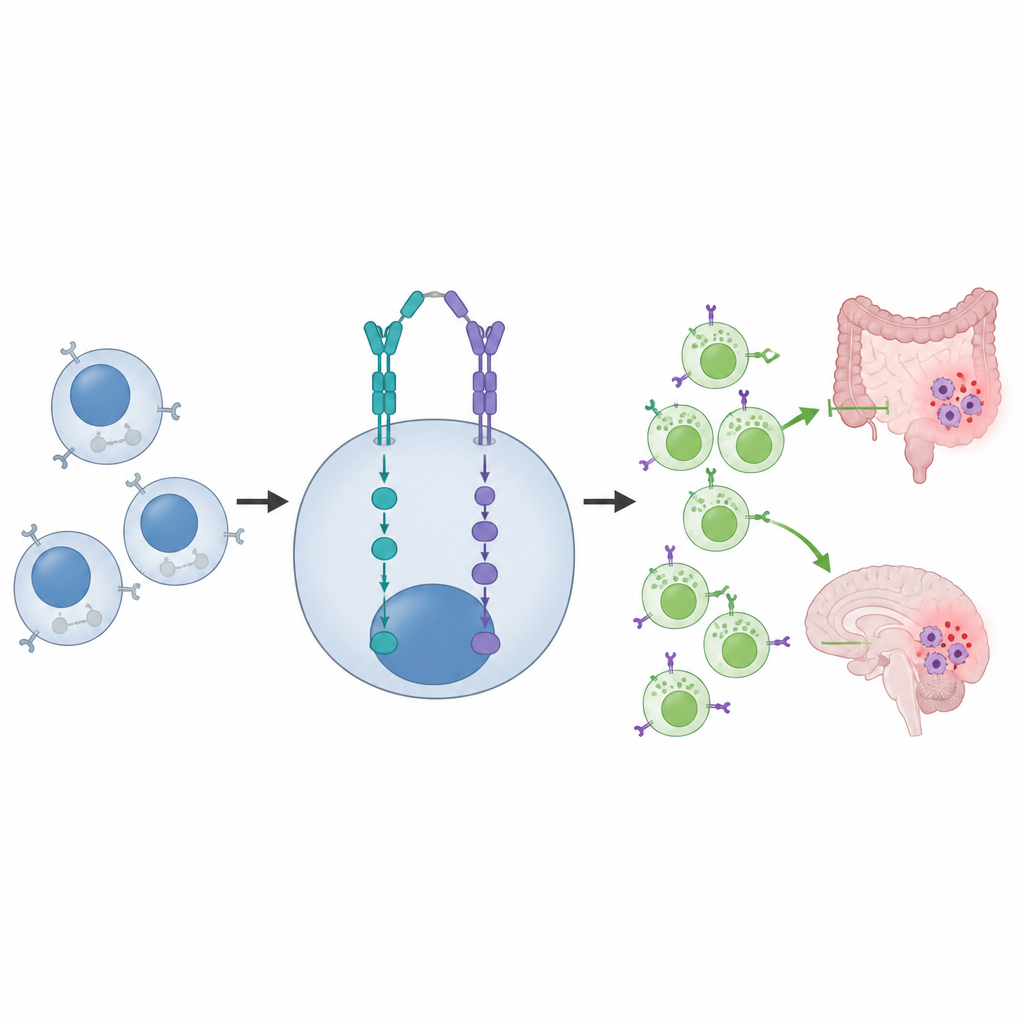
From Mouse Experiments to Future Treatments
Overall, the work shows that combining IL-2 and a safer TGF-beta mimic in a single, targeted molecule can reliably grow large numbers of stable, mobile regulatory T cells that recognize precise triggers. In mice, this strategy quieted allergic, autoimmune, and gut inflammation without broadly boosting other immune cells. While more engineering would be needed before such molecules could be used in people, the study points toward therapies that restore tolerance by re-educating the immune system rather than simply suppressing it.
Citation: Sun, Q., Barrett, A.K., Ogishi, M. et al. Facile induction of immune tolerance by an interleukin-2–TGFβ surrogate agonist. Nature 653, 888–899 (2026). https://doi.org/10.1038/s41586-026-10208-0
Keywords: regulatory T cells, immune tolerance, interleukin-2, autoimmune disease, allergy