Clear Sky Science · en
Fatigue failure in glasses under cyclic shear deformation
Why repeated gentle pushes can still break solid materials
Bridges, phone screens and aircraft parts can all fail not because of a single violent blow, but because of many smaller pushes over time. This slow weakening, called fatigue, is especially mysterious in glassy and other disordered materials that lack the neat crystal structure of metals. In this study, researchers use large-scale computer simulations to watch, in microscopic detail, how model glasses respond to repeated shearing back and forth—revealing clear rules for when they finally give way and how early signs can be used to forecast failure.
Watching model glass under rhythmic stress
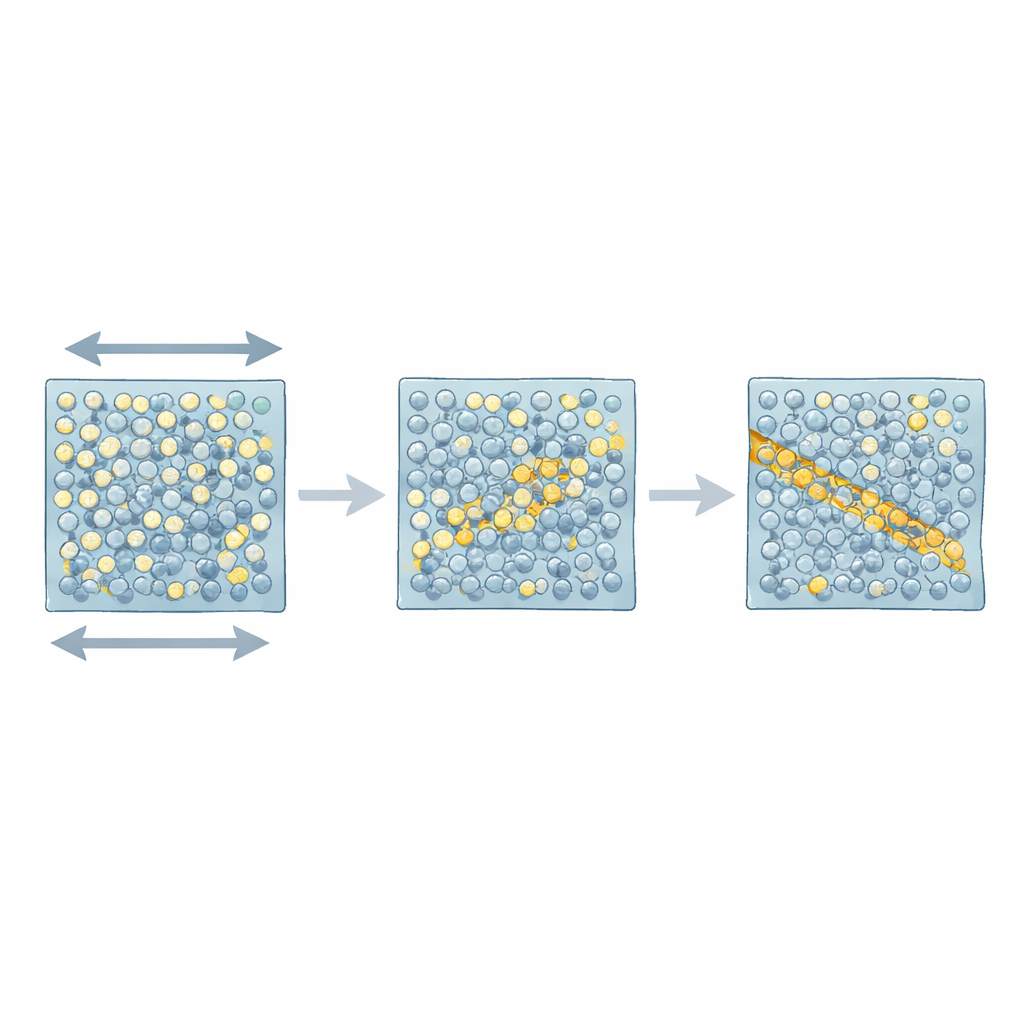
The team simulated several types of glassy materials at very low temperature while they were deformed in a cyclic fashion: imagine gently but repeatedly sliding the top face of a block back and forth. For each level of deformation, they tracked how many loading cycles the material could survive before it "failed"—that is, before particles began to wander diffusively and a permanent shear band, a narrow zone of intense slip, formed across the sample. They monitored the energy stored in the material, subtle changes in local structure and how far individual particles moved away from their original positions. Failure showed up sharply as a sudden jump in energy and particle motion, allowing the researchers to define a precise failure time for each simulated sample.
A sharp rule for how long the material can last
By varying how strongly they sheared the glass, the authors uncovered a simple but powerful law. When the maximum shear in each cycle was only slightly above a critical "yield" level, the number of cycles to failure grew very rapidly as the applied shear was reduced. In fact, the average failure time diverged according to a clean power law: it scaled as the inverse square of the distance between the applied strain and the yield strain. This −2 exponent held robustly across different system sizes, different ways the samples had been prepared and even for very different glass models, including network-like silica. This behavior contrasts with several existing theoretical predictions, which suggest other exponents, highlighting that current models of fatigue in amorphous solids are incomplete.
How preparation history changes durability
The history of a glass—how slowly it was cooled or how carefully it was annealed—strongly influenced how long it could endure cyclic loading at a fixed deformation level. Better-annealed glasses, which start in lower-energy, more stable configurations, survived many more cycles before failing. As the degree of annealing improved, the failure time first followed an Arrhenius-like dependence, typical of thermally activated processes, and then crossed over to an even steeper, super-Arrhenius growth. This crossover lined up with a characteristic temperature previously identified in glass physics as marking a change in the nature of the material’s dynamics. In practice, this means that making glasses more stable can dramatically delay fatigue failure, but in a way that is controlled by underlying glassy physics rather than by simple engineering rules.
Damage building up in hidden pathways
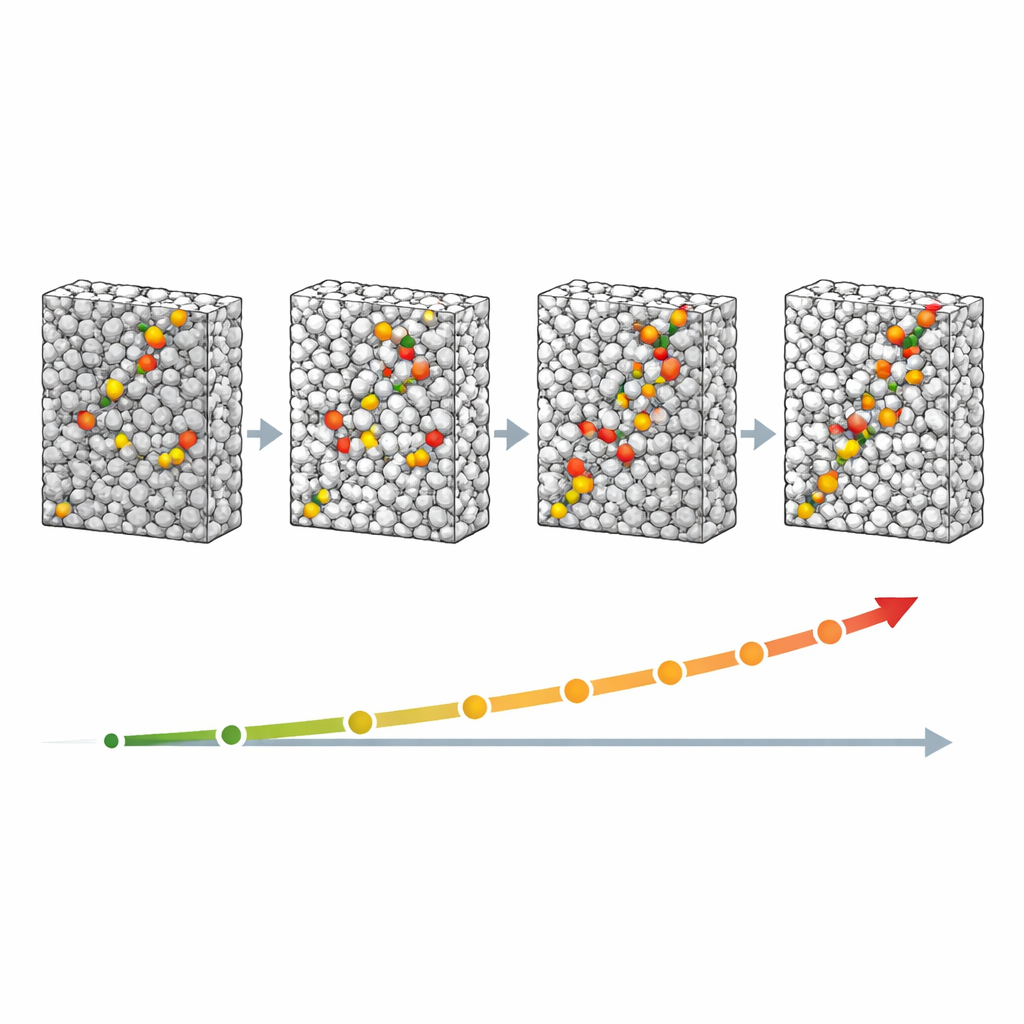
To understand the microscopic mechanism, the researchers quantified “damage” in two complementary ways: how much particles underwent irreversible rearrangements and how much mechanical energy was dissipated as heat-like loss each cycle. They found that particles which move plastically do so in a highly uneven way, clustering in certain regions. As cycles proceed, more particles join these clusters until a nearly fixed fraction of all particles in the sample has undergone such motion; at this point, the clusters connect across the system and a shear band forms, triggering failure. This percolation of accumulated mobile particles consistently occurred just before failure and served as a clear precursor, in contrast to snapshots of only the momentary mobile particles, which were less predictive.
Using early-cycle energy loss to forecast failure
Energy-based damage told a complementary story. The area enclosed by each stress–strain loop—a measure of energy dissipated per cycle—was small and roughly constant while the material was still intact, then jumped once the glass yielded. When the total accumulated dissipated energy up to the onset of failure was plotted against the failure time, the data followed a robust power law across many samples and conditions. Because the damage per cycle is nearly steady before failure, this relation lets one infer the eventual failure time from the rate of energy loss in just the first few cycles. In tests within the simulations, predictions based on early-cycle data matched the actual failure times remarkably well, suggesting a practical route for predicting fatigue life in real amorphous materials.
What this means for everyday materials
Together, these findings present a microscopic picture of fatigue in disordered solids: repeated gentle shearing gradually activates small, irreversible particle rearrangements that gather into system-spanning pathways, while the time this takes obeys simple scaling rules with loading and with how the glass was prepared. Crucially, the work shows that by monitoring either microscopic motion or overall energy loss during only the initial loading cycles, it should be possible to estimate how long a glassy material can survive under repeated stress. This bridges the gap between abstract glass physics and practical design of more durable materials for technologies that must endure many years of tiny, repeated deformations.
Citation: Maity, S., Bhaumik, H., Athani, S. et al. Fatigue failure in glasses under cyclic shear deformation. Nat. Phys. 22, 402–408 (2026). https://doi.org/10.1038/s41567-026-03174-x
Keywords: fatigue failure, amorphous glasses, cyclic shear, plastic rearrangements, damage prediction