Clear Sky Science · en
Epitope-focused discovery of SARS-CoV-2 antibodies that potently neutralize Omicron variants
Why this research matters now
As the coronavirus keeps mutating, many of the monoclonal antibody drugs that once worked well have lost their punch, especially against Omicron offshoots like XBB and BQ.1.1. This study explores a clever way to stay ahead of the virus by deliberately reshaping the bait scientists use to fish out human antibodies, so that only the rare, most broadly effective ones are caught. The work points toward faster, more targeted discovery of antibody therapies and may also guide future vaccine design.
How antibodies see the virus
The virus that causes COVID-19 uses its spike protein to latch onto human cells. A key portion of that spike, called the receptor-binding domain, is where many protective antibodies attach. Over the past few years, scientists have learned that antibodies tend to recognize this domain in several recurring ways, or “classes.” Some classes focus right where the spike grabs the human ACE2 receptor, while others lock onto nearby surfaces. Omicron variants carry a tangle of mutations across these regions, which is why so many earlier antibody drugs fail. Yet one region, known as the class 3 site, remained relatively stable at first and has produced especially powerful antibodies, making it an attractive target for new treatments.
Using sugar shields as a smart filter
To focus on that promising region, the researchers used a trick borrowed from nature itself. Viruses and our own proteins are often coated in chains of sugars, called glycans, that act like tiny umbrellas, hiding underlying surfaces from the immune system. The team engineered a version of the Omicron BA.1 receptor-binding domain with an extra sugar chain placed precisely over the class 3 area. This “glycan-masked” spike fragment could still fold correctly but now hid the very site they were most interested in. By pairing this masked fragment with unmasked versions from advanced Omicron variants XBB and BQ.1.1, they designed a sorting scheme that would highlight B cells whose antibodies specifically recognize the class 3 region. 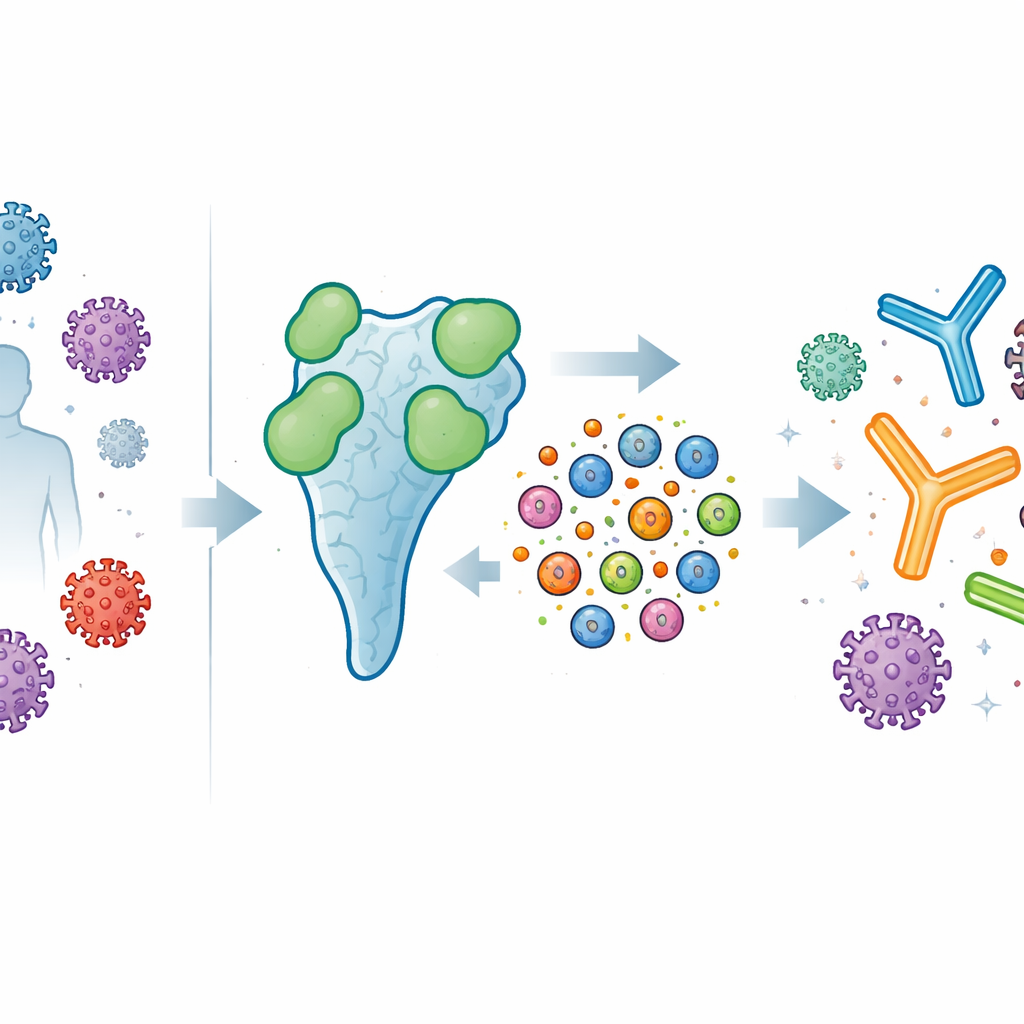
Fishing out rare but powerful B cells
Blood cells from a vaccinated and previously infected volunteer were first enriched for memory B cells, the long-lived cells that remember past encounters with viruses. These cells were then probed with fluorescent versions of the engineered spike fragments. B cells that bound the XBB or BQ.1.1 fragment but ignored the glycan-masked version were flagged as likely class 3 specialists, because the added sugar should block that site. These rare cells—often less than half a percent of all memory B cells—were isolated and coaxed to become antibody-secreting cells in culture. Using high-throughput sequencing and miniature expression systems, the team produced a library of 303 distinct human monoclonal antibodies from this single donor, and then systematically tested how well each one bound to different spike variants and blocked infection in cell-based assays.
What the new antibodies can do
The screening revealed many antibodies that strongly neutralized cutting-edge Omicron variants like XBB.1.5 and BQ.1.1, and some that also recognized the earlier SARS virus, hinting at especially conserved targets. A smaller panel of the most promising antibodies was examined more closely. Several showed potent activity not only in pseudovirus tests but also against authentic SARS-CoV-2 isolates representing multiple lineages. When these antibodies were given to susceptible mice before exposure to an XBB.1.5 virus, they sharply reduced viral levels in the lungs, demonstrating real protection in a living organism. Structural studies using cryo–electron microscopy and X-ray crystallography revealed exactly how selected antibodies clasp the spike surface, explaining why some lose effectiveness when specific Omicron mutations appear, while others continue to grip conserved features shared across variants. 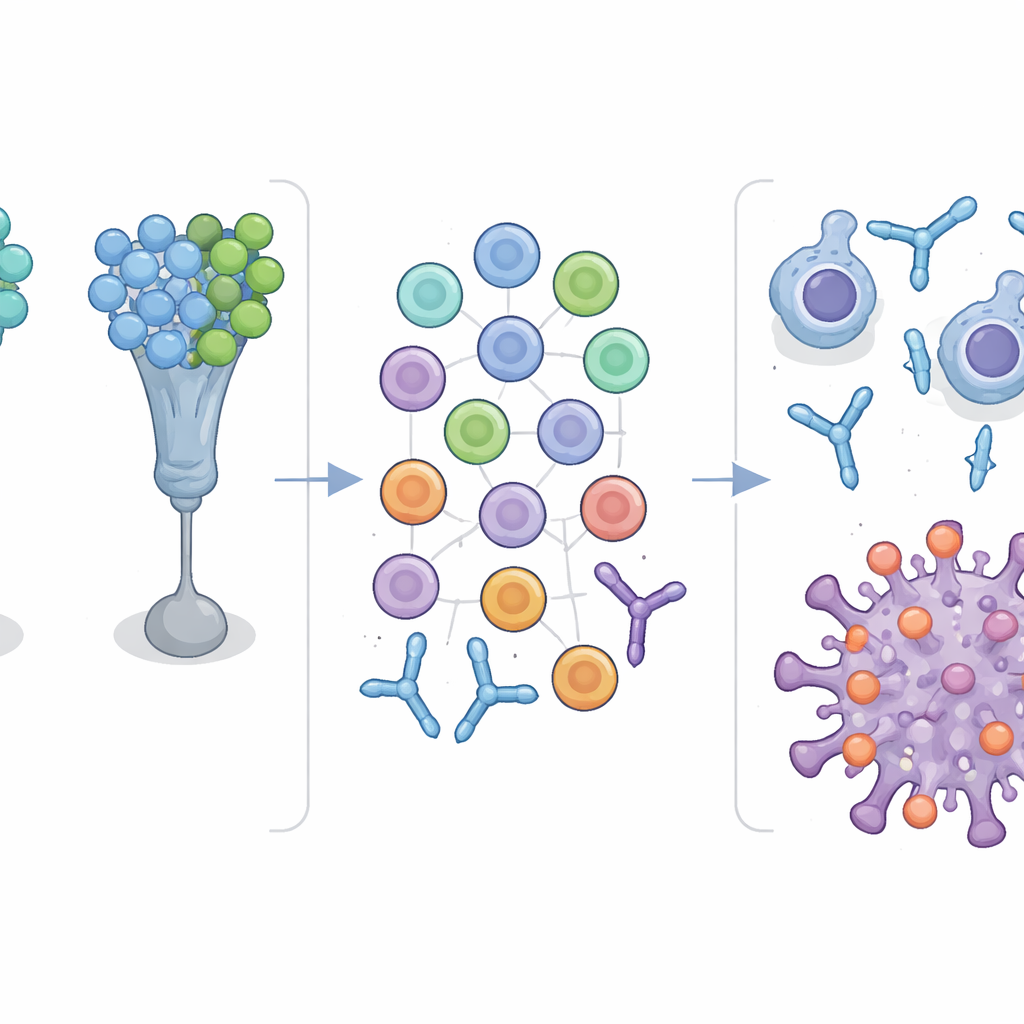
Testing the strategy in more people
Because the initial large-scale antibody hunt came from just one volunteer, the researchers next asked whether their sugar-masking enrichment strategy would work more broadly. They applied the same approach to blood from four additional, differently exposed individuals. In each case, they could detect B cells with the desired binding pattern and isolate antibodies that showed the same competition behavior as in the first donor, confirming that class 3–focused memory B cells are present across people and can be selectively captured with this engineered bait.
What this means for future defenses
The study shows that by thoughtfully adding sugar shields to the spike protein, scientists can steer their searches toward antibodies that target specific, hard-to-change regions of the virus. This epitope-focused method uncovered human antibodies that still neutralize some of the most evasive Omicron variants and protect animals from infection. Beyond immediate drug discovery, similar engineered spikes could be used to design vaccines that nudge our immune systems toward these more broadly protective sites, helping keep antibody-based defenses one step ahead of a fast-evolving virus.
Citation: Zost, S.J., Suryadevara, N., Williamson, L.E. et al. Epitope-focused discovery of SARS-CoV-2 antibodies that potently neutralize Omicron variants. Nat Microbiol 11, 1113–1132 (2026). https://doi.org/10.1038/s41564-026-02282-x
Keywords: SARS-CoV-2 antibodies, Omicron variants, glycan masking, epitope-focused discovery, monoclonal antibody therapy