Clear Sky Science · en
Cation–polymer interactions drive water expulsion and deswelling in n-type ladder organic mixed conductors
Why this shrinking plastic matters
Electronics that talk to living tissue, store renewable energy or bend light on command increasingly rely on special plastics that carry both ions and electrons. This article explores a surprising behavior in one such plastic: under certain conditions it actually shrinks and squeezes out water when more charge is added. Understanding this counterintuitive effect could help engineers design more stable bioelectronic devices and new kinds of tunable optical surfaces.
Plastics that conduct in two ways
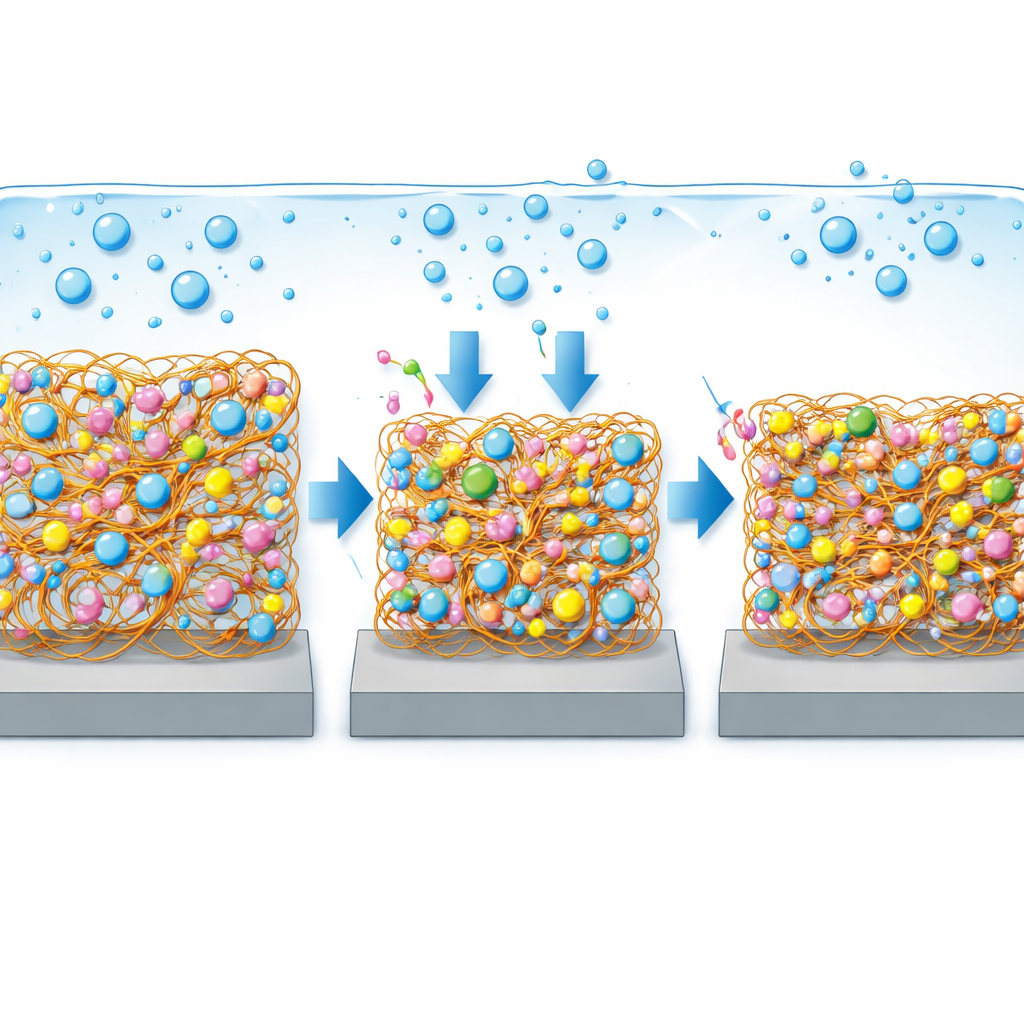
Most everyday plastics are electrical insulators, but a growing class of materials can move both electrons and charged atoms, or ions. These mixed conductors are key to devices such as organic electrochemical transistors used in medical sensors, soft actuators and energy storage. When they operate in salty water, ions from the liquid slip into the polymer, bringing water with them and causing the material to swell. Swelling has long been viewed as a necessary part of how these devices work, but the detailed relationship between ion uptake, water movement and the polymer’s structure has been murky.
A polymer that slims down when charged
The researchers studied a well known electron carrying polymer called BBL, which has a rigid, ladder like backbone and no side chains. They compared how BBL behaves in solutions containing sodium ions versus solutions containing ammonium ions, which can form hydrogen bonds. Using a sensitive quartz balance and atomic force microscopy while the material was being electrically charged, they found that in sodium salt solution the polymer simply gained mass and thickness as more charge was injected. In ammonium salt solution, however, the mass and thickness first increased and then dropped sharply at higher charging levels, indicating that the film was deswelling even as it continued to take up charge.
Water pushed out instead of ions
To find out what was leaving the polymer, the team used operando deuterium nuclear magnetic resonance, which can distinguish heavy water trapped inside ordered polymer regions from water in the surrounding liquid. During electrical cycling in ammonium solution, the signal from confined water rose at low charge and then fell by roughly one third at higher charge, closely matching the loss in mass and thickness. In sodium solution the confined water signal plateaued rather than decreasing. These results show that in the ammonium case the polymer expels water, not ions, at high charging levels. The data also suggest that the hydration shell around the ions collapses, so that ions remain in the film but drag along fewer water molecules.
How sticky ions change charge flow
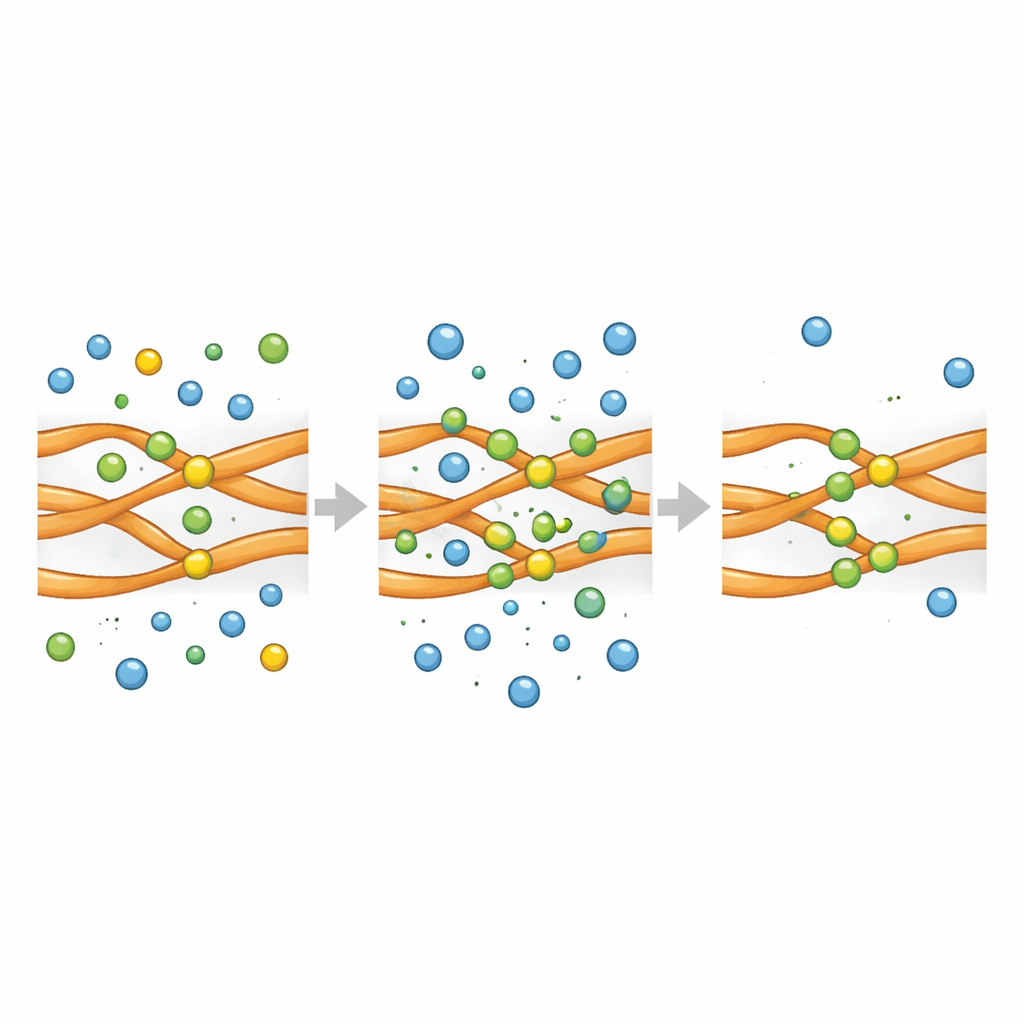
Further measurements probed how these ions interact with the polymer backbone. Infrared spectroscopy revealed that a distinct vibration associated with carbonyl and imine groups appears at lower voltages in ammonium solution than in sodium solution, pointing to strong hydrogen bonding and partial protonation between ammonium and the BBL chain. Terahertz spectroscopy showed that, as this interaction strengthens, charges become more localized and their effective mobility drops, explaining why the overall conductivity peaks and then falls with increasing charge. Computer simulations supported this picture, showing ammonium ions forming more and stronger contacts with the polymer than sodium and indicating that such networks can promote expulsion of water layers between chains.
Designing smarter soft electronics
By systematically replacing the hydrogen atoms on ammonium with methyl groups, the authors showed that only ions capable of forming hydrogen bonds cause the same water loss and shrinking, and that the onset of this effect tracks how strongly each ion can donate hydrogen bonds. This connects the microscopic chemistry of ion–polymer interactions to the macroscopic changes in volume and conductivity. The study concludes that a hydrogen bonding network between certain cations, water and the polymer backbone drives water expulsion and deswelling at high charge levels. For device designers, this means that choosing the right ions can stabilize mixed conducting polymers, control their thickness and even tune their optical properties, opening avenues from more durable biointerfaces to reconfigurable light bending surfaces.
Citation: van der Pol, T.P.A., Lyu, D., Truyens, Z. et al. Cation–polymer interactions drive water expulsion and deswelling in n-type ladder organic mixed conductors. Nat. Mater. 25, 832–839 (2026). https://doi.org/10.1038/s41563-025-02478-2
Keywords: organic mixed conductors, ion polymer interactions, water expulsion, electrochemical doping, bioelectronics materials