Clear Sky Science · en
Photoswitchable isomers to improve grain boundary resilience and perovskite solar cells stability under light cycling
Why sunlight can slowly break solar cells
Perovskite solar cells are rising stars in the clean‑energy world because they can be made cheaply and already rival the efficiency of today’s rooftop panels. But there is a catch: out in the real world, these cells must endure years of changing sunlight and temperature. This study asks a simple question with big consequences: how do daily cycles of bright sun, darkness, heat and ultraviolet light slowly damage perovskite cells—and can we build in a kind of microscopic shock absorber that lets them survive this constant stress?
Everyday weather as a hidden stress test
Outside the lab, solar panels do not bask under steady, gentle illumination. Instead, they heat up and cool down, and the light intensity rises and falls as clouds pass and day turns to night. By analysing global weather data, the researchers show that such cycling is the rule, not the exception. To mimic this, they exposed perovskite devices to repeated light–dark cycles, sometimes including harsh ultraviolet light. They found that rapid cycling can age devices far faster than continuous light, shrinking months of wear into hours. Under ultraviolet‑rich cycling, performance fell more quickly, revealing that this kind of test is a realistic and demanding stand‑in for outdoor operation. 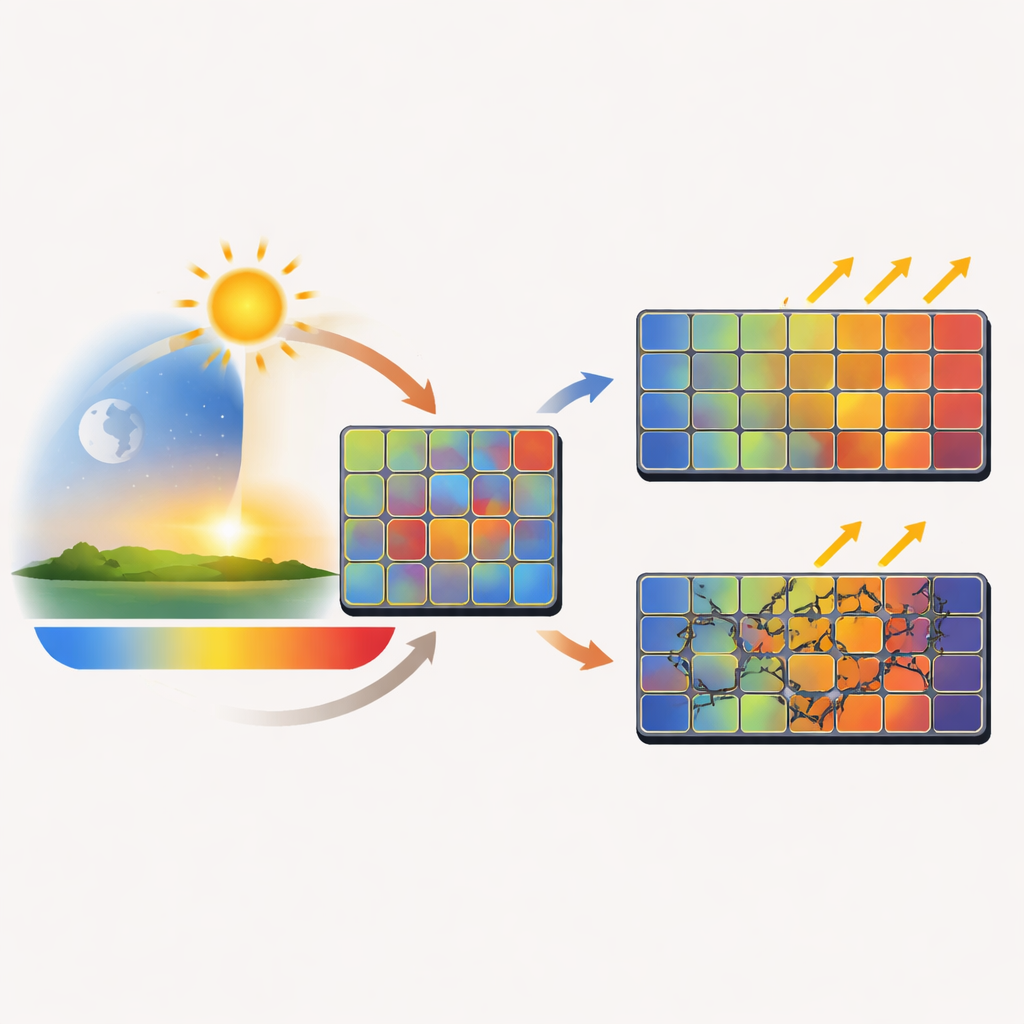
Cracks along the hidden seams
Perovskite thin films are made of many tiny crystals that meet at grain boundaries—the invisible seams in the material. Microscopy and X‑ray measurements showed that light cycling causes these seams to develop pinholes, microscopic gaps and unwanted new phases that do not absorb light well. Computer simulations backed this up, indicating that repeated illumination and heating drive atoms to shuffle and bonds to break, particularly at the boundaries between grains. Over time, the perovskite partly decomposes into other compounds and even metallic lead, leaving behind defects that trap charge and reduce the solar cell’s output. In other words, the material is not simply fading; it is being mechanically and chemically pulled apart from the inside.
Building a microscopic shock absorber
To counter this, the team borrowed a trick from smart molecular design. They added a small “photoswitchable” molecule, based on azobenzene, that can flip between two shapes when exposed to ultraviolet light and then relax back in the dark. One end of this molecule anchors to the perovskite at the grain boundaries, while the rest remains flexible. Under illumination, the molecules bend; in the dark, they straighten. This reversible motion lets them act like tiny springs that stretch and relax in step with the material, buffering the strain that would otherwise tear at the boundaries. Detailed measurements of crystal structure, Raman signals and atomic‑scale simulations showed that with these additives, the lattice changes shape less during cycling, accumulates far less strain and forms fewer new defects.
Better charge flow and higher efficiency
Stabilizing the seams does more than prevent cracking; it also improves how charges move through the device. Spectroscopic tests and transient voltage measurements revealed that the modified films have fewer traps where electrons and holes can recombine and disappear as wasted heat. Charges travel more cleanly across the grain boundaries, leading to higher voltages and improved fill factors in complete solar cells. Devices containing the photoswitchable molecules achieved a power conversion efficiency of about 27%, among the best reported for this class of perovskite cells, and these results were independently certified. 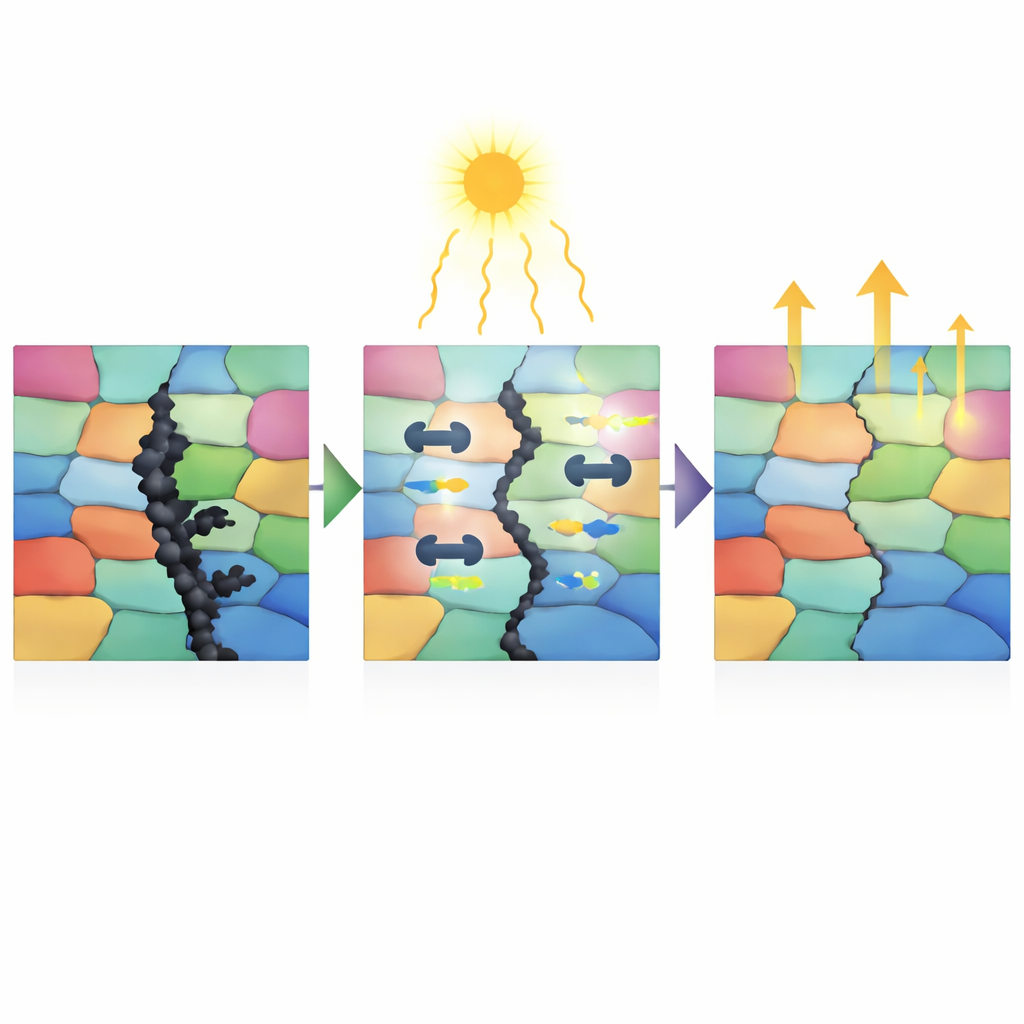
Staying power under brutal cycling
The real test was long‑term operation under demanding conditions. When run at maximum power under steady light, the treated cells kept more than 90% of their initial performance after 2,500 hours, while untreated cells dropped to about 60%. Under more realistic day–night style light cycling at 65 °C, and even when ultraviolet light was included, the modified devices maintained over 95% of their starting output after 2,000 hours. They also withstood 500 rapid temperature swings between deep cold (–40 °C) and high heat (85 °C) with only minor losses, a level of resilience crucial for outdoor deployment.
What this means for future solar panels
In simple terms, this work shows that a carefully chosen, light‑responsive molecule can act as a built‑in stress‑relief layer inside perovskite solar cells. By letting the material flex instead of crack during everyday light and temperature cycles, the additive keeps the cells both highly efficient and remarkably stable. If scaled up, this approach could help turn perovskite technology from a lab curiosity into a durable, real‑world option for powering homes and cities, even under the relentless on–off rhythm of the sun.
Citation: Zhang, Z., Zhu, R., Li, G. et al. Photoswitchable isomers to improve grain boundary resilience and perovskite solar cells stability under light cycling. Nat Energy 11, 623–632 (2026). https://doi.org/10.1038/s41560-026-01993-z
Keywords: perovskite solar cells, solar cell stability, grain boundaries, photoswitchable molecules, ultraviolet light cycling