Clear Sky Science · en
Missing planktivore functions drive global variation in reef fish productivity
Why jelly eaters matter for coral reefs
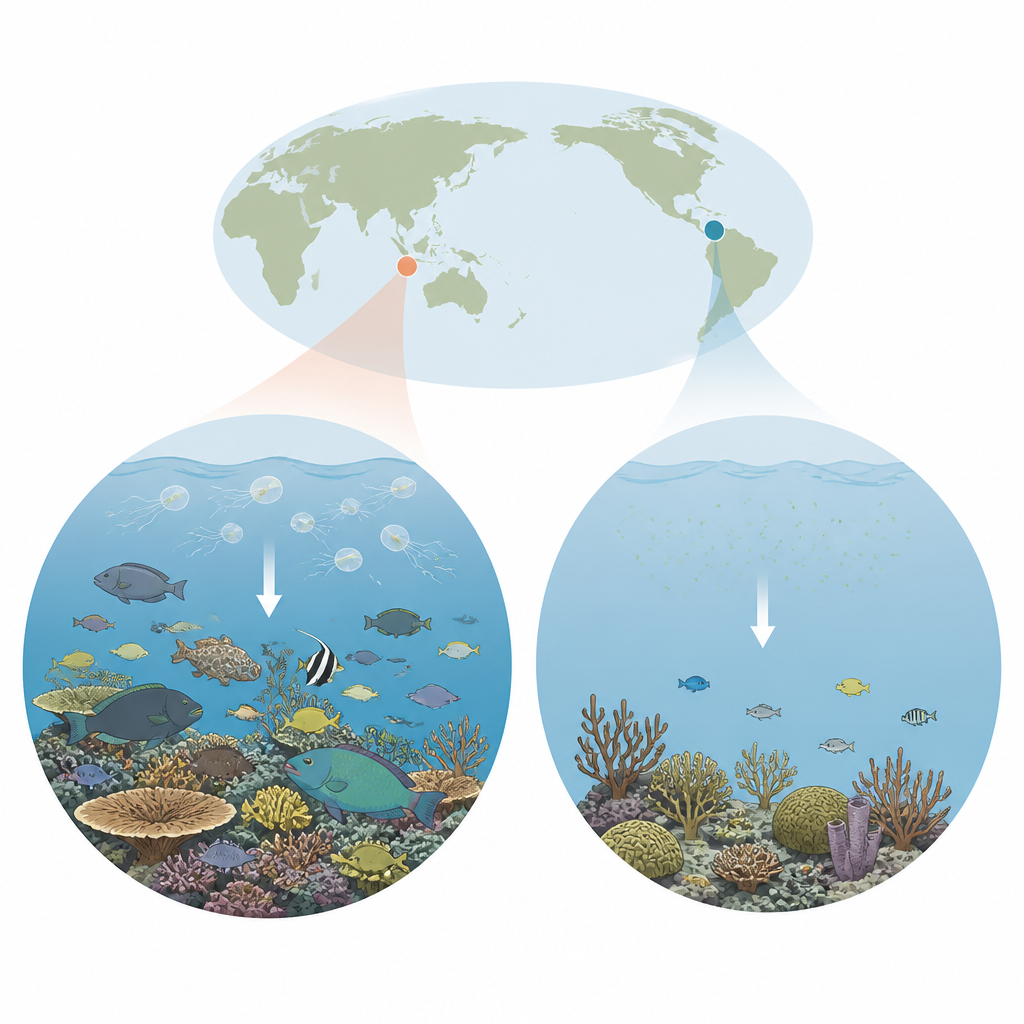
Coral reefs are famous for bright fish and clear water, but behind this beauty lies a hidden food highway. Tiny drifting animals in the open ocean feed fish that, in turn, help support reef life and coastal fisheries. This study asks a simple question with big consequences: why do reefs in the Indo Pacific teem with productive fish, while many Caribbean reefs do not, even when they look similar on the surface?
Two oceans, two very different reef worlds
The researchers compared thousands of underwater fish counts from coral reefs across the Indo Pacific and the Caribbean. They focused on planktivores, fishes that feed on drifting plankton in the water rather than on the seafloor. Using these global surveys, they calculated how many planktivorous fish were present, how heavy they were, and how much new fish tissue they produced each day. Although Indo Pacific reefs had only a bit more planktivorous fish in terms of head count, they held far more flesh and growth overall. On average, Indo Pacific reefs supported about six and a half times more planktivorous fish biomass and over three times the daily productivity seen on Caribbean reefs.
The hidden role of jelly like prey
To understand this gap, the team looked closely at what different fish species prefer to eat. Not all plankton is alike. Some types, such as copepods and small crustaceans, are dense and firm. Others, such as jelly like animals and transparent floating “tunics,” are mostly water and look less nutritious. By combing through identification guides, a global fish database and detailed studies of stomach contents, the authors split 336 reef planktivorous fish species into those that mainly eat gelatinous plankton and those that focus on non gelatinous prey. They discovered that fish that specialize on gelatinous prey were found only in the Indo Pacific and were completely absent from the Caribbean fish lists.
Few jelly feeders, but giant contributions
At first glance, jelly feeding fish seem unimportant because they are rare. In the Indo Pacific surveys, they made up just 4 percent of individual planktivorous fishes. Yet these few species punch far above their weight. Thanks to their generally large body sizes, they stored about one third of all planktivorous fish biomass and produced about one quarter of the daily growth from this group. When the team compared fish of different sizes, Caribbean planktivores became scarce above 10 centimeters in length, while Indo Pacific reefs were rich in larger planktivores, especially those that target gelatinous prey. On a per fish basis, Indo Pacific planktivores generated more than twice the daily growth of their Caribbean counterparts, and gelatinous feeders in particular produced several times more biomass per individual than other planktivores.
Shaped by ocean history and moving water
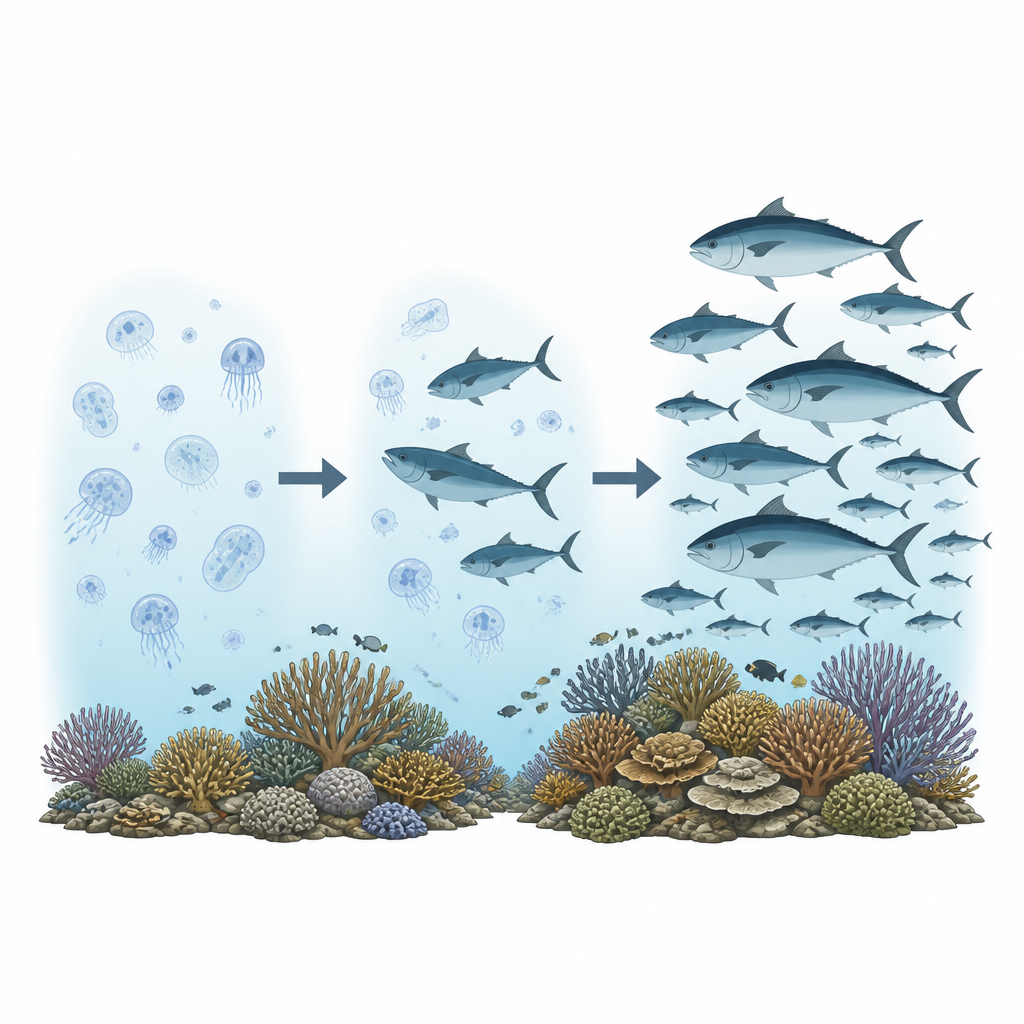
The study links these patterns to the long history and geography of each ocean realm. The Indo Pacific contains intricate island chains and complex currents that continually deliver rich plankton supplies to reefs. This setting appears to have encouraged the evolution and success of large planktivores that can exploit blooms of gelatinous plankton, grow quickly, and range farther offshore in search of food. The Caribbean, in contrast, has simpler circulation and has faced repeated extinction events over millions of years. These events, combined with local conditions that favor algae on the seafloor, seem to have pushed many fishes toward feeding on bottom based foods rather than on plankton. As a result, Caribbean reefs now host fewer planktivorous species overall and lack the big gelatinous feeders entirely.
What this means for reefs and people
The absence of jelly feeding planktivores in the Caribbean does more than change the fish community; it alters how energy moves through the whole reef. Indo Pacific reefs can tap large flows of pelagic food and spread that energy through big, fast growing fishes that may also contribute to local fisheries. Caribbean reefs must rely more heavily on other pathways, such as fish that graze algae or feed on the bottom, which may already be under pressure from fishing and habitat change. In simple terms, Caribbean reefs represent a stripped down, less productive version of their Indo Pacific cousins when it comes to plankton eating fish. This difference in “jelly eaters” helps explain why some reef regions are better able to support rich fish life and human uses than others.
Citation: Gahan, J., Yan, H.F., Bellwood, D.R. et al. Missing planktivore functions drive global variation in reef fish productivity. Nat Ecol Evol 10, 987–996 (2026). https://doi.org/10.1038/s41559-026-03029-x
Keywords: coral reefs, planktivorous fish, gelatinous plankton, Indo Pacific, Caribbean