Clear Sky Science · en
CAM photosynthesis may have conferred an advantage during the Permian–Triassic mass extinction event
When the World Nearly Died
The greatest mass extinction in Earth’s history, 252 million years ago, nearly wiped life from the planet. Yet some small, unassuming plants not only survived but quickly took over damaged landscapes. This study asks how these modest lycophytes, distant relatives of today’s quillworts, managed to endure searing heat and unstable climates that followed the catastrophe—and what their tricks might tell us about life in a warming world.
Small Plants in a Harsh New World
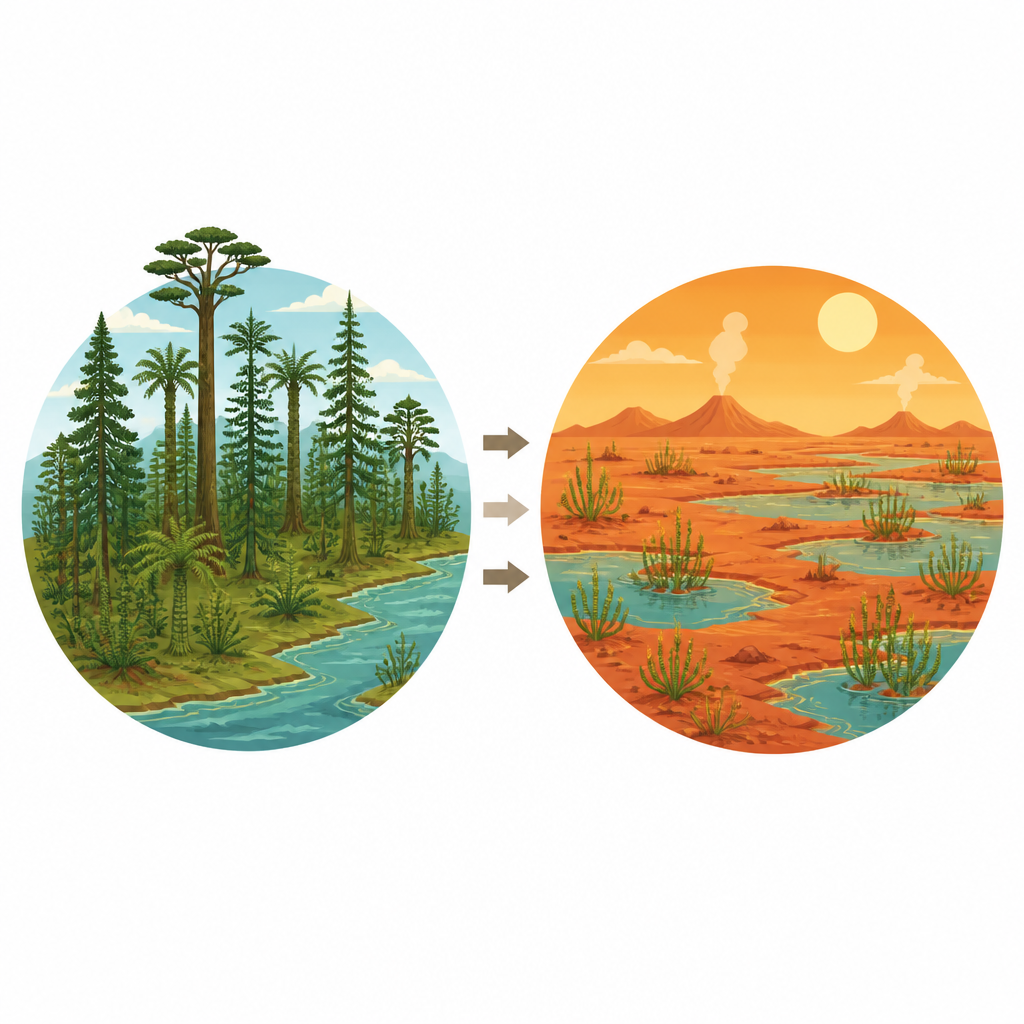
Before the crisis, Earth’s lowlands were covered by dense forests of tall trees. Volcanic outbursts from the Siberian Traps drove extreme global warming, ocean disruption and the loss of most animal species. On land, the familiar forests vanished and were replaced by sparse communities dominated by short, herb-like lycophytes. These “disaster plants” spread from the tropics to high latitudes, especially in what is now South China, raising the puzzle of how such delicate-looking plants could thrive when conditions were too hot for most modern crops to function.
Reading Form and Family Ties in Fossils
The researchers assembled a large collection of 485 fossil “sporophylls,” the spore-bearing leaves of lycophytes, from Late Permian to Middle Triassic rocks and compared them with modern relatives. By scoring 127 simple shape features—such as leaf outline, vein arrangement and spore-case form—they used statistical tools to map how fossil species cluster in “shape space.” This analysis clarified messy fossil names and showed that the Early Triassic pioneers belong to a genus called Tomiostrobus, closely related to modern Isoetes, while later Triassic forms group into another genus called Lepacyclotes. The strong similarity in their reproductive structures suggests a tight evolutionary link between the Triassic plants and today’s flexible quillworts.
Clues Hidden in Ancient Carbon
To probe how these plants made a living, the team measured the ratio of carbon isotopes in fossil plant material and the surrounding sediments. Different photosynthetic styles leave distinct isotopic fingerprints. In rocks from tropical coastal lowlands of South China, non-lycophyte plants show large, negative shifts in carbon values consistent with the global carbon-cycle disturbance. The lycophytes, in contrast, remain relatively enriched in heavy carbon compared with their neighbors, even as atmospheric carbon dioxide soared. Their values sit close to those of nearby sediments, hinting at a mix of carbon sources and an unusual way of concentrating carbon inside their tissues.
Surviving the Super Greenhouse
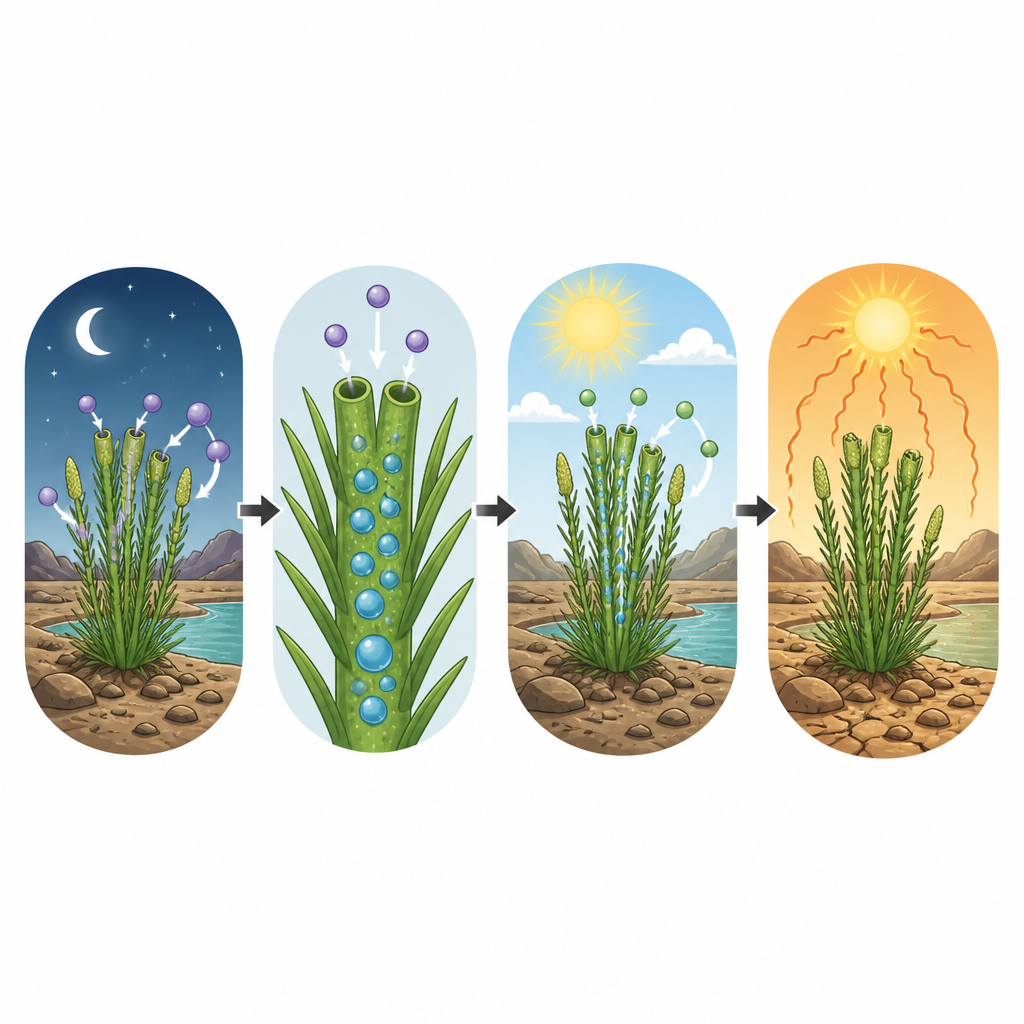
The team then used an Earth system climate model to reconstruct land surface temperatures before, during and after the extinction. When these maps were combined with the fossil findspots, many lycophytes were found to occupy regions where peak daily land temperatures likely exceeded 45 to 60 degrees Celsius, hotter than most modern C3 plants can tolerate. Modern Isoetes, however, can switch on a photosynthetic style called CAM, which allows them to take in carbon mostly at night, store it as organic acids and use it for photosynthesis by day while keeping leaf pores closed. Many also draw carbon directly from water and sediment through their roots.
Night Work that Saved the Day
Bringing together shape comparisons, isotope evidence and climate modeling, the authors argue that Early Triassic lycophytes likely used CAM-style night-time carbon uptake, much like living Isoetes. This would have let them conserve water, reduce heat stress and survive in hot, drought-prone coastal plains where other plants failed. A world dominated by such low, slow-growing plants would have buried less carbon in soils, potentially helping keep the planet in a prolonged greenhouse state. Yet these same hardy pioneers also stabilized damaged landscapes and maintained a thin green cover that helped life recover. In short, a quiet, nocturnal photosynthetic strategy may have been one of the keys that kept Earth’s land ecosystems from collapsing entirely.
Citation: Xu, Z., Hilton, J., Yu, J. et al. CAM photosynthesis may have conferred an advantage during the Permian–Triassic mass extinction event. Nat Ecol Evol 10, 997–1010 (2026). https://doi.org/10.1038/s41559-026-03026-0
Keywords: Permian Triassic extinction, CAM photosynthesis, lycophyte fossils, paleoclimate warming, plant survival strategies