Clear Sky Science · en
Priority questions for the next decade of blue carbon science
Why coastal “blue carbon” matters to everyday life
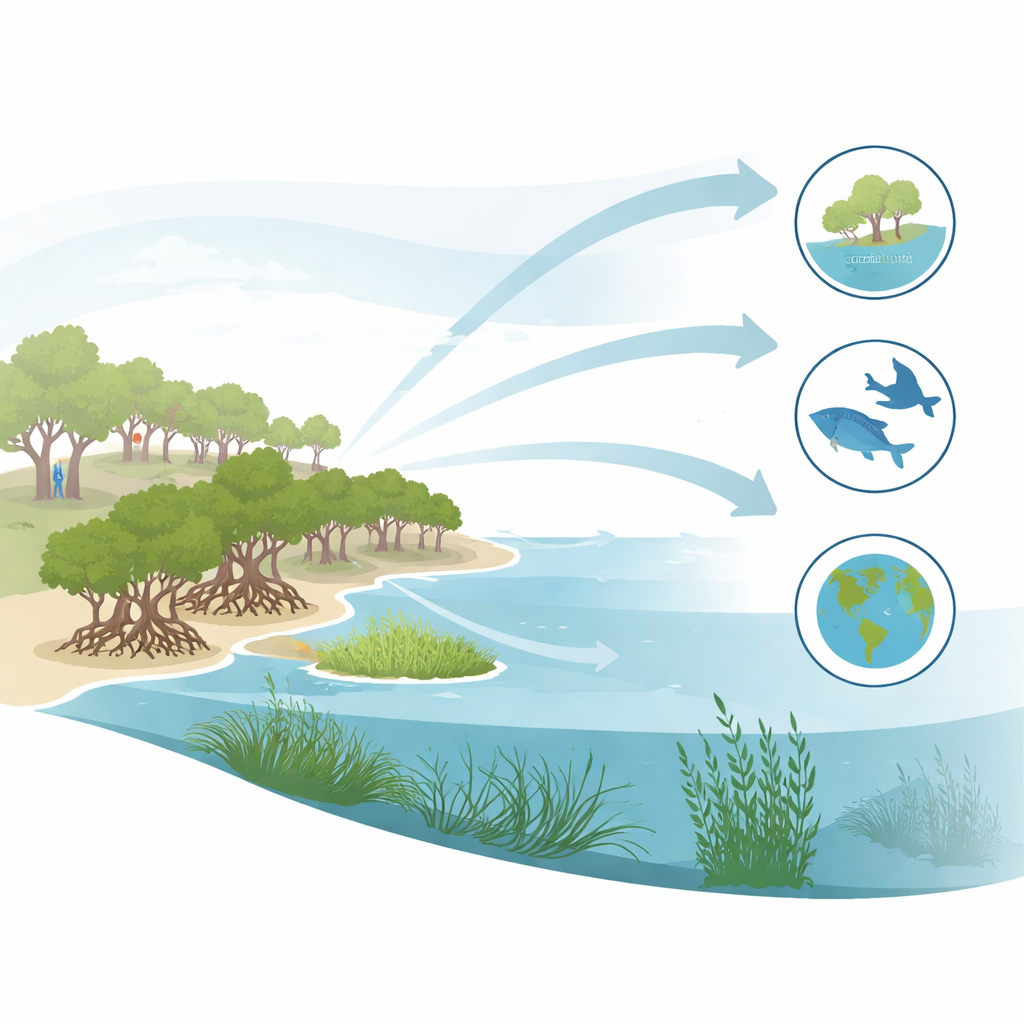
Along the world’s shorelines, mangrove forests, tidal marshes, seagrass meadows and other “blue” habitats quietly lock away large amounts of carbon while sheltering fish, birds and coastal communities. As governments and businesses look to nature to help slow climate change, these ecosystems are attracting intense attention—and money. This article asks a simple but urgent question: what do scientists, policymakers and local people most need to know in the next decade to protect these habitats in a fair, effective and lasting way?
Setting the stage for the next decade
“Blue carbon” began as a scientific idea describing how coastal plants capture and store carbon in their soils. It has now become part of formal climate policy, shaping national greenhouse gas accounts and emerging carbon markets. Yet the science is still catching up with the speed of policy and investment. Building on a 2019 roadmap, the authors brought together 28 experts from six world regions for a structured workshop. From 116 candidate questions about blue carbon ecosystems, they distilled a top ten list that highlights where new knowledge is most urgently needed to support credible climate action, biodiversity protection and the livelihoods of people who live by the sea.
Putting coastal people at the center
The highest-ranked question asks how to manage blue carbon ecosystems while supporting coastal livelihoods. The article stresses that mangroves, marshes and seagrasses are tightly bound to the cultures and economies of the communities that depend on them. Past conservation efforts that relied on top-down rules or blanket fishing bans often struggled or produced unfair outcomes. In contrast, projects that weave together local and Indigenous knowledge with academic science tend to be more durable and accepted. Examples from the Pacific and elsewhere show how community-led management can guide where to restore mangroves, how to use wetlands sustainably and how to ensure that benefits from new funding streams do not bypass local people.
Restoring damaged shores without breaking the bank
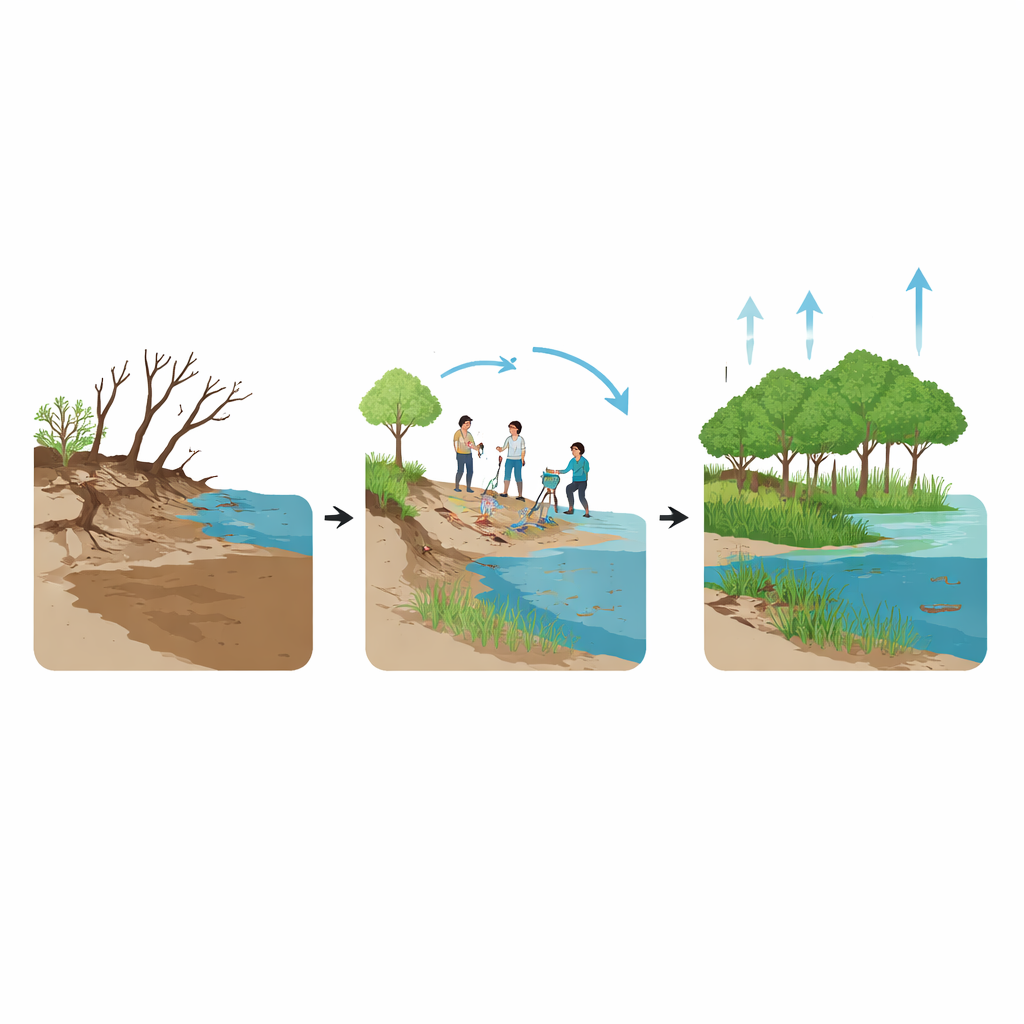
Another priority is finding affordable, reliable ways to restore degraded coastal habitats. Many blue carbon projects aim to replant mangroves or re-establish seagrass, but costs and success rates vary widely. The article explains that the first step is almost always to fix the original cause of damage—such as altered water flow or pollution—before planting anything. New approaches like “ecological mangrove restoration” focus on restoring natural tides and sediment so that forests can recover on their own, often at comparable cost to simple planting but with better biodiversity outcomes. For seagrasses and tidal marshes, restoration can be far more expensive and technically demanding. The authors call for clearer reporting of both successes and failures, better pre-project assessments, and stronger local capacity for long-term monitoring so that investments lead to real, measurable gains in carbon storage and ecosystem health.
Measuring hidden flows of gases and benefits
A large share of the article is devoted to improving how we measure carbon and other greenhouse gases in coastal ecosystems. While scientists now have good maps of carbon stored in soils and plants—especially in mangroves—data on actual gas exchanges with the atmosphere and the sea are patchy, particularly for methane and nitrous oxide, which can erode climate benefits. Many measurements also come from wealthier countries, leaving big gaps in the global south and in emerging habitats such as macroalgal forests or tidal flats. The authors highlight the promise of new tools: networks of gas-sensing towers, low-cost field instruments, satellite and radar imagery, and machine learning models that can fill in missing areas. They stress that open data platforms and shared standards are essential so that results can feed into national greenhouse gas inventories, natural capital accounts and high-integrity carbon crediting systems.
Linking science, money and clear messages
The remaining priority questions focus on how to translate complex measurements into tools that decision-makers can actually use. This includes simplifying carbon credit rules without lowering environmental standards, improving methods to “scale up” local data to national or global estimates, and developing accounting frameworks that capture not just carbon but also coastal protection, fisheries, recreation and cultural values. The authors argue that clearer, evidence-based communication is needed to avoid overselling blue carbon as a simple fix for fossil fuel emissions, while still recognizing its real contributions to climate adaptation and biodiversity. International guidance, such as reports from the Intergovernmental Panel on Climate Change, must be regularly updated to reflect new science and to include a wider range of blue habitats.
What this means for our coasts and climate
In plain terms, the article concludes that blue carbon science has grown up. It is no longer just about how much carbon sits in wetland mud, but about how to manage whole coastal landscapes in ways that are scientifically sound, socially just and financially credible. The ten priority questions mapped out here emphasize partnerships with local communities, smarter and cheaper restoration, better tracking of greenhouse gases and fairer accounting of all the benefits that coastal ecosystems provide. If these challenges are met in the coming decade, blue carbon will be better positioned to support resilient coasts and contribute meaningfully—but realistically—to global climate solutions.
Citation: Macreadie, P.I., Biddulph, G.E., Masque, P. et al. Priority questions for the next decade of blue carbon science. Nat Ecol Evol 10, 751–764 (2026). https://doi.org/10.1038/s41559-026-03020-6
Keywords: blue carbon, coastal wetlands, climate mitigation, ecosystem restoration, community livelihoods