Clear Sky Science · en
Greater trophic diversity of soil animal communities under agricultural land use and tropical climate
Why the Life Beneath Our Feet Matters
Most of us think of forests, fields and farms in terms of what we can see—trees, crops and animals above ground. But beneath our feet lies an enormous hidden world of tiny creatures that quietly recycle dead material, release nutrients for plants and help control pests. This study asks a deceptively simple question: how does the “menu” and feeding behavior of these soil animals change across the globe and under different kinds of land use, from woodlands to farmland and from cool temperate regions to the tropics? The answer helps us understand how resilient our ecosystems may be in the face of farming expansion and a warming climate.
The Underground Dining Hall
Soil is one of the most diverse habitats on Earth, hosting everything from microscopic worms and mites to beetles, centipedes and earthworms. These creatures form complex food webs: some feed on dead leaves and roots, others graze on bacteria and fungi, and still others are predators. Instead of tracking every mouthful they take, the researchers used a chemical fingerprinting method, measuring naturally occurring forms of carbon and nitrogen in the bodies of more than 17,000 soil animals from 456 sites in 19 countries. The spread of these fingerprints reveals how many different food sources are used and how many steps there are in the food chain—together, a measure of “trophic diversity,” or how varied the feeding roles are in a community.
Different Jobs in the Soil Workforce
The team grouped soil animals into broad “jobs”: detritivores that chew through dead plant material, microbivores that feed on microbes, herbivores that eat living roots, predators that hunt other animals and mixed feeders that sample many sources. They found that microbivores had by far the widest range of feeding roles. Their small bodies let them move through fine pores in the soil and tap into many different microbial communities, each with its own chemical signature. In contrast, larger detritivores and predators tended to show more similar diets to one another, suggesting they share prey and food sources and therefore occupy more overlapping niches in the underground food web.
Farms and the Tropics: More Variety on the Menu
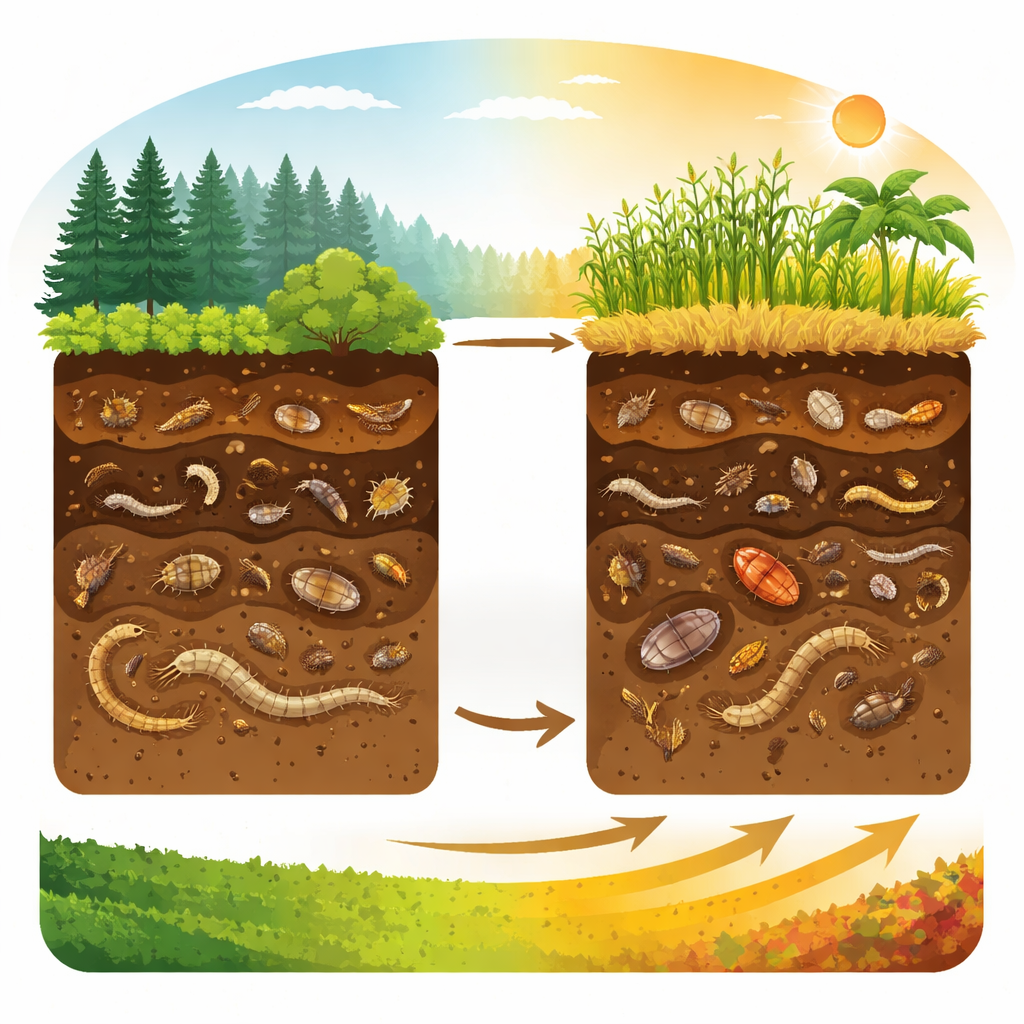
Conventional wisdom holds that intensive land use and biodiversity loss go hand in hand. Strikingly, this study found that while farmland often hosts fewer species overall, the soil animals that remain show greater trophic diversity than those in nearby woodlands—about one-third higher on average. Similarly, communities in tropical regions showed about 40 percent greater trophic diversity than those in temperate areas. In both cases, limited and patchy resources seem to push soil animals to broaden and differentiate their diets, tapping into a wider array of food sources and occupying more distinct positions in the food web.
How Environment Shapes Underground Choices
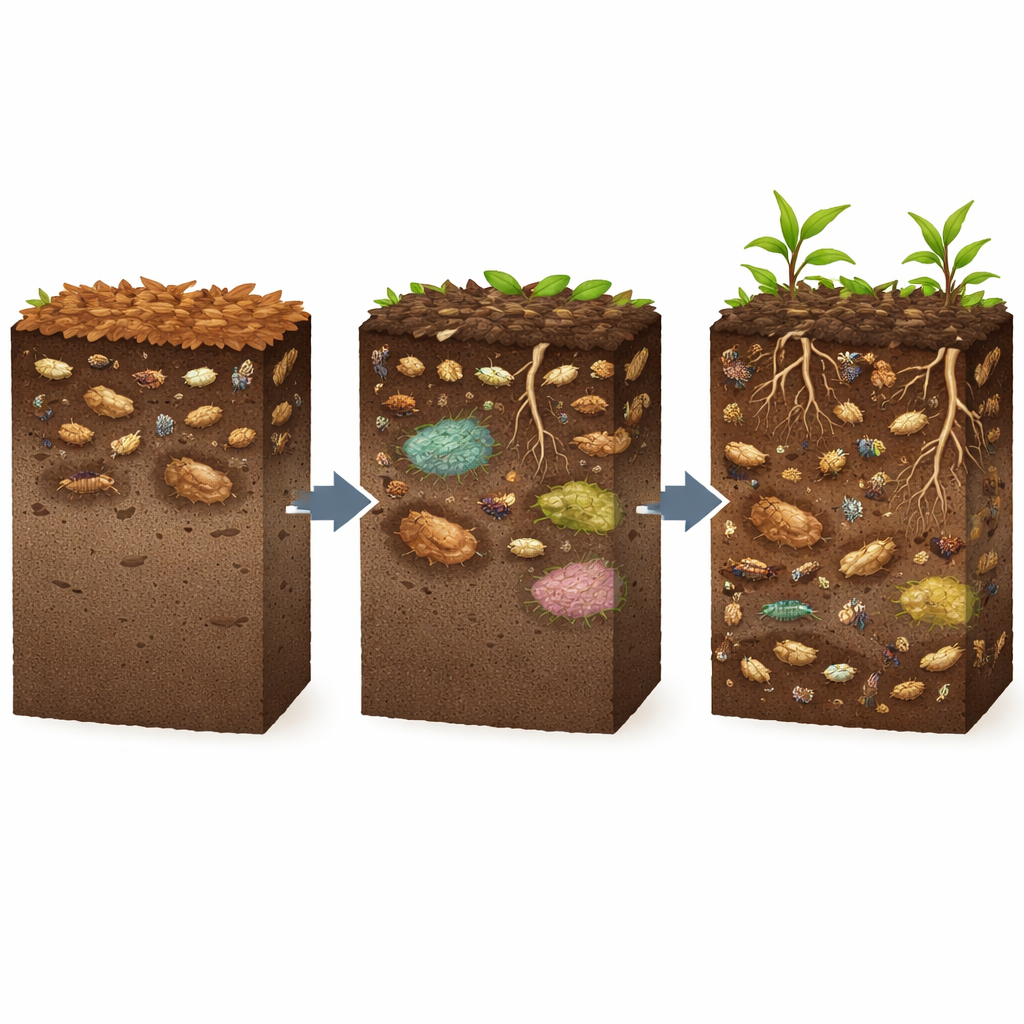
To understand why trophic diversity changes, the researchers examined climate, soil and vegetation at each site. Warmer and wetter climates with strong seasonal swings, typical of many tropical regions, were strongly linked to a broader spread of feeding roles. In these settings, low-quality litter and nutrient-poor soils mean that high-energy food is scarce and hot competition pushes species to specialize on different resources. In contrast, where plant production and soil organic matter are high and more uniform—conditions closer to many woodlands—animals can afford to be “choosy generalists,” converging on the richest foods and thereby reducing overall diversity of feeding strategies.
What This Means for a Changing World
The findings suggest that as agriculture expands and climates warm, soil animal communities may respond by stretching their dietary options and rearranging who eats what. This flexibility could help keep key processes—like decomposition and nutrient cycling—running even when some sensitive species disappear. Microbial feeders, in particular, may play an outsized role by tapping underused resources and keeping nutrients flowing. However, the shift toward a smaller set of adaptable generalists at the expense of specialized species may come with long-term costs for biodiversity and ecosystem stability. Understanding this hidden reshuffling of underground diets will be crucial for designing farming and land management practices that protect not only how many species live in the soil, but also the many ways they help ecosystems function.
Citation: Zhou, Z., Eisenhauer, N., Barnes, A.D. et al. Greater trophic diversity of soil animal communities under agricultural land use and tropical climate. Nat Ecol Evol 10, 700–711 (2026). https://doi.org/10.1038/s41559-026-03014-4
Keywords: soil food webs, trophic diversity, agricultural ecosystems, tropical soils, nutrient cycling