Clear Sky Science · en
Convergent evolution of hexenal isomerases in Lepidoptera and plants
The hidden messages in the smell of fresh-cut leaves
That sharp, pleasant smell that rises when you mow the lawn or crush a leaf is more than a simple scent—it is part of an invisible communication system between plants, insects and their predators. This study explores how both plants and caterpillars independently evolved enzymes that tweak those “green” odors, changing who listens to the message and how they respond. Understanding this arms race in scent not only illuminates a remarkable evolutionary story, it also helps explain how crops signal distress and how insects find, or avoid, their enemies.
How plants talk through the air
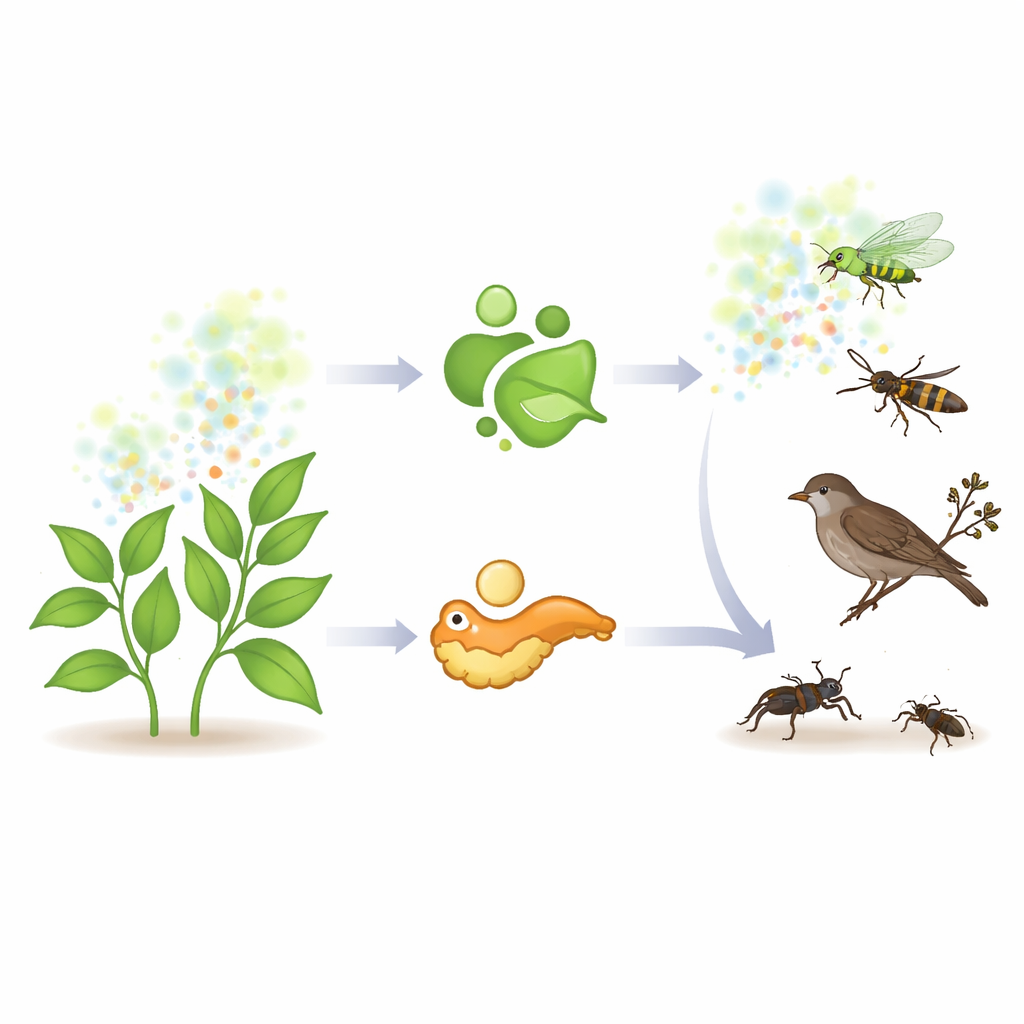
When a leaf is chewed, torn or stressed, the plant rapidly releases a cocktail of six-carbon molecules known as green leaf volatiles. These are the main carriers of the familiar grassy smell. They appear within seconds of damage and can directly repel hungry herbivores or hinder invading microbes. At the same time, they act as airborne alarm calls, priming nearby leaves and neighboring plants to brace for attack and summoning insects that prey on or parasitize the herbivores. A central component of this bouquet is a pair of closely related compounds that differ only in the position of a chemical bond; shifting from one form to the other can dramatically change how powerful the scent is as a weapon and a warning.
Enzymes that flip plant scents
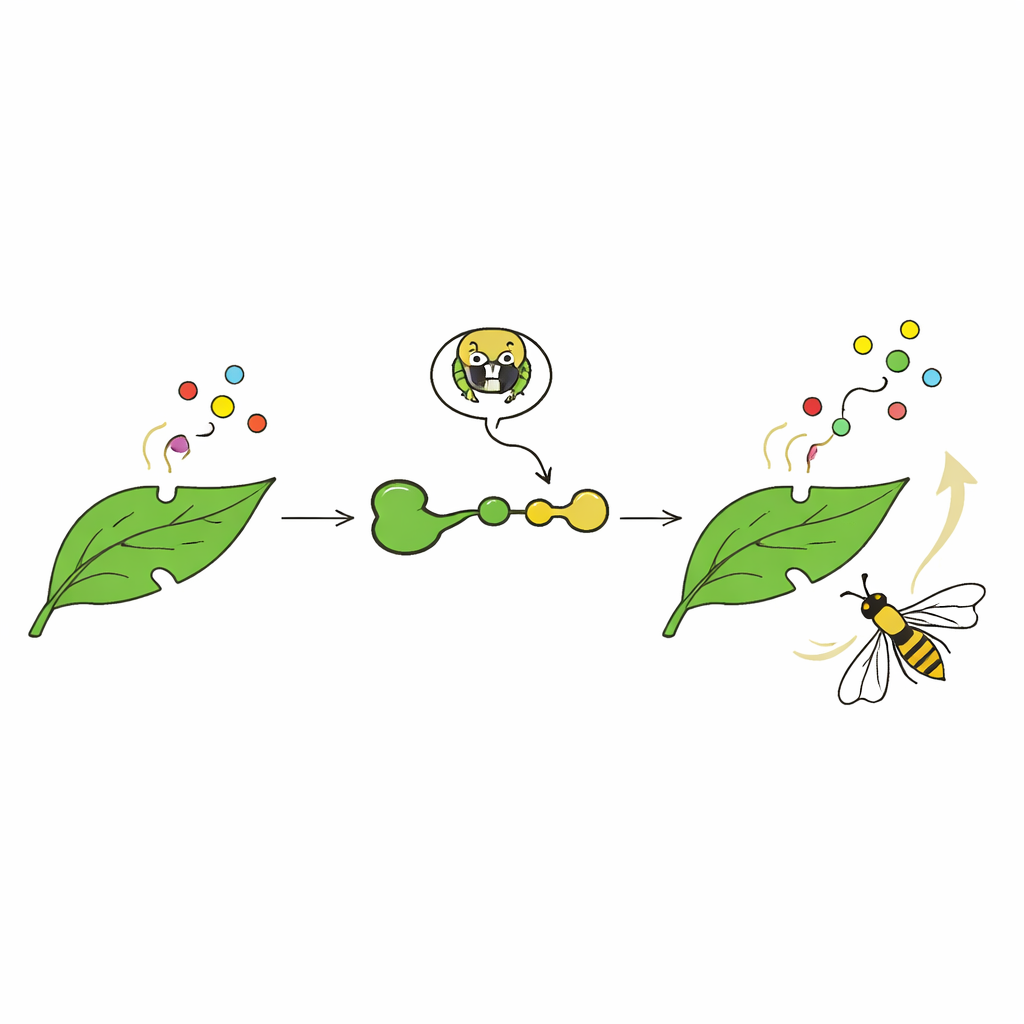
Inside plant tissues, special enzymes can convert the early-arriving odor molecule into a more reactive form that tends to be more toxic to pathogens and more potent in triggering plant defenses. This flipping step also steers which related alcohols and esters are later produced, subtly reshaping the overall blend of volatiles. Earlier work showed that plants use enzymes from a large family called cupins to perform this conversion. Intriguingly, caterpillars of the hawk moth Manduca sexta were found to carry a different kind of enzyme in their saliva that can perform the same chemical trick on the plant’s own scent molecules as they chew, shifting the balance of odors rising from the wounded leaf.
Caterpillar chemistry and its consequences
The authors scanned the genomes of 34 moth and butterfly species to trace the history of these caterpillar enzymes. They found that many species carry related genes within a subgroup of the glucose–methanol–choline oxidoreductase family, but only some versions actively reshape plant scents. By expressing these candidate enzymes in bacteria and testing them side-by-side, the team showed that Manduca sexta’s main enzyme is especially powerful at converting one odor form into the other, both in test tubes and when applied to wounded tomato leaves. Other species, including crop pests and the silk moth, possessed weaker or inactive versions, leading to much smaller shifts in the emitted scent. These differences likely translate into distinct “odor footprints” left on plants by different herbivores.
The molecular toolkit behind scent flipping
To uncover how the caterpillar enzyme works, the researchers modeled its three-dimensional structure and compared it with known enzymes from fungi. They discovered that it, too, relies on a helper molecule called FAD nestled deep within the protein. Although the overall reaction does not change the net oxidation state of the substrate, the FAD ring appears to stabilize fleeting, charged intermediates as the bond rearranges. By precisely mutating three key amino acids predicted to interact with FAD or position the substrate, the team could abolish or greatly slow the reaction. When these mutated proteins were placed on tomato wounds, the leaves largely reverted to releasing the original odor form, confirming that the intact FAD-binding pocket is crucial for the caterpillar’s ability to rewrite plant scent.
Parallel inventions in plants and insects
Beyond the chemistry, the work traces when these enzymes first appeared. By building evolutionary trees for thousands of plant and insect proteins, the authors show that plants and Lepidoptera (moths and butterflies) arrived at scent-flipping enzymes independently, using unrelated protein families. Plant enzymes with the necessary catalytic features are found only in a branch of flowering plants called mesangiosperms, while active caterpillar enzymes appear much later, restricted to more recently evolved moth and butterfly groups. Both origins roughly coincide with the great diversification of flowering plants in the Cretaceous period, suggesting that expanding plant chemistry created new opportunities—and pressures—for insects. In some plant families and their specialist herbivores, these enzymes are missing, hinting that other defensive chemicals, such as glucosinolates in mustards, can take over the role of key signals.
What this means for life above and below the leaves
Seen together, the findings reveal a striking case of convergent evolution: plants and caterpillars separately invented molecular tools that perform almost the same transformation on green leaf scents, yet do so with different protein architectures. These enzymes help tune who hears a plant’s distress calls, influencing herbivore behavior, predator attraction and even insect development. For a lay observer, it means that every whiff of crushed foliage carries traces of a long-running chemical negotiation between plants and their attackers—one in which both sides have learned to bend the same simple odor molecules to their own advantage.
Citation: Lin, YH., Wu, B.Ch., Sharaf, A. et al. Convergent evolution of hexenal isomerases in Lepidoptera and plants. Nat Ecol Evol 10, 807–819 (2026). https://doi.org/10.1038/s41559-026-02999-2
Keywords: green leaf volatiles, plant–insect interactions, convergent evolution, Lepidoptera, chemical ecology