Clear Sky Science · en
More eddying of subtropical western boundary currents boosts stratification and cools shelf seas
Why swirling seas matter to life on the coast
Along the coasts of many countries, narrow bands of fast-moving water race past the continental shelf like atmospheric jet streams in the sky. These powerful ocean currents shape regional climate, fisheries and even storms over land. This study focuses on one such current, the Agulhas Current off South Africa, and reveals that as climate change fuels more energetic ocean “swirls” known as eddies, shelf seas nearby are likely to become cooler at depth, more nutrient-rich in places, and more extreme overall—even while the surface continues to warm rapidly.
Strong ocean rivers and their restless edges
The Agulhas Current is a western boundary current, an ocean “river” that hugs the southeast coast of Africa and moves warm water poleward. Similar currents exist off Japan, Australia and the eastern United States. Traditionally, these jets have been seen as barriers that keep coastal shelf waters and the open ocean largely separate. Yet satellite images increasingly show their edges wrinkling and looping. The authors used two years of continuous measurements from a line of seven moorings anchored across the Agulhas Current to find out how this growing restlessness reshapes temperatures and salt levels in the water, and what that means for nearby marine ecosystems and climate.
Two moods of a powerful current
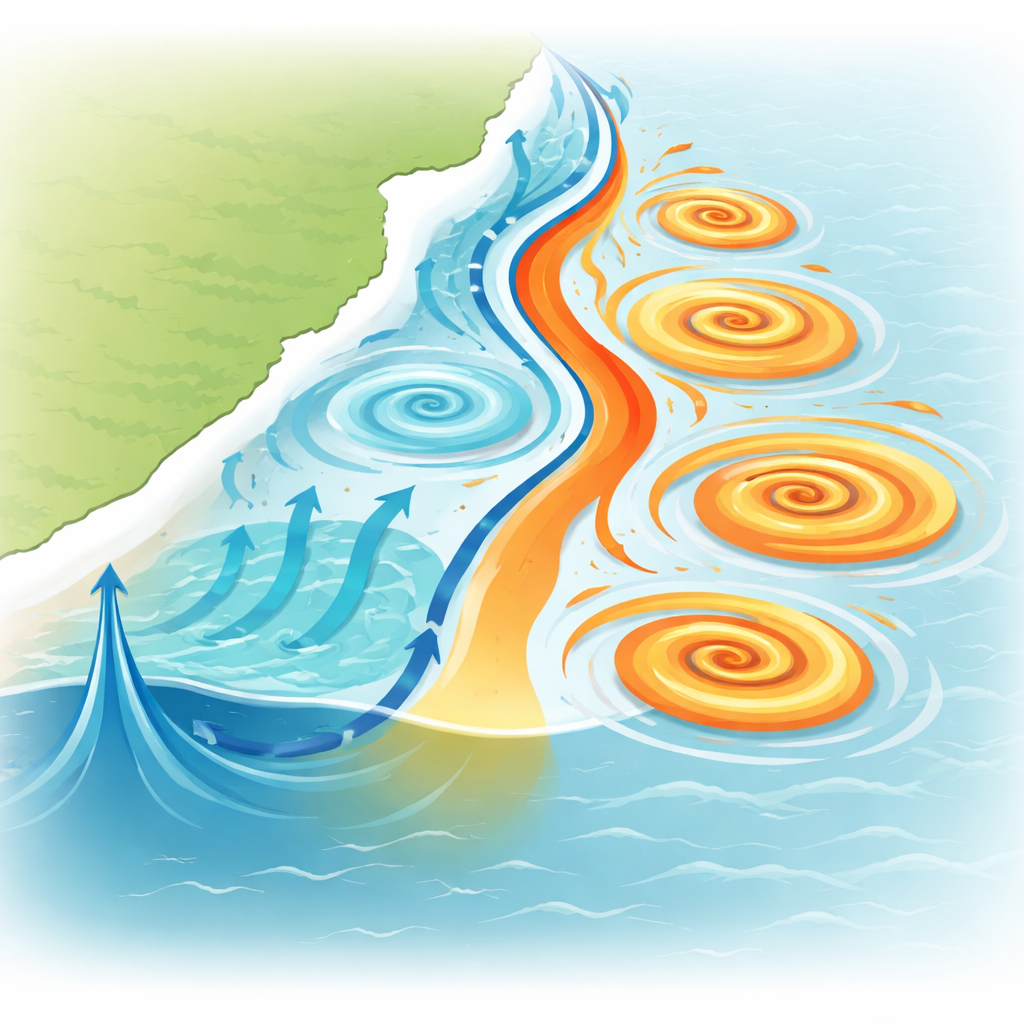
The data reveal that the Agulhas Current spends most of its time in a relatively steady, “linear” state, closely following the continental slope. About 90 percent of the time, the jet is narrow and fast, with its core just offshore of the shelf break. During this state, frequent small, roughly 10-kilometer-wide wiggles develop along the inshore edge where the current meets the sloping seabed. These frontal disturbances, like wrinkles on a speeding ribbon, tap energy from the current and spin up short-lived eddies that interact strongly with the bottom. Roughly 10 percent of the time, the current swings offshore into large loops, or meanders, that can span about 100 kilometers. In this meandering state, the jet is broader, slower and reaches deeper, and the whole structure of the flow temporarily reorganizes before snapping back toward the slope.
Hidden pumping of cold water toward the coast
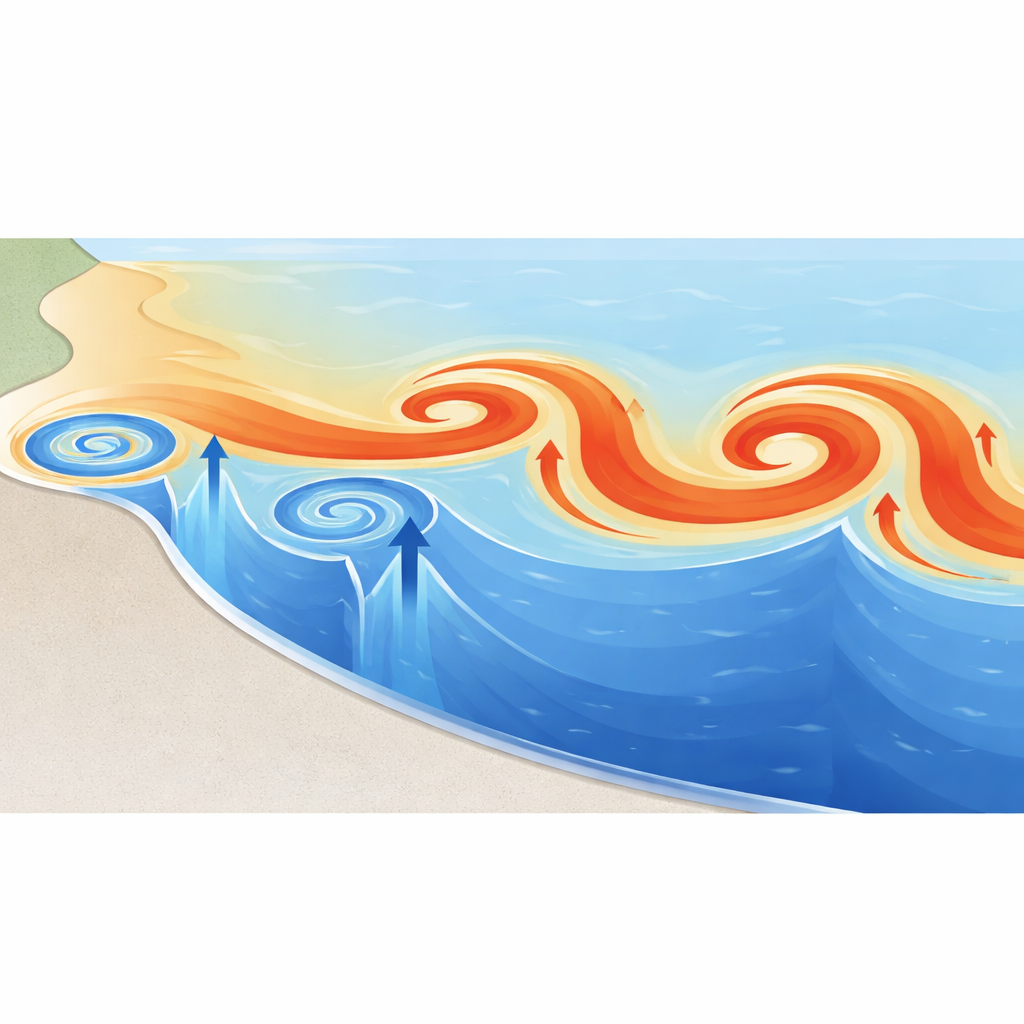
By tracking how temperature, saltiness and flow fluctuated together, the authors calculated how eddies move heat and salt sideways across the current. Individual events push warm water offshore at one moment and back toward the coast the next, almost canceling out. But when they added up two years of observations, a clear pattern emerged. On average, eddies move heat and salt toward the central core of the Agulhas Current. On the inshore side, this means cooler, fresher deep water is pumped upward and onto the South African shelf, while warmer, saltier water is drawn into the jet. Offshore, meanders stir heat and salt along sloping layers, broadening the current and making the upper ocean more strongly layered, with warm water on top and cooler water trapped below.
More swirling, more extremes
These findings explain an important climate puzzle. Satellites show that surface waters in the Agulhas system are warming three to four times faster than the global ocean, yet measurements suggest the current is not carrying more heat poleward overall. The study shows that stronger eddy activity can both intensify surface warming by sharpening the warm core of the current and, at the same time, enhance upwelling of cold water onto the shelf and cooling at depth. The result is a more strongly stratified ocean: hotter at the top, cooler below, with steeper vertical contrasts. Because similar jet–eddy interactions are expected in western boundary currents around the world, the authors argue that shelf seas from South Africa to Australia and the North Atlantic will likely face more frequent temperature swings and extremes as eddy activity increases.
What this means for coasts and climate
For coastal life and people, these subtle shifts in swirling water can have outsized consequences. Stronger upwelling inshore of major currents may supply more nutrients, boosting plankton and supporting fisheries and corals in some zones, while rapid surface warming and more frequent cold pulses could stress or kill sensitive species in others. The study suggests that rather than focusing only on how much water these great currents carry, scientists and climate models should pay closer attention to how eddies redistribute heat and salt within them. As the ocean becomes more agitated in a warming world, the fine-scale churning at the edges of boundary currents may be one of the clearest signals of changing coastal climates.
Citation: Gunn, K.L., Beal, L.M. More eddying of subtropical western boundary currents boosts stratification and cools shelf seas. Nat. Clim. Chang. 16, 575–582 (2026). https://doi.org/10.1038/s41558-026-02599-9
Keywords: Agulhas Current, ocean eddies, coastal upwelling, western boundary currents, climate change