Clear Sky Science · en
Longitudinal localization of leukaemic stem cells between the metaphysis and central marrow governs their behaviour
Why the bone’s layout matters in leukemia
Acute myeloid leukemia is driven by rare "founder" cells that can hide in bone marrow and survive treatment, seeding relapse years later. This study asks a simple but powerful question with big clinical implications: does the precise spot inside our bones where these stemlike leukemia cells take shelter influence how dangerous they are, and can shifting their position make them easier to eliminate?
Hidden corners inside our bones
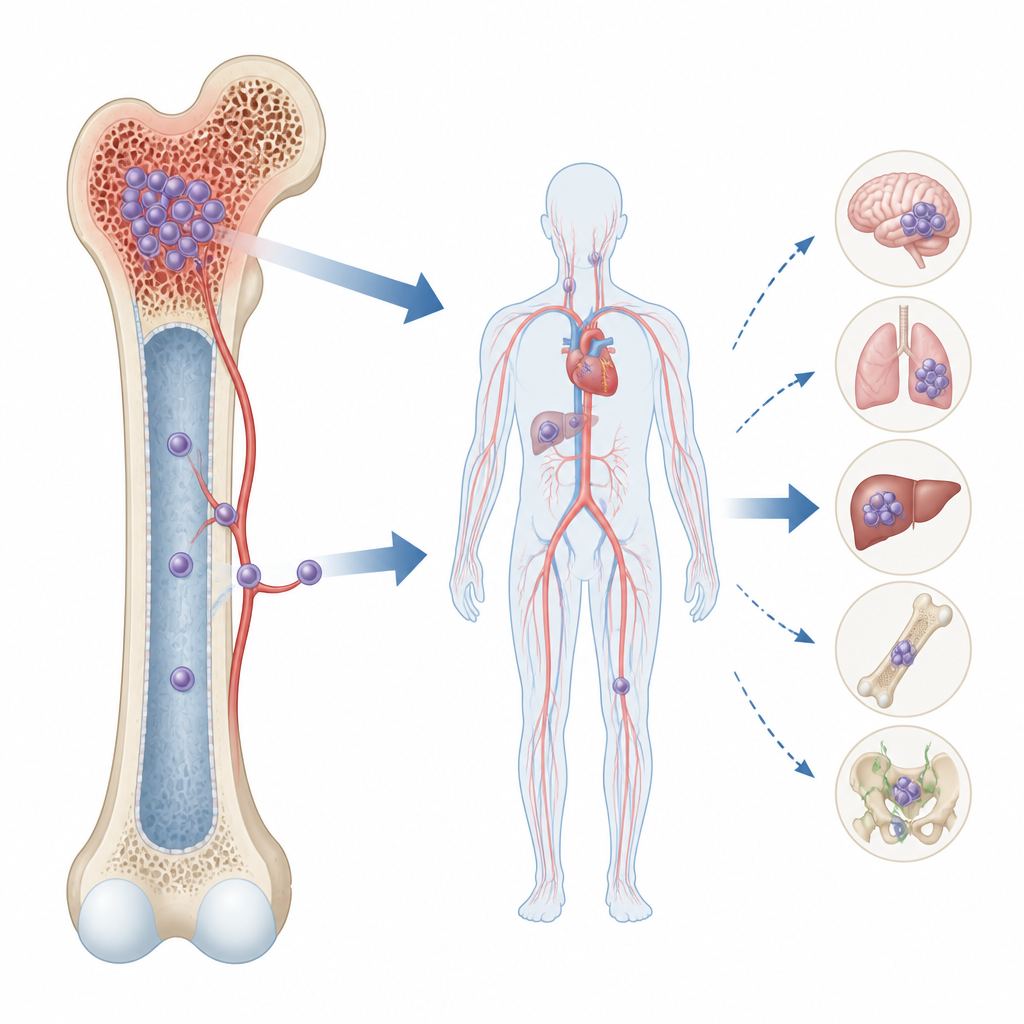
Long bones, such as the femur, are not uniform tubes of marrow. Near each end lies the metaphysis, a spongy, lattice-like region rich in specialized support cells, while the central shaft holds a smoother stretch of marrow. The researchers mapped where leukemia stem cells tend to live along this lengthwise axis. They found that these cells strongly favor the metaphysis, both near the joint end and slightly farther inward, and are far less common in the central region. When stemlike leukemia cells were isolated from each area and transplanted into new mice, metaphysis-derived cells produced more aggressive disease, confirming that these zones form especially protective niches.
A chemical gradient that cages leukemia
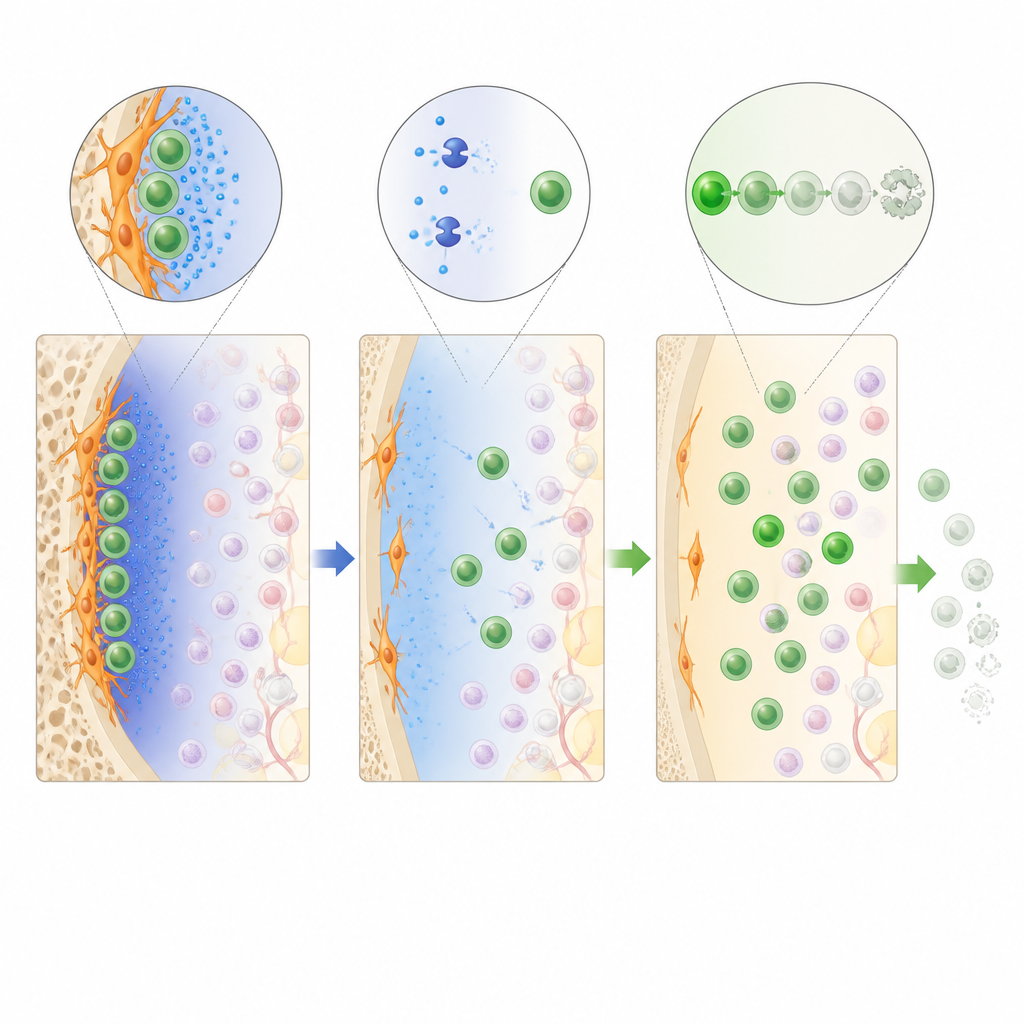
To understand what draws leukemia stem cells to these niches and helps them stay there, the team focused on CXCL12, a small signaling protein that acts like a homing scent, and DPP4, an enzyme on leukemia cells that clips and inactivates CXCL12. In normal leukemia-bearing mice, CXCL12 is arranged as a set of gradients at several scales: between bone marrow and blood, between metaphysis and central marrow, and even over just a few cell diameters around certain stromal cells. These gradients guide leukemia cells out of marrow into blood and toward favored shelters. When the scientists removed DPP4 from leukemia cells, they rewired the CXCL12 landscape: CXCL12 levels rose in places where they had been low, gradients flipped direction, and leukemia cells became trapped within bone marrow instead of spilling into the blood and organs.
Support cells that protect or expose cancer
The metaphysis niches are built around a particular type of bone marrow support cell that displays the adhesion molecule N-cadherin. Using single-cell RNA sequencing and imaging in reporter mice, the authors showed that these N-cadherin–positive stromal cells produce large amounts of CXCL12 and cluster closely with leukemia stem cells. They also make glypican-3, a surface molecule that binds to DPP4 on nearby leukemia cells and dampens its activity. This local brake preserves CXCL12 right around the niche, creating tiny chemical "hotspots" that attract and retain stemlike leukemia cells. When CXCL12 or glypican-3 was genetically deleted specifically in these N-cadherin–positive cells, the protective metaphysis niches collapsed: CXCL12 levels fell, leukemia cells moved away toward the central marrow, and they could no longer crowd so tightly around their stromal partners.
When relocation leads to exhaustion
What happens to leukemia stem cells once they are forced out of their favorite hideouts? Across multiple mouse models, stemlike cells displaced from the metaphysis into central marrow began to divide more actively but lost their long-term self-renewing capacity, a pattern the authors describe as exhaustion. They formed fewer colonies in culture, showed reduced expression of gene programs linked to stemness and survival, and activated metabolic pathways associated with stress. Many underwent programmed cell death. Importantly, both direct removal of DPP4 from leukemia cells and targeted disruption of CXCL12 in N-cadherin–positive stromal cells produced almost identical molecular signatures: key signaling routes such as JAK/STAT, MAP kinase, and NF-κB were dampened, pointing to a shared mechanism by which niche disruption undercuts leukemia stem cell fitness.
Therapeutic angles from gradients and niches
The work suggests that leukemia control depends not only on how many stemlike cells exist, but on where they sit and how chemokine gradients sculpt that geography. By tuning the CXCL12–DPP4–glypican-3 axis, it may be possible to both cage leukemia cells within bone marrow and strip them of the quiet niches that preserve their stemlike, relapse-promoting properties. Drugs that inhibit DPP4 are already in clinical use for diabetes, raising the possibility that, combined with agents that interfere with CXCL12 signaling or cell adhesion, they could help drive leukemia stem cells out of their safe metaphysis shelters, push them into a vulnerable, exhausted state, and make standard treatments more effective.
Citation: Wang, C., Pan, Y., Dong, R. et al. Longitudinal localization of leukaemic stem cells between the metaphysis and central marrow governs their behaviour. Nat Cell Biol 28, 890–902 (2026). https://doi.org/10.1038/s41556-026-01939-3
Keywords: acute myeloid leukemia, leukemia stem cells, bone marrow niche, chemokine gradient, DPP4 inhibition