Clear Sky Science · en
Vaccine-induced mouse antibodies targeting Plasmodium falciparum PfVFT antigen inhibit blood stages through multiple mechanisms
Why this matters for future malaria vaccines
Malaria still sickens hundreds of millions of people every year, and current vaccines only partly protect those at risk. This study looks for a new weak spot in the malaria parasite, focusing on an overlooked protein called PfVFT1. By showing how antibodies against this protein can attack the parasite in several ways, the work points to a fresh direction for stronger, longer lasting vaccines.
Hunting for hidden targets on the malaria parasite
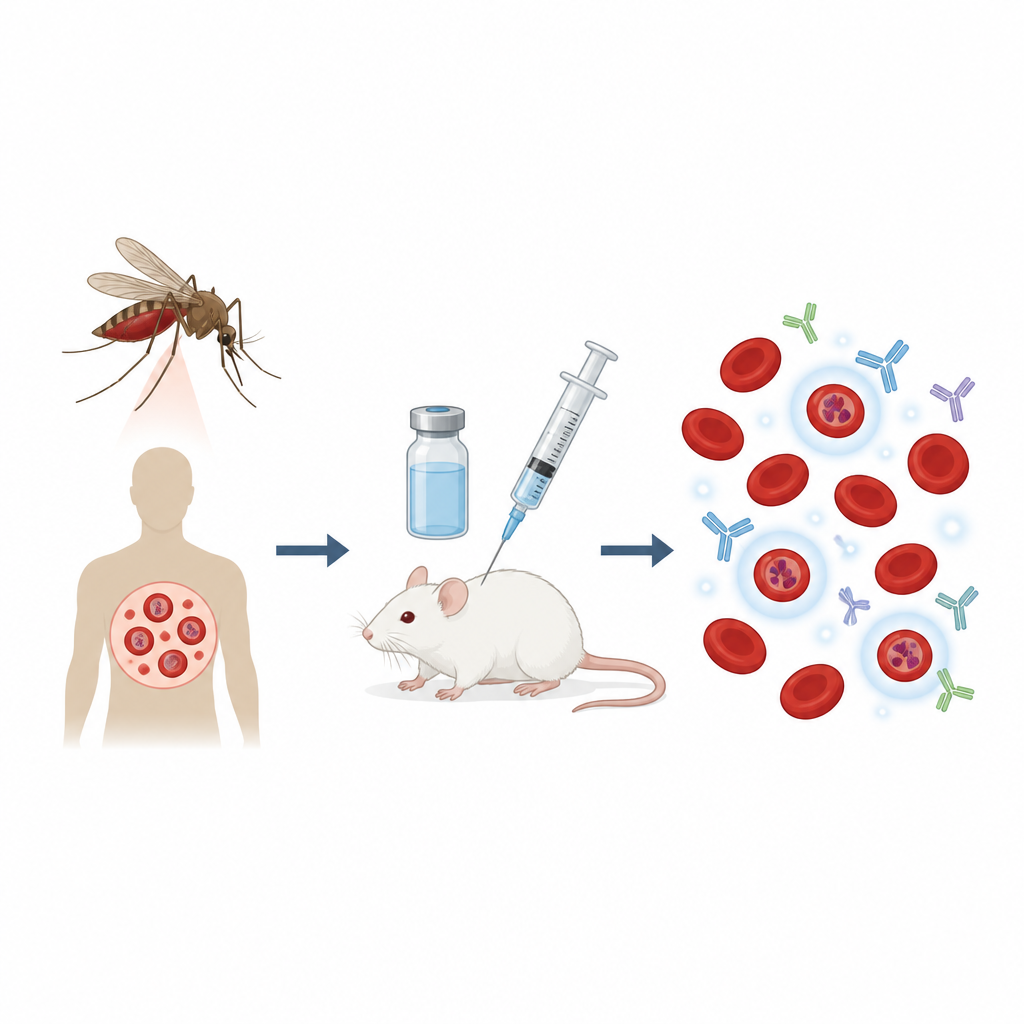
The researchers began with an unusual clue. In earlier trials, healthy volunteers were bitten by malaria infected mosquitoes while taking a drug that stopped severe illness. Some volunteers later resisted deliberate malaria infection, while others did not. The team compared blood samples from these two groups, testing how their antibodies reacted to a large panel of parasite proteins. Among ten poorly understood candidate proteins, one called PfVFT1 stood out. Every protected volunteer had antibodies against PfVFT1, especially of the IgM type, whereas this pattern was rare in people who were not protected. This repeated finding across two separate groups of volunteers suggested that PfVFT1 might be linked to natural protection.
Where PfVFT1 appears during infection
To understand what PfVFT1 does, the team mapped where it shows up in the parasite life cycle. Using fluorescent antibody staining, they could not detect the protein on the early mosquito transmitted form that first invades the liver. Instead, PfVFT1 appeared on all blood stages inside red blood cells, including the free swimming merozoites that burst out to infect new cells. Measurements of parasite RNA and protein levels showed that PfVFT1 was made most strongly in later blood stages, suggesting a role during growth and cell to cell spread in the bloodstream. Genetic surveys of lab strains and field samples from Thailand revealed very little variation in the PfVFT1 gene, a promising feature for a vaccine target that needs to work against many parasite strains.
How PfVFT1 antibodies slow parasite growth
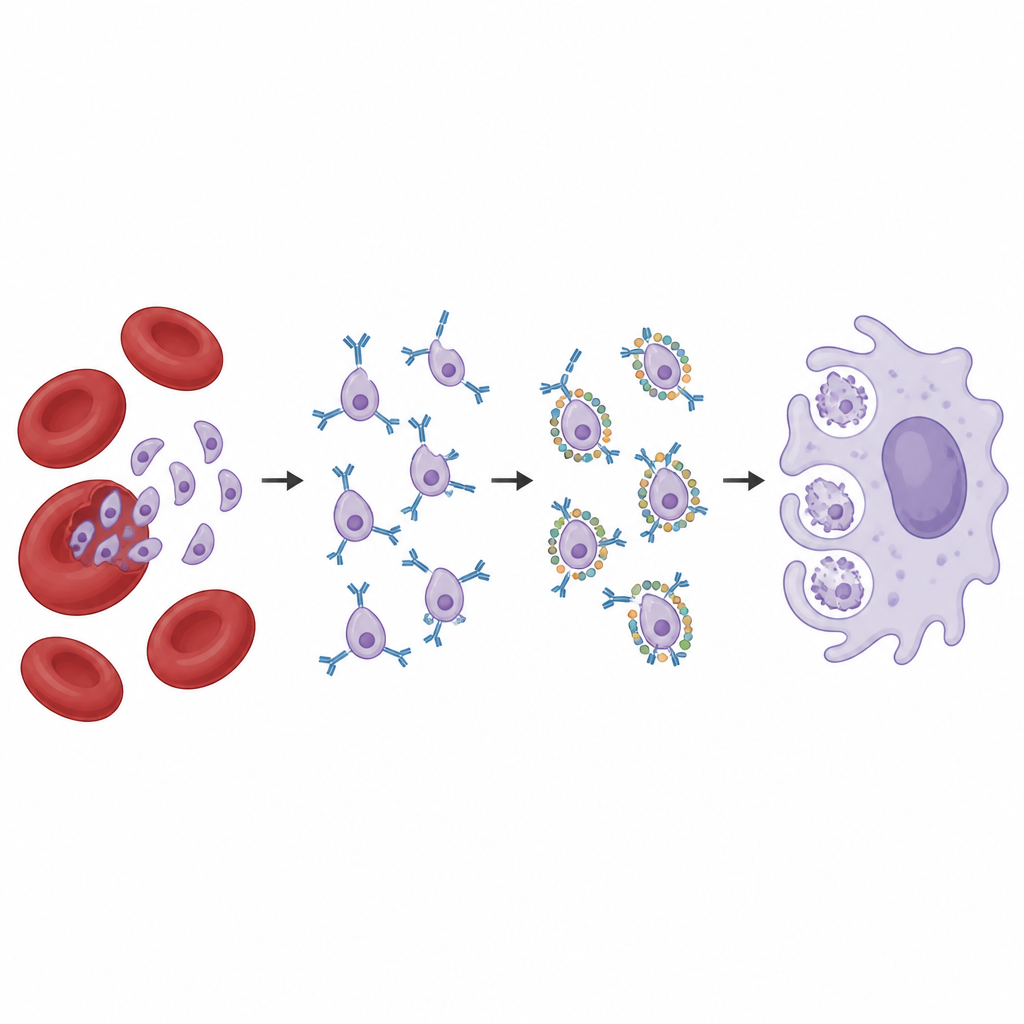
Because human samples were limited, the scientists immunized mice with purified PfVFT1 to generate high antibody levels and then tested how these antibodies behaved in the lab. When mixed with malaria parasites and red blood cells, mouse anti PfVFT1 serum reduced the ability of merozoites to invade new cells by about one third. Parasites genetically engineered to lack PfVFT1 could still survive, but they grew more slowly and took longer to complete their 48 hour blood cycle, hinting that PfVFT1 helps the parasite move from one growth stage to the next. This combination of partial invasion blocking by antibodies and a built in growth delay in parasites lacking PfVFT1 points to a useful vulnerability.
Calling in the body’s cleanup crews
The study also explored how PfVFT1 antibodies cooperate with other parts of the immune system. In cell culture, these antibodies coated infected red blood cells and free merozoites, making them easier for mouse macrophages to swallow and destroy. The antibodies also enabled a process called antibody dependent cellular inhibition, where macrophages exposed to coated parasites slow down parasite multiplication. In another set of tests, PfVFT1 antibodies triggered the complement system, a cascade of blood proteins that punch holes in microbes. When complement proteins were present, merozoites coated with PfVFT1 antibodies rapidly burst, with roughly a third destroyed within minutes.
What this could mean for malaria control
Taken together, the findings suggest that antibodies against PfVFT1 can attack malaria parasites through several overlapping tactics: partly blocking entry into red blood cells, tagging parasites for removal by immune cells, and activating complement to rupture them. None of these effects alone is perfect, but combined they may meaningfully reduce parasite numbers and ease disease. Because PfVFT1 is highly conserved and seems specific to the deadliest malaria species, it could be a valuable component in future multi part vaccines designed to hit the parasite at different stages. Further work in humans using clinically suitable vaccine formulations will be needed to confirm whether targeting PfVFT1 can improve real world protection.
Citation: Goh, Y.S., Mao, H., Hor, P.X. et al. Vaccine-induced mouse antibodies targeting Plasmodium falciparum PfVFT antigen inhibit blood stages through multiple mechanisms. npj Vaccines 11, 107 (2026). https://doi.org/10.1038/s41541-026-01433-9
Keywords: malaria, PfVFT1, blood-stage immunity, antibodies, vaccine candidate