Clear Sky Science · en
Impact of CRM197-based conjugate vaccines, schedules, and regions on pneumococcal immunogenicity in young children: systematic review
Why this matters for children everywhere
Pneumonia and other infections caused by the bacterium Streptococcus pneumoniae remain a major threat to young children around the world. Modern childhood shots called pneumococcal conjugate vaccines have saved many lives, but the germs are changing and new vaccine versions keep being introduced. Parents, doctors, and policymakers all face the same question: how well do these newer vaccines actually train a baby’s immune system, and how does timing of the doses or where a child lives affect protection? This study pulls together data from hundreds of trials to give the clearest picture yet.
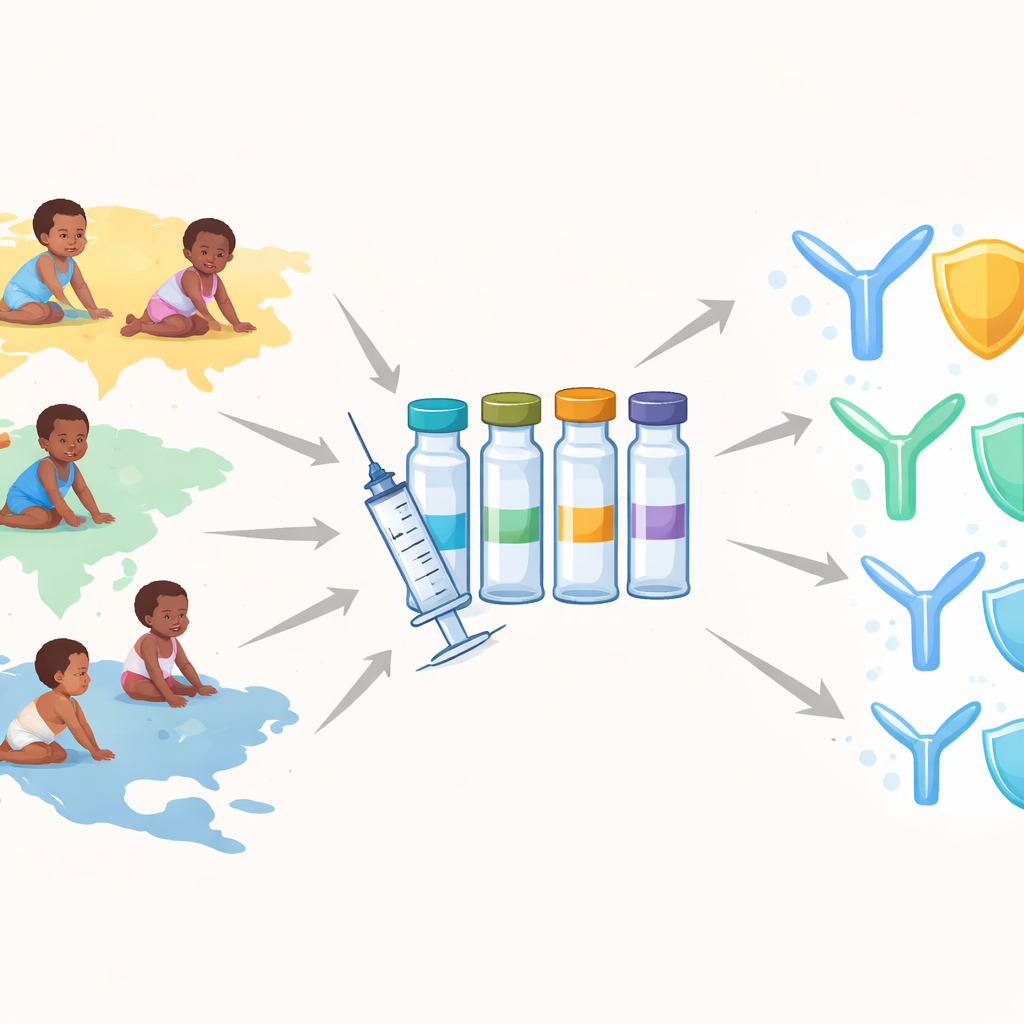
Looking across many studies at once
The researchers carried out a large systematic review and meta-analysis, meaning they searched multiple scientific databases for every study they could find on certain pneumococcal vaccines in children under two years of age, and then combined the results. They focused on vaccines that use the same carrier protein, called CRM197, to keep comparisons fair. These vaccines include older products such as the 7-valent and 13-valent shots and newer versions that cover 15 or 20 types of the bacterium, plus a 10-valent product designed mainly for low- and middle-income countries. In the end, they analysed 243 separate groups of vaccinated children from 138 study populations around the globe.
How well the shots raise protective antibodies
The team examined blood levels of a key antibody, IgG, after children completed their early-life shot series, and whether those levels passed a widely used benchmark for protection against severe invasive disease. Overall, for all the pneumococcal types included in the vaccines, average antibody levels were above this threshold and more than 95% of children reached it—except for one stubborn type known as serotype 3. Still, the strength of the response varied widely between individual serotypes and between vaccine products. Some types, such as 14 and 6B, routinely triggered strong responses, whereas serotype 3 remained weak even with the newest 20-valent vaccine.
Trade-offs with broader coverage and dose schedules
One striking pattern was that as vaccines were redesigned to cover more bacterial types, the average antibody levels for shared types tended to drift downward. After adjusting for differences in laboratory tests, responses with the 20-valent vaccine were generally lower than with the 13-valent shot for the same serotypes, suggesting a possible trade-off between breadth of coverage and strength of response. How shots were scheduled also mattered. Schedules that included a booster in the second year of life (such as 2+1 or 3+1 patterns) produced higher and more sustained antibody levels than “primary-only” schedules that stopped after three early doses. A single-dose start followed by one booster (a 1+1 pattern) could give strong antibody levels after the booster, but left many infants with low levels in the first year of life.

Differences by region, age, and spacing
Children’s responses were not the same everywhere. For the commonly used 3+1 schedule, antibody levels after the full series were generally highest in countries in the Western Pacific, intermediate in Africa and South-East Asia, and lowest in Europe and the Americas, even though the proportion of children reaching the basic protection threshold was similar. Starting vaccination a little later, at three months rather than one-and-a-half or two months, often led to higher antibody levels after both the primary series and the booster. Changing the gap between early doses from one month to two months helped some bacterial types but slightly hurt others, showing there is no single perfect spacing for every serotype at once.
What this means for protecting young children
Put simply, the study shows that today’s pneumococcal vaccines do a good job overall of getting most babies above a basic protection line, but the details matter. Some bacterial types, especially serotype 3, remain difficult to control with current vaccines. Adding more types into a single shot may slightly weaken responses, and the benefit of a booster dose is clear for keeping protection up beyond the first year of life. Because immune responses vary by region, age at first shot, and spacing between doses, countries may be able to fine-tune their schedules to local conditions rather than following a one-size-fits-all plan. The authors argue that future vaccine design should aim not only to cover more bacterial types, but also to strengthen responses to the hardest-to-control ones, ensuring that every extra drop of vaccine truly translates into better protection for the world’s youngest children.
Citation: Chen, X., Tavlian, S., Carville, K.S. et al. Impact of CRM197-based conjugate vaccines, schedules, and regions on pneumococcal immunogenicity in young children: systematic review. npj Vaccines 11, 87 (2026). https://doi.org/10.1038/s41541-026-01395-y
Keywords: pneumococcal vaccines, childhood immunization, vaccine schedules, serotype replacement, global health