Clear Sky Science · en
Multi-omics integration reveals ANXA6-high γδ T cell–endothelial communication as a potential link between periodontitis and MASLD
Why Your Gums Might Matter to Your Liver
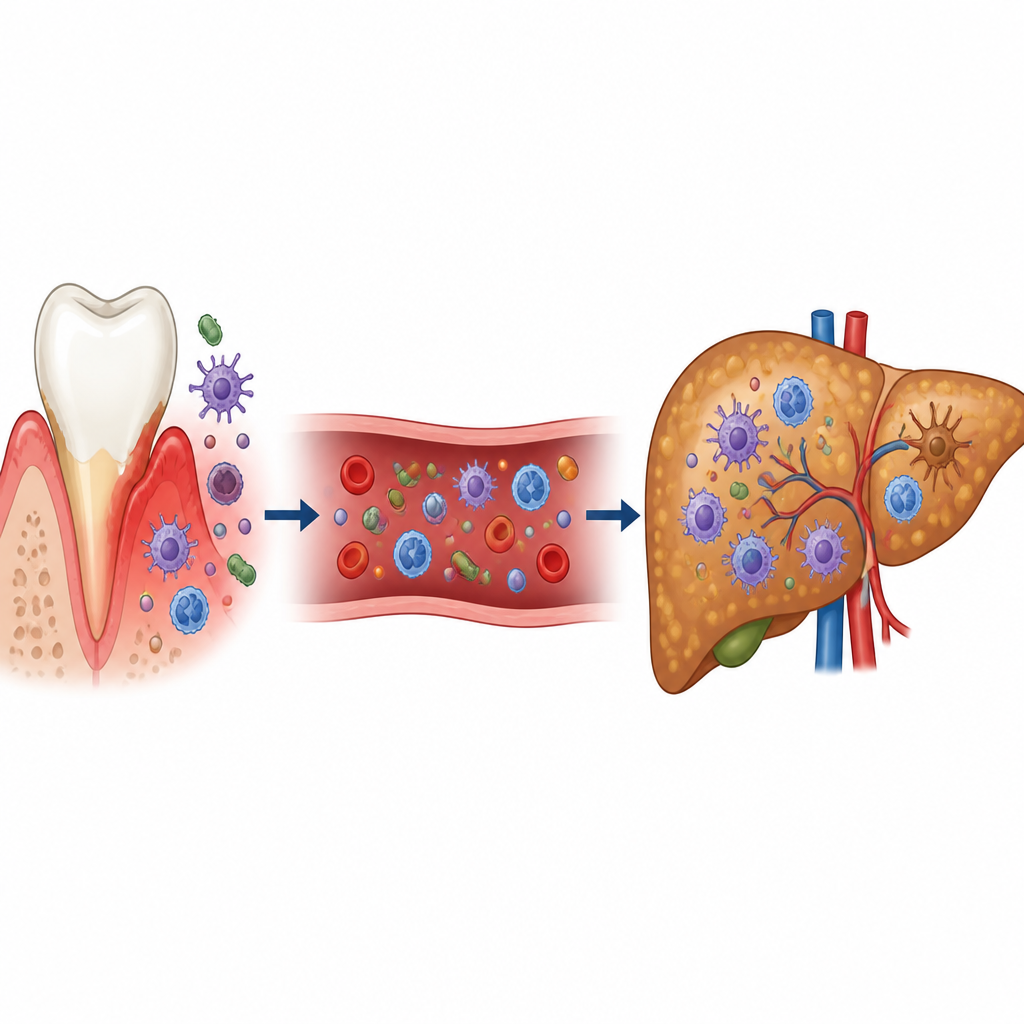
Most people think of bleeding gums and fatty liver as separate problems, one for the dentist and one for the liver specialist. This study suggests they may be closely connected. By mining large public datasets at the level of single cells and tissues, the researchers uncover a shared immune signal that links sore gums in periodontitis with fat buildup and inflammation in the liver, a condition now known as metabolic dysfunction-associated steatotic liver disease (MASLD). Understanding this hidden oral–liver connection could help doctors spot people at higher risk and point toward new treatment ideas.
Two Common Diseases That Travel Together
Periodontitis is a long-lasting infection of the tissues that support the teeth and often leads to tooth loss. MASLD is the most common chronic liver condition, tied to obesity, diabetes, and other features of modern lifestyles. Large population studies have shown that people with periodontitis are more likely to develop fatty and scarred livers, and that those with MASLD are more likely to have unhealthy gums. Germs escaping from the mouth, along with the body’s own inflammatory molecules, can enter the bloodstream and reach distant organs. Yet until now, the precise cell types and genes that might drive this two-way relationship remained unclear.
Reading the Body’s Molecular Maps
To tackle this puzzle, the team used a multi-omics approach, combining several layers of biological data. They analyzed bulk RNA profiles, which capture average gene activity in whole tissue samples, and then overlaid this with single-cell RNA data that can distinguish dozens of cell types in inflamed gums and diseased livers. Spatial transcriptomics added another layer, preserving where in the tissue each gene is switched on. Advanced statistics, network analysis, and machine learning were then used to sift through thousands of genes and highlight a small set that behaved similarly in both diseases. Eleven such “hub” genes emerged as potential bridges between immune activation and changes in metabolism.
A Special Immune Cell as a Common Link
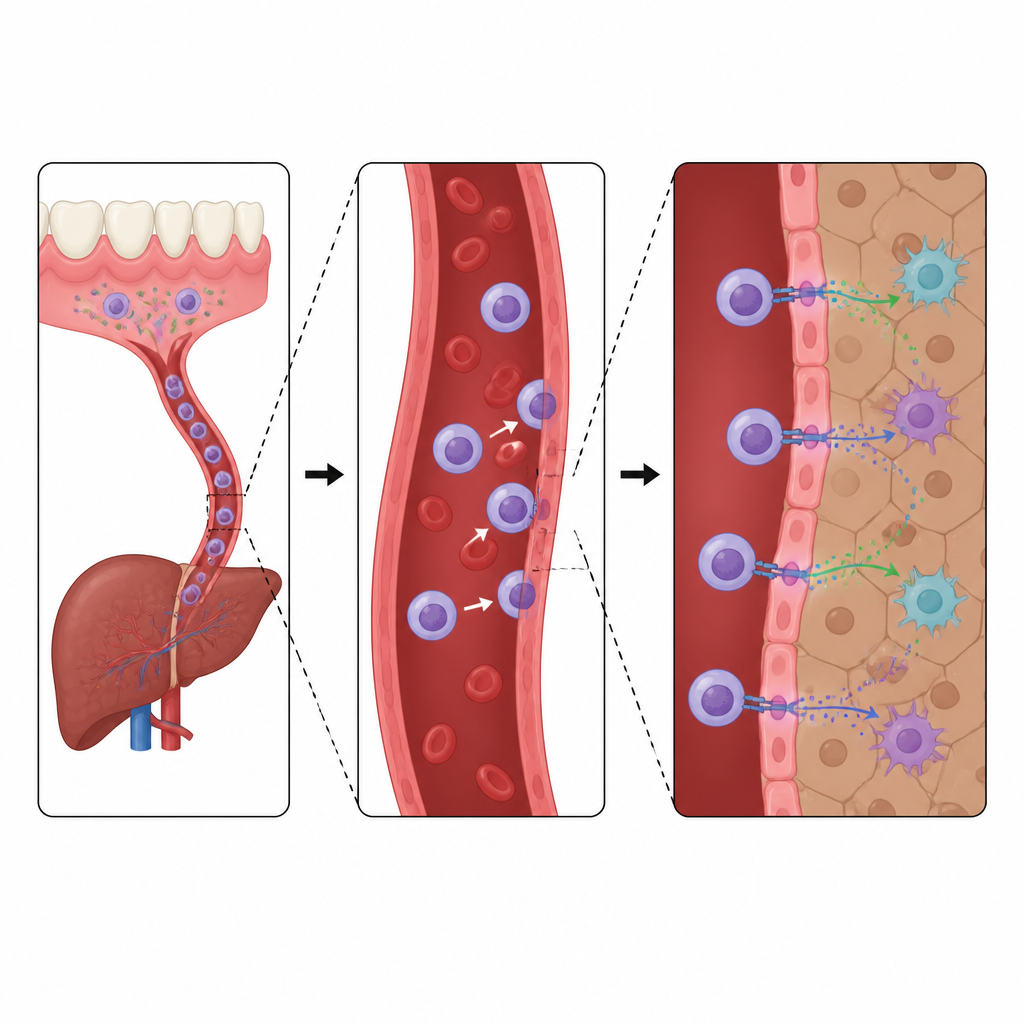
Among the shared genes, one called ANXA6 stood out. It was not just present but strongly active in a particular type of immune cell known as γδ T cells, found in both unhealthy gums and fatty livers. These cells are part of the body’s rapid-response defense system at surfaces such as the mouth and gut. The data showed that γδ T cells were more abundant in diseased tissues than in healthy ones, and that those with especially high levels of ANXA6 formed a distinct subgroup. Spatial mapping confirmed that this ANXA6-high γδ T cell state appeared in specific tissue niches, rather than being evenly spread, hinting at focused roles in local inflammation.
Talking to Blood Vessels Across the Oral–Liver Axis
The researchers then asked how these ANXA6-high γδ T cells might shape disease. By using computational tools that infer cell-to-cell “conversations” from gene activity, they found that this cell subset showed stronger predicted interactions with endothelial cells, the cells that line blood vessels, in both gums and liver. Signals related to immune attraction and cell adhesion appeared particularly active in these contacts. This pattern suggests that ANXA6-high γδ T cells may help guide inflammatory traffic along blood vessels, contributing to the spread or persistence of disease in both mouth and liver. Upstream analysis pointed to sets of transcription factors that could drive this high-ANXA6 state, and drug-response databases highlighted several existing compounds whose gene effects might counteract the ANXA6-linked program.
What This Could Mean for Patients
For non-specialists, the main message is that chronic gum disease and fatty liver share more than just risk factors; they may share a concrete immune pathway centered on ANXA6-high γδ T cells and their dialogue with blood vessel cells. The study does not prove cause and effect, and all findings rely on careful but indirect analysis of previously collected data. Still, by narrowing the field to a specific cell type, a key gene, and a pattern of communication with blood vessels, the work provides a testable roadmap for future experiments and hints that caring for oral health could one day play a recognized role in managing systemic metabolic disease.
Citation: Zhang, Z., Ma, Z., Zhang, R. et al. Multi-omics integration reveals ANXA6-high γδ T cell–endothelial communication as a potential link between periodontitis and MASLD. npj Syst Biol Appl 12, 70 (2026). https://doi.org/10.1038/s41540-026-00690-7
Keywords: periodontitis, MASLD, oral liver axis, immune cells, multi omics