Clear Sky Science · en
Generative design of synthetic gene circuits for functional and evolutionary properties
Teaching Cells to Keep Their Cool
Living cells face constant change: food appears and disappears, temperatures swing, and toxins come and go. Yet many cells can sense these shocks and calmly return to normal, a trick called adaptation. Engineers would love to build synthetic genetic "circuits" that behave this reliably, for use in medicine, industry, and environmental cleanup. This paper explores how a type of artificial intelligence can automatically design such circuits, not only to work well today but also to stay useful as they mutate and evolve over time.
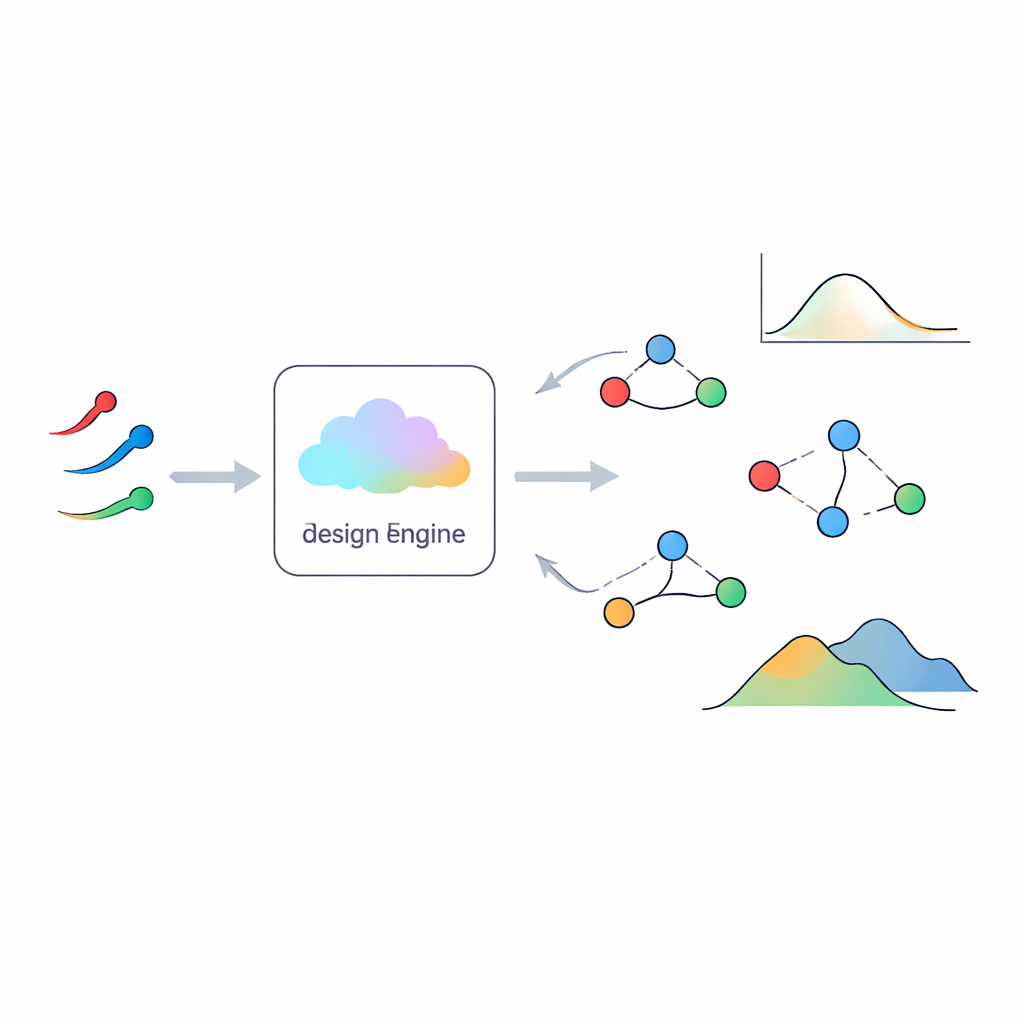
Why Smart Genetic Circuits Are Hard to Build
In synthetic biology, researchers wire genes together so that a cell can, for example, glow when it detects a toxin or turn off growth when nutrients run low. But these circuits often fail. They may respond too weakly, never settle back to a stable state, or stop working after a few genetic mutations. Even though scientists have mathematical models and large libraries of DNA parts, the number of possible circuit designs is astronomically large, and tiny changes can have big, unpredictable effects. As a result, finding circuits that both adapt reliably to signals and remain functional as they evolve is a major bottleneck.
Building a Virtual Playground of RNA Circuits
To tackle this, the authors created a purely digital testing ground. Instead of experimenting with real cells, they simulated millions of tiny genetic circuits built from three interacting RNA molecules. Specialized physics-based software predicted how strongly each pair of RNAs would bind, and these binding strengths were converted into reaction rates governing how RNA concentrations changed over time. For each circuit, the team simulated what happened when an input signal suddenly jumped. They measured how strongly the output responded (sensitivity) and how completely it returned to its starting level (precision), combining these into a single score that captures how well the circuit adapts.
Training a Generative Model to Invent New Circuits
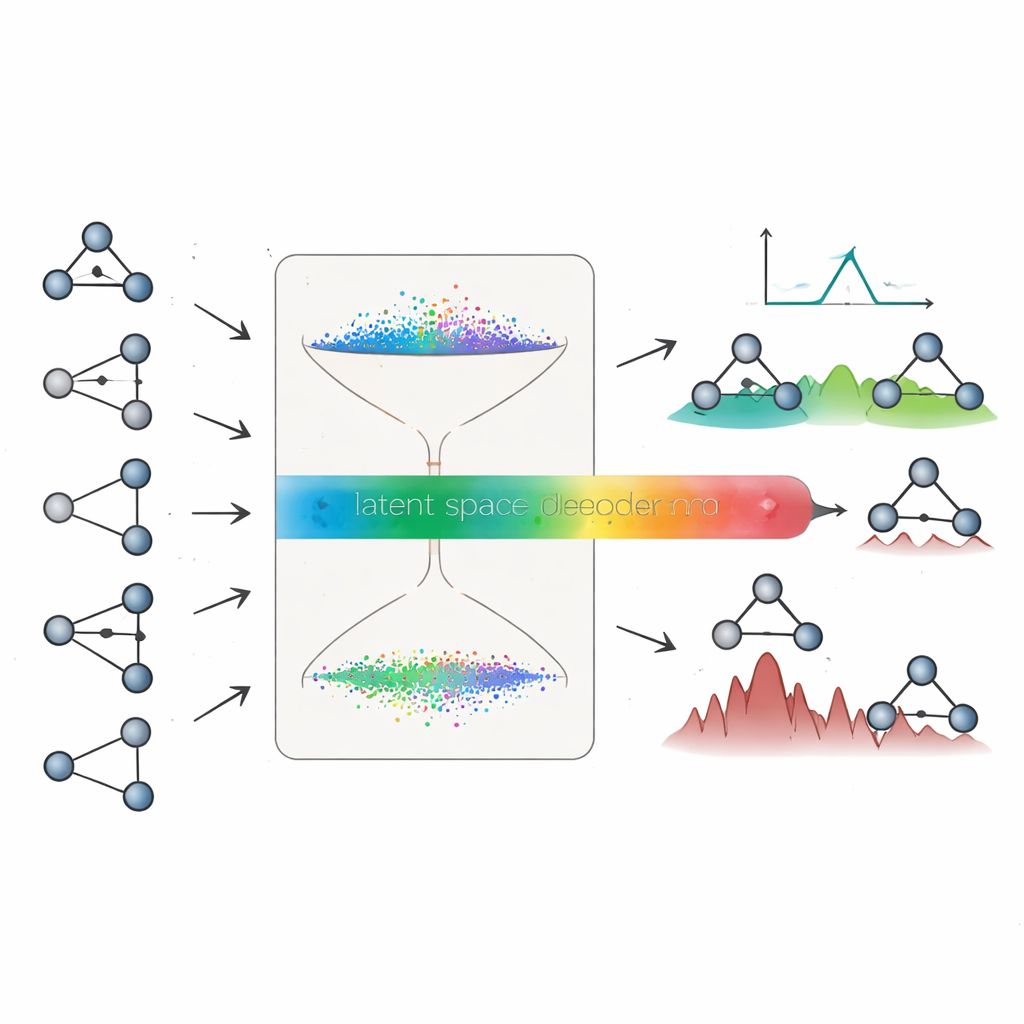
With this large simulated dataset in hand, the authors trained a type of generative AI called a conditional variational autoencoder. This model learns to compress each circuit into a low-dimensional "latent" representation and then reconstruct it, while being told how good the circuit’s adaptation score is. Once trained, the decoder part of the model can be fed a desired adaptation level and random noise, and it will produce many new candidate circuits predicted to meet that target. The researchers found that even this relatively simple model recreated circuit properties with high accuracy and, when prompted, generated diverse designs whose simulated behavior clustered around the requested level of adaptation—even for goals slightly beyond what it had seen during training.
Discovering Design Patterns and Evolutionary Tradeoffs
By visualizing the model’s internal latent space, the team saw that circuits naturally grouped according to how well they adapted, and that these groups matched network motifs previously known to support robust adaptation. In other words, without being explicitly told any design rules, the AI rediscovered key wiring patterns, such as specific self-interactions and connections between input and output nodes. The authors then added a second goal: evolutionary "ruggedness," a measure of how much a circuit’s behavior changes when its interaction strengths are slightly perturbed, mimicking mutation. Some adaptive circuits lived in smooth regions of this landscape, where many small changes had little effect, while others were perched on rugged terrain, where tiny tweaks could dramatically alter function. Remarkably, the model learned to respond to joint prompts for both adaptation and ruggedness, producing circuits that were either highly evolvable or highly stable, while still maintaining good performance.
Choosing Simple Goals to Guide Complex Designs
The study also shows that how you describe your design goal to the AI matters. When the researchers tried feeding sensitivity and precision separately, or adding extra metrics like overshoot, the model had more trouble following prompts. Encoding adaptation as a single, carefully crafted score—or even as a simple yes/no label—often worked better. This suggests that, for now, it is more effective to give generative models streamlined targets that capture the essence of the desired behavior rather than many raw measurements.
What This Means for Future Bioengineering
Overall, the work demonstrates that generative AI can propose new genetic circuits that not only carry out a complex dynamic function—returning to normal after a disturbance—but can also be steered toward being either robust to mutations or easily evolvable. Because these results were achieved with simulated RNA circuits and relatively small training sets, similar strategies could feasibly be applied to real laboratory data. As such tools mature, engineers may increasingly rely on them as "design partners" to suggest promising circuit architectures that balance performance today with evolutionary behavior tomorrow, making future biotechnologies more reliable and adaptable in the real world.
Citation: Gallup, O., Steel, H. Generative design of synthetic gene circuits for functional and evolutionary properties. npj Syst Biol Appl 12, 62 (2026). https://doi.org/10.1038/s41540-026-00683-6
Keywords: synthetic gene circuits, generative machine learning, biological adaptation, evolutionary stability, RNA network design