Clear Sky Science · en
Neuro-Dynamic Quantitative Systems Pharmacology (QSP) model describing Alzheimer’s disease pathophysiology and treatment effects
Why This Matters for Families and Patients
Alzheimer’s disease slowly robs people of memory and independence, yet doctors still struggle to predict who will decline, how fast, and which treatments will truly help. This paper introduces a new computer-based "disease simulator" that ties together brain changes seen on scans, blood tests, and thinking tests over many years. It offers a way to understand how the disease unfolds inside the brain and how drugs such as lecanemab might slow or reshape that journey.
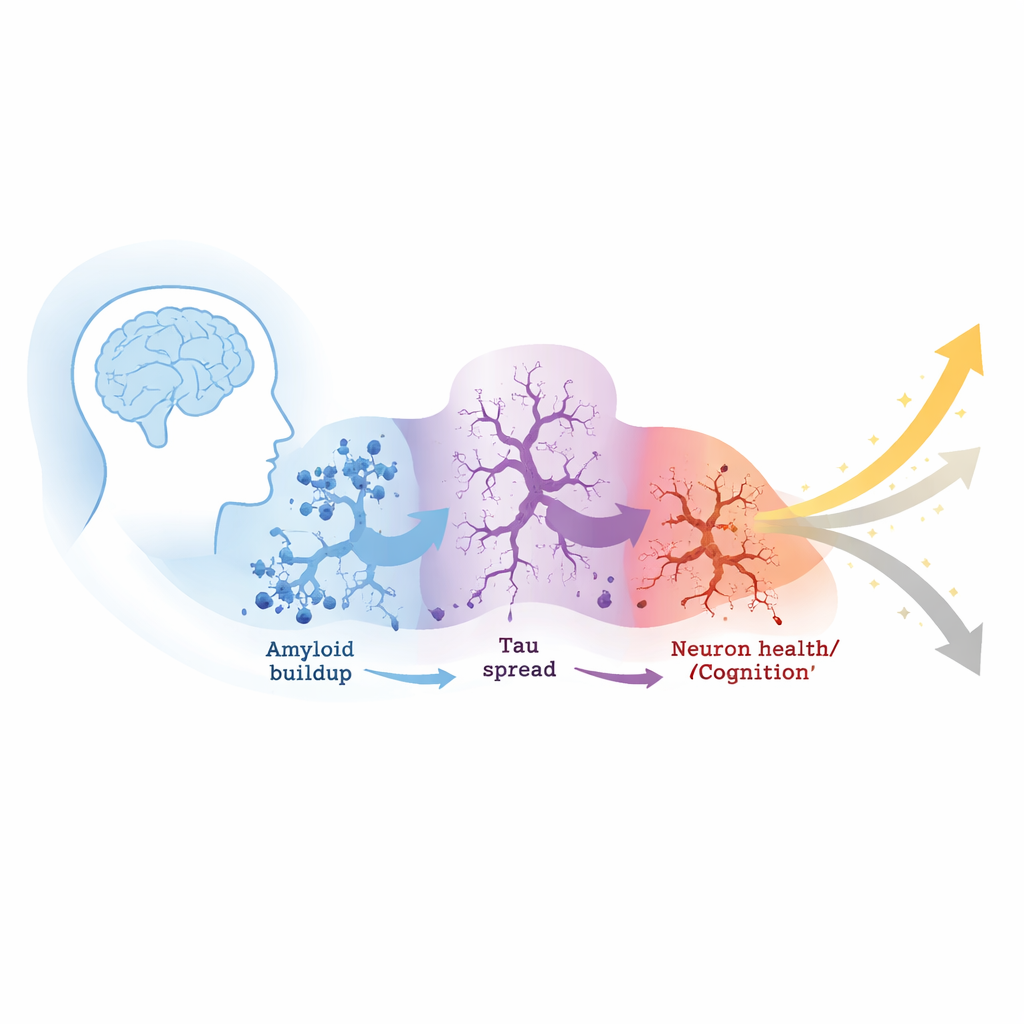
Following the Dominoes in the Diseased Brain
Scientists know that Alzheimer’s involves two major types of abnormal proteins: amyloid, which forms sticky deposits between nerve cells, and tau, which clumps up inside them. Over time, these changes lead to the death of neurons and worsening thinking problems. The new Neuro-Dynamic Quantitative Systems Pharmacology (QSP) model turns this chain of events into a set of linked mathematical rules. It tracks four forms of amyloid, several stages of tau damage inside neurons, and the gradual loss of cognitive ability. With only 11 core equations, the model is designed to stay simple enough to work reliably, yet rich enough to mimic the complex real-world course of the disease.
Building a Virtual Population of Patients
To make the model realistic, the authors drew on data from 4,056 people in lecanemab clinical trials and from the large Alzheimer’s Disease Neuroimaging Initiative. These volunteers were followed for up to 15 years with brain scans, spinal fluid and blood tests, and standard memory and thinking scores. The team adjusted the timing of each person’s data to line up with an estimated “disease clock,” starting before symptoms appear. They then tuned the model so that its simulated patients reproduced six key measurements: amyloid scans, a blood amyloid ratio, tau scans, blood p-tau levels, and two common cognitive scales (CDR-SB and ADAS-Cog). The resulting virtual population showed the now classic pattern: amyloid changes first, tau follows, and cognitive decline lags behind but ultimately causes the greatest disability.
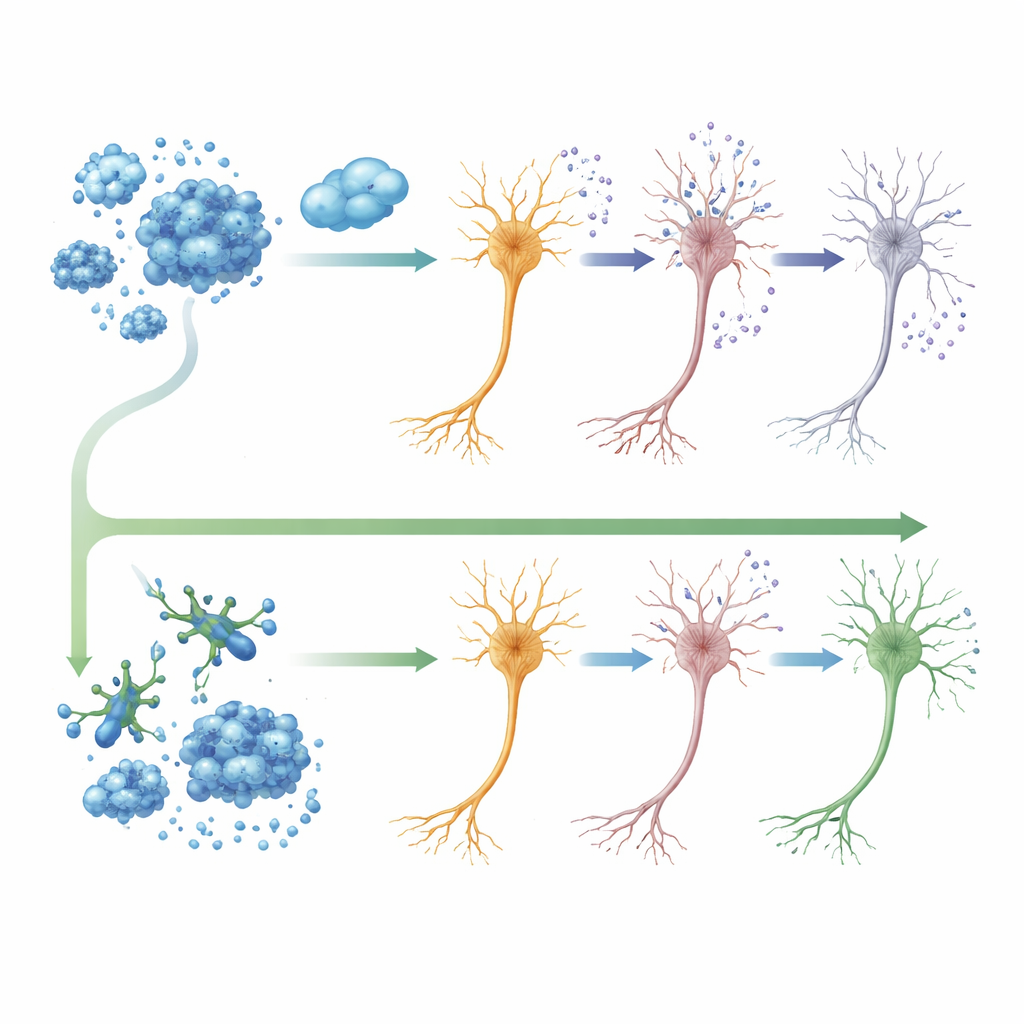
What the Model Reveals About Lecanemab and Other Drugs
Because the model links protein buildup directly to neuron damage and symptoms, it can be used to test "what-if" scenarios that would be impossible or unethical to run in real life. When the researchers gave their virtual patients lecanemab—the antibody that removes amyloid—the simulated outcomes closely matched results from large phase 2 and 3 trials. The model captured how amyloid on brain scans falls, how tau signals slow, and how thinking and daily function decline more slowly than in untreated patients. It also reproduced the effects of other amyloid-targeting antibodies, each with different strengths in clearing various amyloid forms, and correctly predicted the size of their benefits on both scans and cognition.
Protofibrils: Small Clumps With Big Impact
A striking insight from the simulations is that not all amyloid is equally harmful. The model suggests that intermediate-sized clumps called protofibrils are much more potent at driving tau damage than the large, more visible amyloid plaques seen on scans. In numerical terms, plaques may cause only about 40 percent of the toxicity of the same amount of protofibrils. The model also indicates that after stopping lecanemab, protofibrils rebound nearly twice as fast as plaques. This helps explain why clearing protofibrils in particular, and keeping them low over time, could be critical for sustaining long-term cognitive benefit.
Looking Ahead to Personalized Predictions
Beyond explaining existing trials, the Neuro-Dynamic QSP model points toward more individualized care. In principle, a person’s own scan and blood marker results could be matched to one of the model’s virtual patients to estimate where they are on the disease timeline and how they might fare with or without a given therapy. The authors stress that the model is not perfect: it does not yet include the brain’s immune system, has limited information on tau in regions outside the medial temporal lobe, and has mainly been tested in people with early, amyloid-positive Alzheimer’s. Still, by uniting amyloid, tau, and cognition in a single coherent framework, this work offers a powerful new tool for designing trials and for understanding why continuing effective treatment—especially those that tackle protofibrils—may yield lasting benefits for patients and their families.
Citation: Cao, Y., Willis, B.A., Horie, K. et al. Neuro-Dynamic Quantitative Systems Pharmacology (QSP) model describing Alzheimer’s disease pathophysiology and treatment effects. npj Syst Biol Appl 12, 55 (2026). https://doi.org/10.1038/s41540-026-00677-4
Keywords: Alzheimer’s disease modeling, amyloid and tau, lecanemab, disease progression simulation, quantitative systems pharmacology