Clear Sky Science · en
Motor sequences resist automatization as attentional demands increase with sequence learning
Why everyday skills still need your attention
From driving a car to playing a favorite song on the piano, we often feel that practice turns effortful actions into smooth routines that “run on autopilot.” This study asks how far that autopilot really goes. When we learn a fixed pattern of movements, do those actions eventually free our attention so we can easily handle another task at the same time, or do well‑learned sequences still place hidden demands on the mind?
How researchers tested practiced versus new patterns
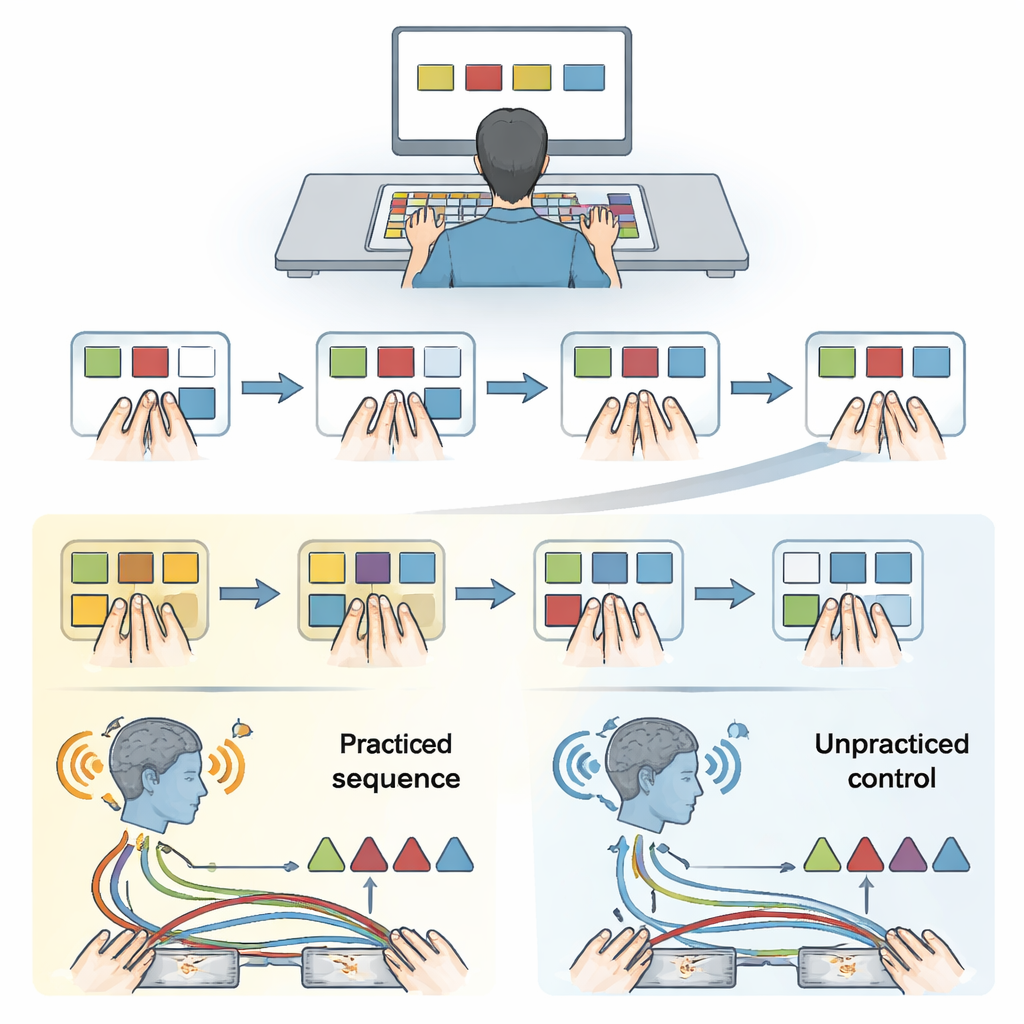
The scientists used a classic computer task in which people press keys that match the position of a light on the screen. Unbeknownst to participants, the lights often followed a repeating 12‑step pattern, creating a “practiced sequence.” A second, equally complex pattern served as a control sequence that participants hardly practiced. Over ten daily sessions, 87 adults repeated the practiced sequence thousands of times. Half were told that a pattern existed and even shown it beforehand (intentional learning), while the others simply reacted to the lights without being told about any structure (incidental learning). Some participants also saw subtle visual cues that hinted at the upcoming light. Before and after training, everyone performed both the practiced and control sequences under two conditions: alone, and while also counting specific tones played in the background.
Getting faster is not the same as going on autopilot
As expected, people became much faster overall from the first to the last test, and they responded more quickly on the practiced sequence than on the control sequence. Those who knew there was a pattern and had studied it in advance showed the strongest sequence learning and could later recall and recognize the pattern more accurately. In other words, clear instruction and awareness helped them build a detailed mental representation of the key‑press order. Yet the crucial question was whether this well‑learned sequence would demand less attention when another task—tone counting—was added.
When a second task reveals hidden effort
To measure this, the researchers compared reaction times when people performed only the key‑press task with times when they also had to keep a running count of tones. At the beginning, doing two things at once slowed everyone down, for both the practiced and control sequences, showing typical “dual‑task costs.” After ten days of training, however, a surprising pattern emerged. For the little‑practiced control sequence, dual‑task costs became very small: people could respond almost as fast while counting tones as when doing the key task alone. This suggests that basic stimulus‑to‑response connections had become more efficient and placed fewer demands on attention. In stark contrast, dual‑task costs actually grew larger for the practiced sequence. The better people had learned the pattern and the more clearly they could describe or recognize it, the more their performance suffered when the tone‑counting task was added. Stronger learning and greater explicit knowledge were tied to greater interference, not less.
Why deeply learned patterns can still tax the mind
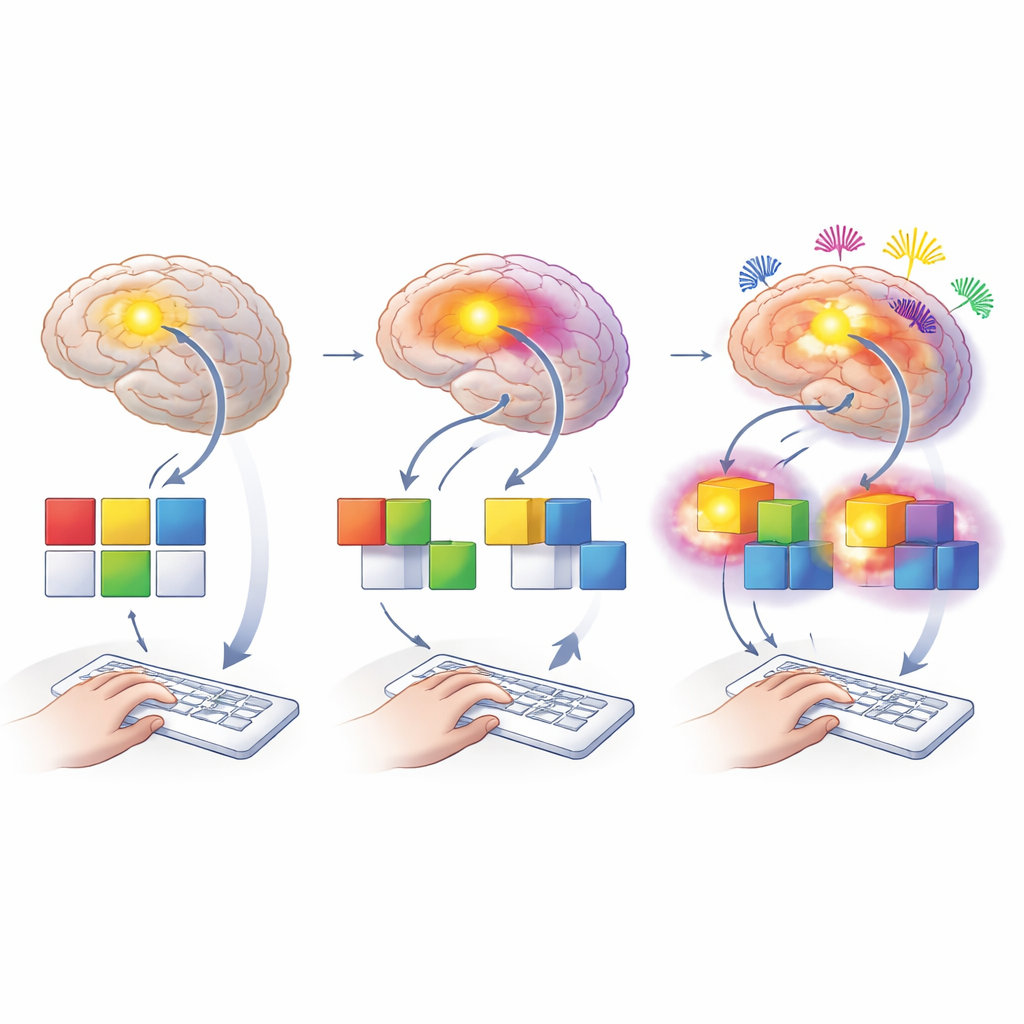
These findings challenge the simple idea that practice automatically makes a movement sequence mentally cheap. The authors suggest that as people learn a long, complex pattern, they form rich internal representations that allow them to anticipate upcoming steps rather than merely react. Controlling this predictive, pattern‑based behavior seems to draw heavily on the same limited attention and working‑memory resources needed for the tone‑counting task. In contrast, the rarely practiced control sequence may rely on more direct stimulus‑to‑response links that demand less central coordination when another task is present. Thus, in this study, what became more “automatic” with practice were the basic building blocks of responding—not the specific learned sequence itself.
What this means for real-world skills
For everyday skills like driving, playing music, or operating machinery, the message is nuanced. Practice certainly makes actions smoother and faster, but deeply encoded sequences—especially long or complex ones—may continue to draw on attention when we try to combine them with other mental tasks. Being highly skilled does not guarantee immunity to distraction; in some cases, a rich internal map of what comes next might actually heighten the need for focused control. Understanding this balance between fluency and attention can inform training in sports, music, and rehabilitation, and reminds us that even well‑practiced routines may not be as automatic as they feel.
Citation: Dahm, S.F., Kraft, V., Martini, M. et al. Motor sequences resist automatization as attentional demands increase with sequence learning. npj Sci. Learn. 11, 26 (2026). https://doi.org/10.1038/s41539-026-00412-y
Keywords: motor sequence learning, automaticity, dual-task performance, attention, serial reaction time task