Clear Sky Science · en
Dynamic behavioral and neural correlates of letter-speech sound learning in typical and dyslexic readers
Why learning letter sounds matters
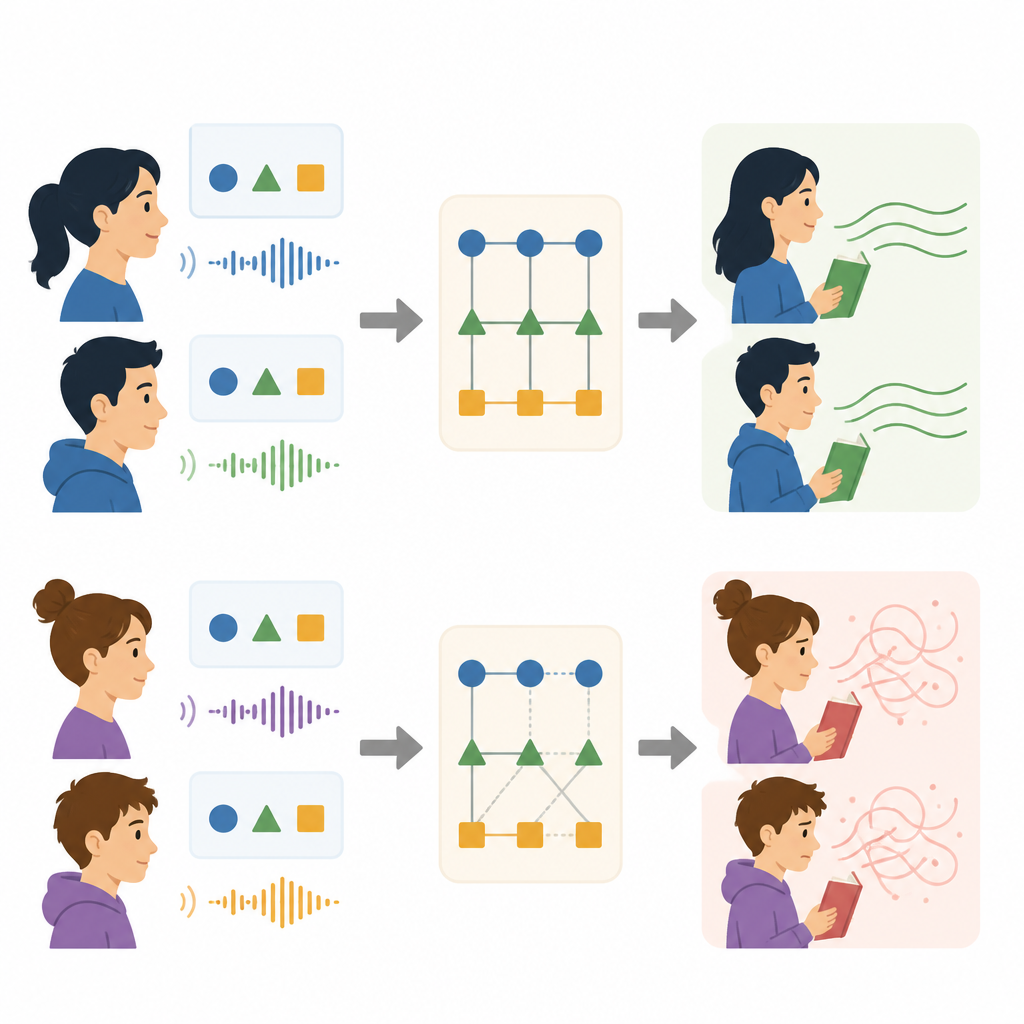
Learning to match written symbols with spoken sounds is one of the first big hurdles on the road to reading. For most people this link between letters and sounds becomes so automatic that they barely notice it. For people with dyslexia, however, this process can be slower and more effortful. This study followed adults with and without dyslexia as they learned a tiny artificial “alphabet” and examined how their brains adapted during learning, revealing that the main challenge in dyslexia may lie less in forming new links and more in using them fluently for reading.
Invented symbols in a controlled learning game
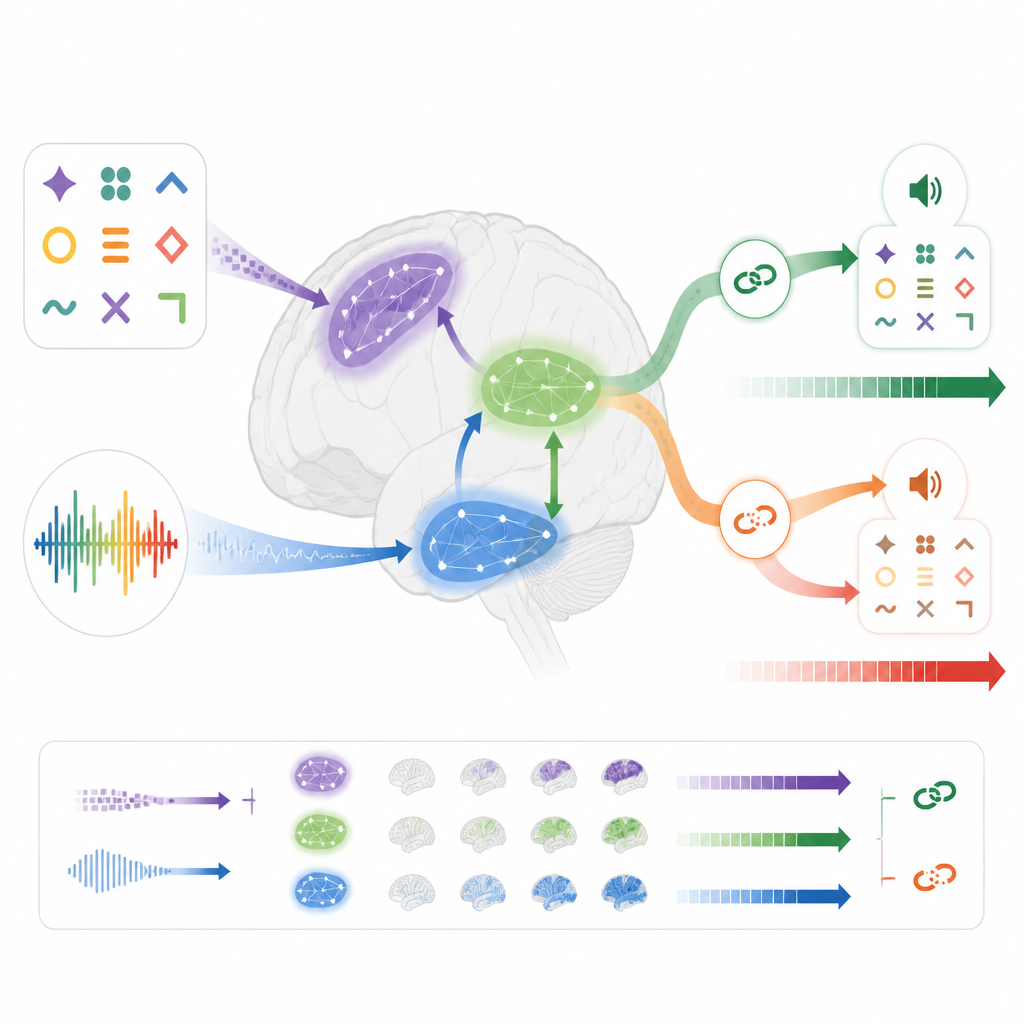
The researchers asked 31 typical readers and 31 adults with dyslexia, all native speakers of Dutch, to learn the meanings of six unfamiliar visual symbols. Each symbol stood for a simple spoken syllable, like “ba” or “fa.” Some syllables sounded very similar to each other, while others sounded clearly different. In a computer task, a symbol and a spoken syllable appeared at the same time, and participants judged whether they matched, receiving feedback after each trial. Over four training blocks, the team tracked how quickly and accurately people learned these pairings and recorded brain activity with electroencephalography (EEG) to capture very fast changes in neural responses.
Learning success and the challenge of similar sounds
Both groups learned the new symbol–sound links well. Accuracy climbed toward the mid‑90 percent range and reaction times steadily dropped, following a typical learning curve. Adults with dyslexia did not lag behind typical readers during training, and their overall learning rate was similar. However, when symbols were tied to syllables that sounded alike, everyone had more difficulty: accuracy was slightly lower and reaction times improved more slowly. Brain responses mirrored this pattern. EEG signals over several scalp regions changed as learning progressed, showing that visual and auditory brain systems were tuning themselves to the new pairings. For symbol–sound pairs with similar syllables, these neural responses were generally weaker, reflecting the extra difficulty of keeping confusable sounds apart.
What brain signals reveal about learning
EEG allowed the researchers to zoom in on brain activity within a few hundredths of a second after each stimulus. In frontotemporal and occipitoparietal regions, activity changed between about 150 and 330 milliseconds after a symbol–sound pair appeared, indicating rapid adjustments in how the brain processed and combined visual and spoken input. Later signals over temporoparietal areas became smaller across blocks and, by the final block, clearly distinguished matching from mismatching pairs. This suggests that these regions had learned the new associations well enough to automatically detect when a symbol and a sound did not go together. Interestingly, the only clear group difference was in timing: adults with dyslexia showed a reduced brain response to similar versus dissimilar sounds in frontotemporal regions one block earlier than typical readers, hinting at a different way of handling sound similarity rather than a total failure to learn.
When new links must support reading
After training, participants completed short “reading” tests using the artificial script. They had to read aloud individual symbols, simple syllables, and short words composed from the new symbols. Here, clear differences emerged. Adults with dyslexia were less accurate on syllable, letter, and word reading tasks than typical readers, even though both groups recognized the visual shapes of the symbols equally well. Error analyses suggested that typical readers tended to confuse sounds that were phonologically similar, while readers with dyslexia showed a more mixed pattern, sometimes confusing less similar sounds. Overall, people who did better on a separate measure of phonological awareness also tended to perform better on these artificial reading tasks, underscoring the importance of sound‑based language skills.
What this means for understanding dyslexia
To a lay reader, the key message is that adults with dyslexia in this study were able to pick up brand‑new symbol–sound links about as well as typical readers during a focused training session. Their brains showed similar patterns of rapid adaptation while learning. The main difference appeared later, when those new links had to be used quickly and smoothly for reading. This suggests that dyslexia may involve particular difficulty in automating and retrieving letter–sound associations rather than an inability to form them in the first place. Recognizing this distinction can help shape support strategies that focus not only on teaching the mappings, but also on repeated practice that builds speed, fluency, and flexible use of these associations in real reading situations.
Citation: Cao, Y., Zhang, M., Gentile, F. et al. Dynamic behavioral and neural correlates of letter-speech sound learning in typical and dyslexic readers. npj Sci. Learn. 11, 27 (2026). https://doi.org/10.1038/s41539-026-00410-0
Keywords: dyslexia, letter sound learning, EEG, reading fluency, phonological similarity