Clear Sky Science · en
A Bayesian perspective on observers’ inference of group norms
Why We So Quickly Fall in Line
When you walk into a new office, classroom, or neighborhood, you rapidly pick up what “people like us” do there—often just by watching others. Do they recycle? Speak up in meetings? Cut across the lawn or stick to the path? This paper asks how our minds turn a few glimpses of other people’s actions into a sense of the unwritten rules, and shows that we do this in a surprisingly mathematical way, even when some people break the rules and even when personal preferences are involved.

Watching Simple Shapes Follow Unwritten Rules
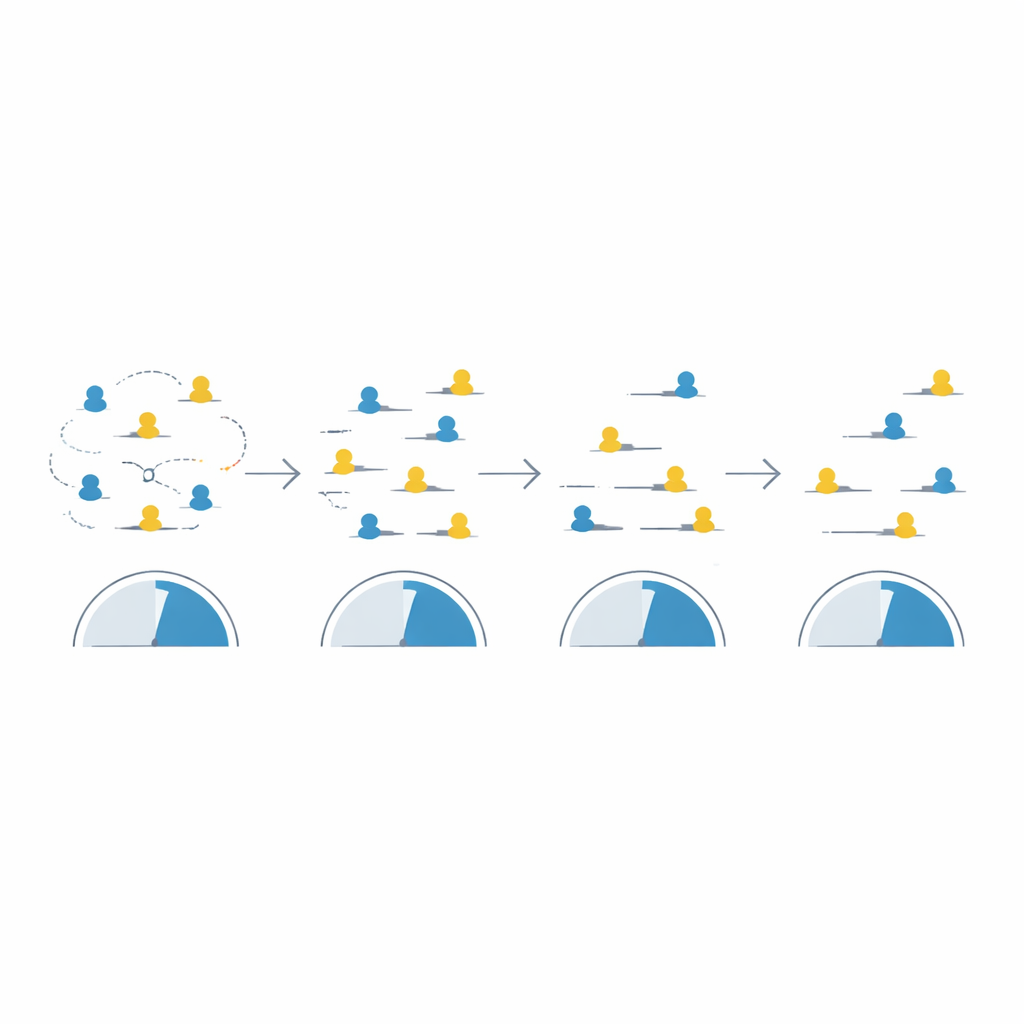
To study this process cleanly, the researchers stripped away real-world complications and used short computer animations. In each scene, five simple cartoon agents formed a group. Some moved in a straight line toward a corner of the screen, while others moved with a bouncy, jumping path. Participants were told nothing about any rules; instead, they were repeatedly asked how likely it was that a group norm existed for how these agents should move in that situation. Ratings were given both before seeing any movement and again after watching several group members act. This allowed the team to track how people’s sense of “there is a rule here” changed as more behavior was revealed.
How Our Beliefs Shift With the Crowd
In the first experiment, the number of agents showing the straight-line movement was varied from one to four. Before seeing any movement, people were roughly uncertain that a norm existed—their judgments hovered around “it might or might not.” After watching the movements, however, their estimated chances that a rule was in place rose steadily as more agents behaved in the same way. Even a single straight-moving agent nudged beliefs upward, and each additional consistent agent strengthened that impression further. When the authors compared these human judgments with the predictions of a formal Bayesian model—a framework that updates beliefs by combining prior expectations with new evidence—the match was close. A simpler model that merely tracked how often a behavior occurred could capture broad trends but missed the finer variations in people’s responses.
Staying Confident Even When Some Break the Pattern
Real groups are messy: some members ignore or resist shared expectations. In the second experiment, all four non-target agents moved, but only a certain fraction followed the straight path; the rest “deviated” with jumping movements. Now the key factor was the proportion of norm-consistent actions—25, 50, 75, or 100 percent of the group. As you might expect, when only a quarter followed the straight path, participants lowered their belief that a rule was in force. Yet their judgments still rose sharply as the majority began to act in line with one another. When three quarters or all of the agents were consistent, people again felt that a norm probably existed. The Bayesian model continued to predict these judgments well, showing that our minds treat deviant behavior as negative evidence but do not abandon the idea of a rule as long as most group members act alike.
Group Rules Versus Personal Wants
In daily life, someone might recycle because “that is what people here do,” because they personally want a clean environment, or both. The third experiment added this extra layer by asking participants not only about possible group norms, but also about how much each agent wanted to move in the straight way. The authors built several competing models of how these two kinds of inferences—about group rules and about personal desires—might be related. In one model, norms and desires both directly shape behavior but do not depend on each other; in another, norms first reshape desires, which then drive behavior. By comparing model predictions to people’s judgments, the best-fitting explanation was that observers infer group norms directly from patterns of behavior, independently of what they think individuals personally want. A model in which norms worked only by changing desires performed noticeably worse.
What This Means for Everyday Life
The study shows that when we enter a new group, we act like intuitive statisticians. We begin uncertain, then rapidly update our sense of “what people ought to do here” as we see more members act in similar ways, weighting majority behavior heavily yet not being derailed by a few odd cases. This belief-updating process follows the logic of Bayesian reasoning and does not require us to first guess everyone’s inner wishes. In simple terms, our brains are tuned to read shared expectations directly from visible patterns in the crowd, helping us adapt quickly and smoothly to new social worlds.
Citation: Duan, J., Guo, X., Zheng, L. et al. A Bayesian perspective on observers’ inference of group norms. npj Sci. Learn. 11, 24 (2026). https://doi.org/10.1038/s41539-026-00405-x
Keywords: social norms, Bayesian reasoning, group behavior, social learning, desire inference