Clear Sky Science · en
Vegetable fermentation as an overlooked source of greenhouse gases: from microbial mechanisms to global budget implications
Pickles and the Climate Connection
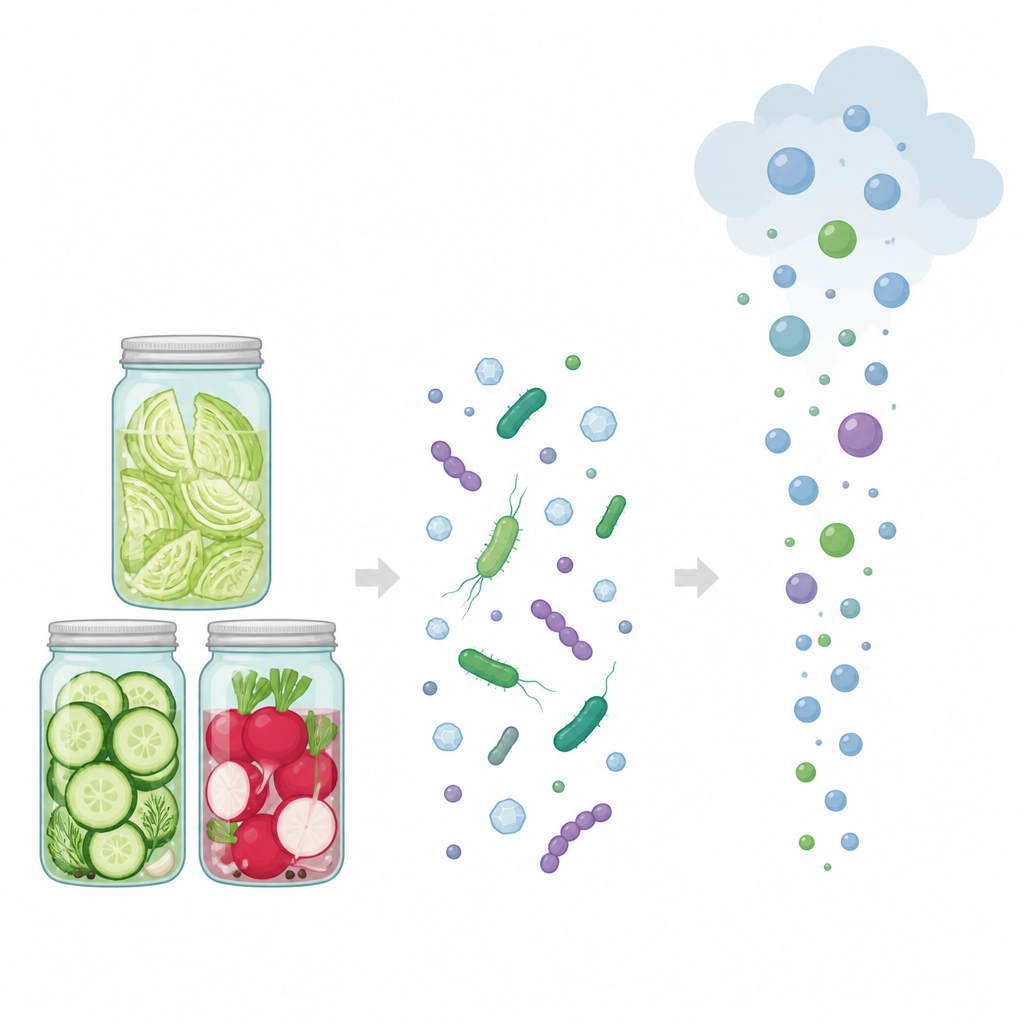
Fermented vegetables such as pickles and kimchi are everyday foods found in kitchens around the world. This study reveals that the jars quietly bubbling on countertops and in factories also release climate warming gases. By looking closely at how microbes behave during vegetable fermentation, the researchers show that this familiar food process is a small but real part of our global greenhouse gas budget.
Why Fermented Vegetables Matter for the Air
The team began by asking whether common pickled vegetables release greenhouse gases as they ferment. They set up controlled jars of Chinese cabbage, cucumber, and radish, then tracked the build up of carbon dioxide and nitrous oxide in the gas and liquid around the vegetables. In only five days, gas levels inside the jars rose far above normal air values, confirming that fermentation is not just a flavor making process but also a gas producing one. Methane appeared only briefly and in tiny amounts, showing that the main climate concern lies with carbon dioxide and nitrous oxide.
Salt Levels Steer the Type of Gas
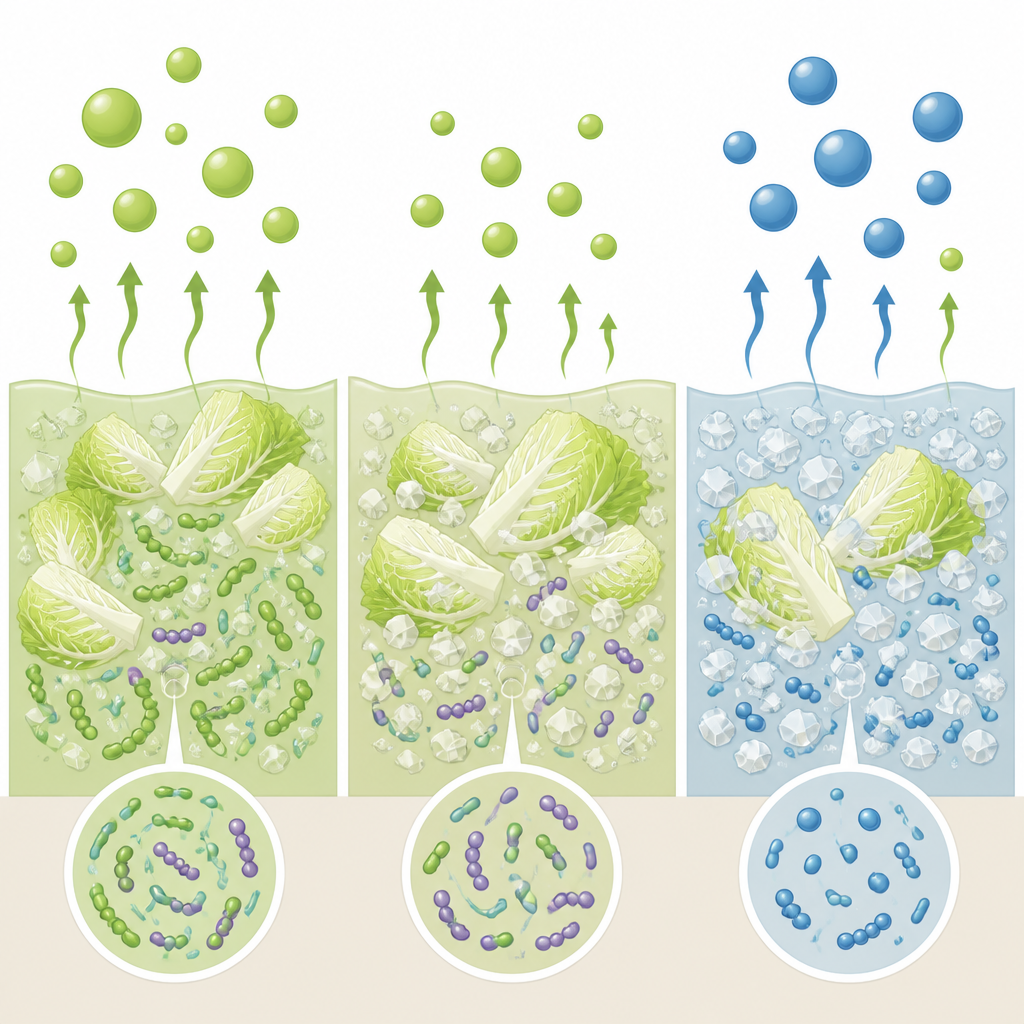
Because salt is central to pickle making, the researchers tested how different salt levels change gas production during a 90 day cabbage fermentation. Low and medium salt brines produced much more nitrous oxide, while high salt brine produced far more carbon dioxide. Detailed measurements of acidity, dissolved nitrogen compounds, and organic carbon showed that stronger brines pulled more sugars and other carbon rich substances out of the cabbage. This extra fuel, together with a salt tolerant microbe community, helped drive higher carbon dioxide release under salty conditions.
Microbes at Work Inside the Jar
To understand who was making which gases, the scientists sequenced microbial DNA from the brine. Low salt jars were dominated by bacteria from the Proteobacteria group, including Enterobacter and Serratia, which are known to turn nitrate into nitrous oxide under low oxygen conditions. At high salt, these salt sensitive microbes declined and salt loving lactic acid bacteria such as Pediococcus, Leuconostoc, and Lactobacillus took over. Computer based analysis of their genetic potential suggested that low salt communities favored pathways that leak nitrous oxide, while high salt communities favored routes that convert nitrate into ammonium instead, avoiding nitrous oxide but still breaking down carbon and releasing carbon dioxide.
From Household Jars to Global Totals
Using the gas emission rates they measured, the authors estimated what this might mean at the scale of the global pickle industry. Assuming that about one tenth of the world’s vegetable harvest is fermented, they calculated that pickled vegetables could release between roughly sixteen thousand and nearly fifty seven thousand tonnes of carbon dioxide equivalent each year. Part of this comes from gas in the headspace of jars and tanks, and part from the later release of dissolved gases when salty brines are drained and exposed to air. Although this is small compared with emissions from power plants or cars, it points to a previously ignored source that is widespread and technically manageable.
What This Means for Food and Climate
In simple terms, the study shows that making pickles is like running many tiny bioreactors that turn vegetable carbon and fertilizer derived nitrogen into gases that warm the planet. High salt recipes tend to swap nitrous oxide for more carbon dioxide, while lower salt recipes do the opposite. The work suggests that food processors and researchers could design fermentation methods that keep flavor and safety while cutting gas release, for example by tuning salt levels, microbe mixes, or brine handling. It also reminds us that the climate impact of plant based diets and food waste includes not only fields and transport but also what happens inside every quietly fizzing jar.
Citation: Huo, P., Zhang, X., Xu, C. et al. Vegetable fermentation as an overlooked source of greenhouse gases: from microbial mechanisms to global budget implications. npj Sci Food 10, 167 (2026). https://doi.org/10.1038/s41538-026-00825-4
Keywords: vegetable fermentation, pickles, greenhouse gases, nitrous oxide, food microbiology