Clear Sky Science · en
Germinated legumes for improving nutritional and technological quality of fortified cakes, with further enhancement using phospholipase and SSL
Why better cake can also be better for you
Cake is usually seen as a treat, not a health food: soft, sweet, and made mostly from refined wheat flour and sugar. This study explores whether everyday cakes can quietly become more nourishing—higher in protein, fiber, and natural plant compounds—without turning into dense, stale bricks. The researchers tested a clever combination: using sprouted chickpeas and white kidney beans in place of part of the wheat flour, then adding two dough improvers to keep the cakes soft and fresh over time.
Turning beans and chickpeas into gentler super-ingredients
The work begins before any baking happens, at the level of the seeds themselves. Chickpeas and white kidney beans were germinated—allowed to sprout for several days—then dried and milled into flour. Sprouting set off the seeds’ own enzymes, shifting how nutrients are packaged inside. Compared with the raw seeds, the sprouted versions had more available protein, slightly less fat, and fewer natural “anti-nutrients” such as phytic acid and tannins, which can block mineral absorption and slow digestion. The sprouted flours also soaked up water better, formed more stable foams and emulsions, and showed higher antioxidant activity, meaning they carried more of the plant compounds that can help neutralize harmful free radicals in the body. 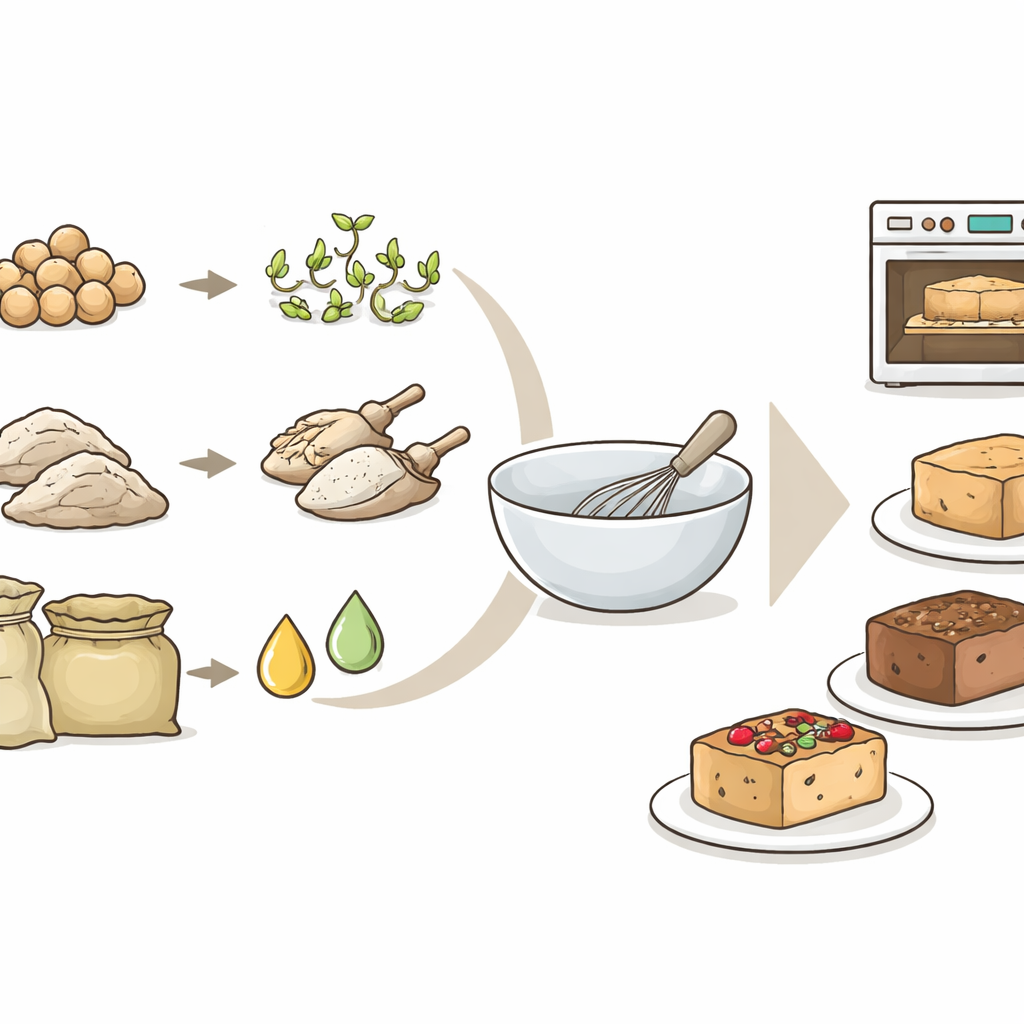
What happens when sprouted legumes meet cake batter
Next, the team baked cakes in which 10–30% of the wheat flour was replaced with sprouted chickpea or sprouted white kidney bean flour. As the legume share rose, cake protein and fiber content climbed, and mineral levels improved. Chickpea flour gave the biggest boost in protein, while white kidney bean flour contributed more moisture and fiber. The crust color darkened and became more yellow-brown as more sprouted flour was added, likely from natural pigments and stronger browning reactions in the oven. Inside, however, there was a trade-off: the more legume flour used, the smaller the cake volume and the firmer, chewier the crumb, especially at the highest (30%) replacement. Sensory panels generally liked cakes with modest substitutions—around 10% sprouted chickpea or up to 20% sprouted white kidney bean—almost as much as standard wheat cake, but enthusiasm dropped at higher levels as texture and flavor changed.
Keeping fortified cakes soft with smart helpers
To tackle the problem of firmness and rapid staling, the researchers turned to two baking aids already used in industry: a phospholipase enzyme and an emulsifier called sodium stearoyl lactylate (SSL). Both influence how fats, starches, and proteins interact in the batter and during storage. Phospholipase transforms natural phospholipids into surface-active molecules that can wrap around gas bubbles and starch, helping the crumb stay soft. SSL interacts with gluten proteins and starch chains, slowing the stiffening that usually makes cake go stale. The team focused on the firmest cake formula—one with a high share of sprouted legume flour—and systematically varied the doses of these two additives to see how much they could soften the crumb after several days.
Finding the sweet spot with statistical tuning
Using a design-of-experiments approach, the scientists mapped how different combinations of phospholipase and SSL affected crumb firmness after three days of storage. Rather than guessing, they fitted a mathematical surface that described how softness rose and fell with each ingredient level. This allowed them to calculate an optimal point where the fortified cake would be as tender as possible while still using realistic amounts of additives. The best result came at about 75 parts per million of phospholipase together with 0.6% SSL (based on flour weight). At these levels, firmness dropped close to a pre-set target for desirable softness, and the model explained almost all of the variation in the data, giving the team confidence in the prediction. 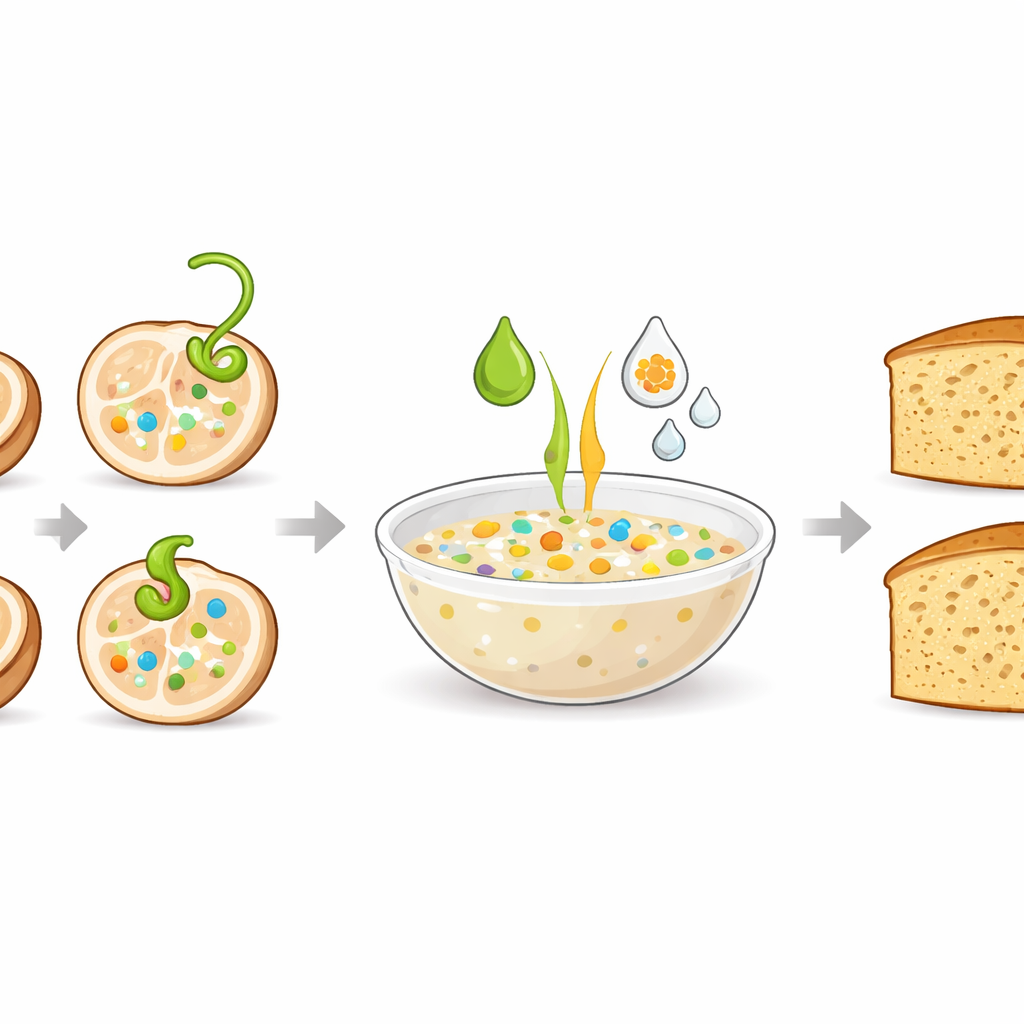
How this could change everyday baked goods
Overall, the study shows that it is possible to transform a familiar indulgence into a more functional food by working both from the seed up and from the recipe down. Sprouting chickpeas and beans turns them into flours that digest more easily, carry more accessible protein and helpful plant compounds, and contain fewer components that block minerals. When these flours are used to replace part of the wheat in cakes, nutrition clearly improves, even though texture suffers at high levels. By carefully adding a tailored mix of an enzyme and an emulsifier, the researchers were able to restore much of the softness and slow down staling. For consumers, this points toward cakes and other baked goods that can deliver more lasting nourishment without giving up the tender bite people expect.
Citation: Ata, S.M., Hussein, A.M.S. & Mostafa, S. Germinated legumes for improving nutritional and technological quality of fortified cakes, with further enhancement using phospholipase and SSL. npj Sci Food 10, 132 (2026). https://doi.org/10.1038/s41538-026-00819-2
Keywords: sprouted legumes, functional cakes, protein-enriched bakery, food texture optimization, phospholipase and emulsifiers