Clear Sky Science · en
Improving foaming properties of fish gelatin by neutral protease and gum arabic
Why Better Bubbles Matter
From fluffy marshmallows to airy mousses, many favorite treats depend on tiny, stable bubbles. Those bubbles are often created and held in place by gelatin. Today most commercial gelatin comes from pigs and cows, which raises religious, cultural, and safety concerns for many people. Fish gelatin is a promising alternative, but on its own it does not make foams that are strong or long‑lasting enough for many foods. This study explores a gentle way to turn fish gelatin into a more powerful foaming and stabilizing agent, opening doors for more sustainable and widely acceptable desserts and food products.
Making Fish Gelatin More Foam Friendly
The researchers focused on two helpers: a neutral protease, a type of enzyme that snips long protein chains into shorter pieces, and gum arabic, a plant‑based gum widely used in foods. On its own, fish gelatin produced modest foam: it whipped up to about the same volume as the starting liquid and held only part of that foam after standing. When the enzyme was added alone, the liquid foamed much more easily, creating finer bubbles, but the foam collapsed quickly. Gum arabic alone gave a small boost in foam formation but did not clearly improve how long the foam lasted. The key discovery came when the team combined both treatments: together, the enzyme and gum arabic raised foam formation to roughly one‑and‑a‑half times the starting volume and made the foam noticeably more stable over time. 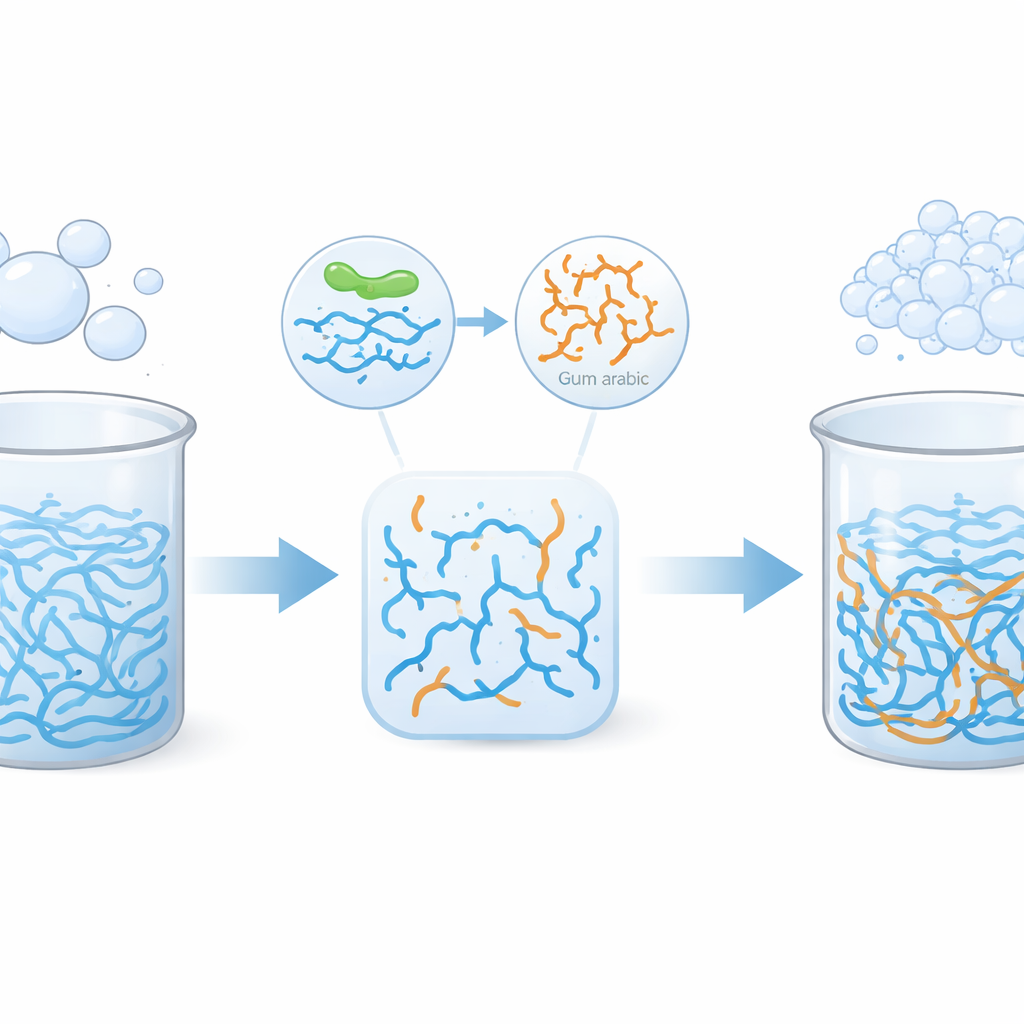
How Enzymes Open the Structure
To understand why the combination worked so well, the scientists probed the gelatin at the molecular level. The enzyme treatment partially cut the long protein chains into smaller pieces, exposing inner sections that were previously buried. This increased the surface "water‑repelling" character of the protein and reduced particle size, both of which are known to help proteins rush to the air–water boundary where foams form. Measurements of free amino groups and imaging of protein bands showed clear signs of this controlled breakdown. The resulting solutions flowed more easily, with lower thickness, and created foams with smaller pores but still prone to collapse because the films around the bubbles were too weak.
How Plant Gum Strengthens the Films
Gum arabic brought a different kind of help. Its long, branched sugar chains carry many acidic groups that can interact with basic and polar sites on the gelatin. When mixed with fish gelatin, these branches acted like soft connectors, forming many weak bonds—mainly electrical attractions and hydrogen bonds—between the two materials. This created a more continuous, flexible film around the bubbles and slightly thickened the liquid. However, without the prior enzyme step, fewer binding spots were available on the gelatin, so the improvement in foam performance was limited. Spectroscopic techniques and charge measurements confirmed that gum arabic changed the protein’s shape, charge balance, and internal bonding.
The Power of Working Together
When the enzyme‑treated gelatin was then combined with gum arabic, both effects reinforced each other. The enzymatic step had already opened the protein, exposing many water‑repelling patches and reactive groups. Gum arabic could now latch onto these sites more extensively, weaving a tighter, more elastic network. This thicker interfacial layer adsorbed more protein at the bubble surface and increased the liquid’s resistance to flow, both key factors in slowing bubble drainage and collapse. Microscopy images showed that foams from the combined treatment had smaller, more uniform pores and a denser structure, matching the higher foam stability measured in the lab. 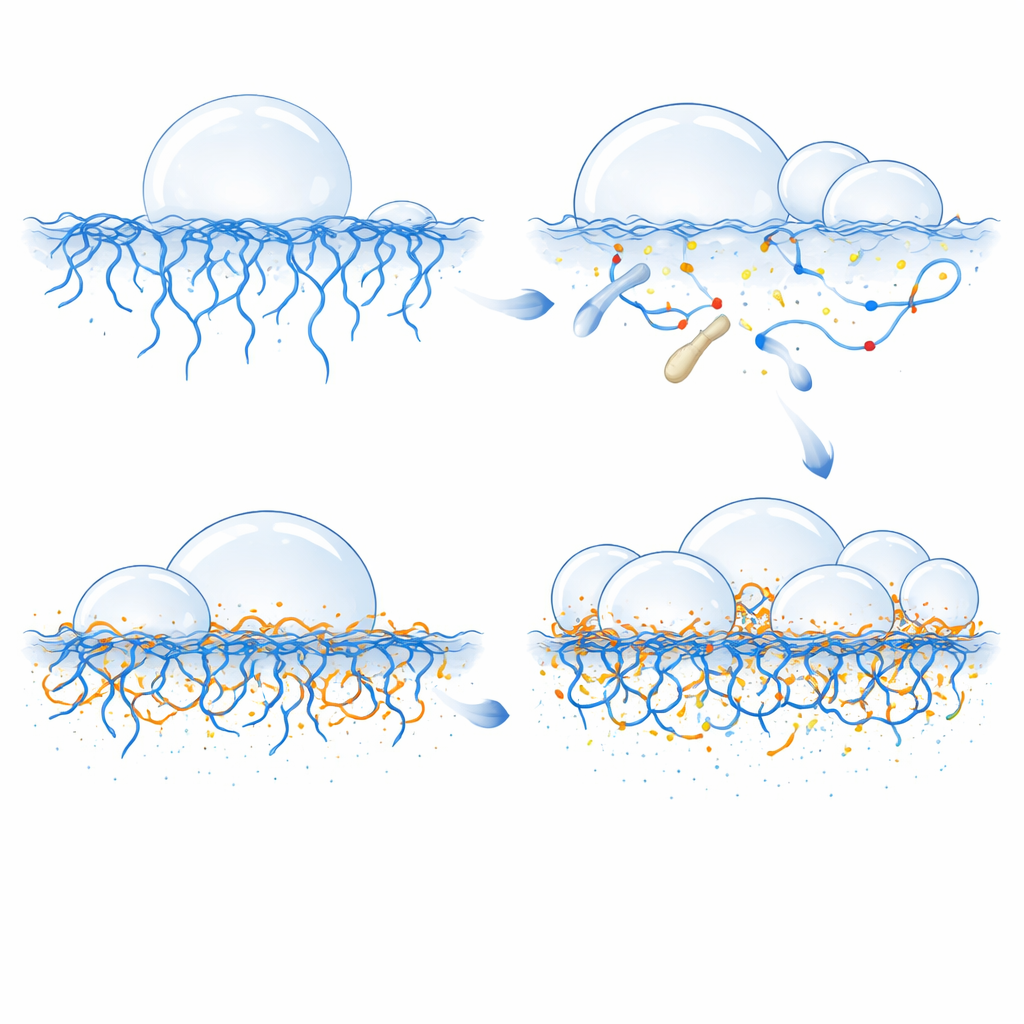
From Lab Foams to Everyday Foods
In plain terms, the study shows that gently cutting fish gelatin into shorter pieces and then pairing it with a natural tree gum turns it into a far better "bubble builder" and "bubble keeper." The enzyme step makes the gelatin more eager to sit at bubble surfaces, while the gum acts like a flexible glue that locks the network in place. Together they create finer, longer‑lasting foams without harsh chemicals or animal sources that conflict with certain diets. This upgraded fish gelatin could help manufacturers craft halal and kosher‑friendly marshmallows, mousses, whipped toppings, and other light, foamy foods using more sustainable ingredients.
Citation: Chen, Y., Pan, Y., Hu, YT. et al. Improving foaming properties of fish gelatin by neutral protease and gum arabic. npj Sci Food 10, 134 (2026). https://doi.org/10.1038/s41538-026-00773-z
Keywords: fish gelatin, food foams, gum arabic, enzymatic modification, sustainable desserts