Clear Sky Science · en
In vivo mapping of protein-protein interactions of schizophrenia risk factors generates an interconnected disease network
Why This Matters for Understanding Schizophrenia
Schizophrenia is a severe mental illness that disrupts how people think, feel, and relate to others. For decades, scientists have known that genes play a major role, but most individual risk genes only nudge risk slightly, making it hard to see how they add up to cause disease. This study tackles that puzzle by asking a different question: instead of looking at single genes, what happens if we chart how many of their protein products physically connect inside the brain, and how those connections change under a drug that mimics schizophrenia-like symptoms?
From Single Genes to Webs of Connections
The researchers focused on protein-protein interactions—the countless physical contacts that let brain proteins form circuits for signaling, metabolism, and structure. A single gene mutation can ripple through these contacts, disturbing not just one protein but an entire local web. Schizophrenia is known to involve thousands of genetic risk factors, many of which act weakly on their own but may be powerful together if they sit in the same web. Earlier computer-based studies hinted that schizophrenia risk proteins tend to cluster in shared networks, especially around synapses, the contact points between nerve cells. But most of those maps came from simplified cell systems, not real brain tissue.
Building a Real-World Brain Network
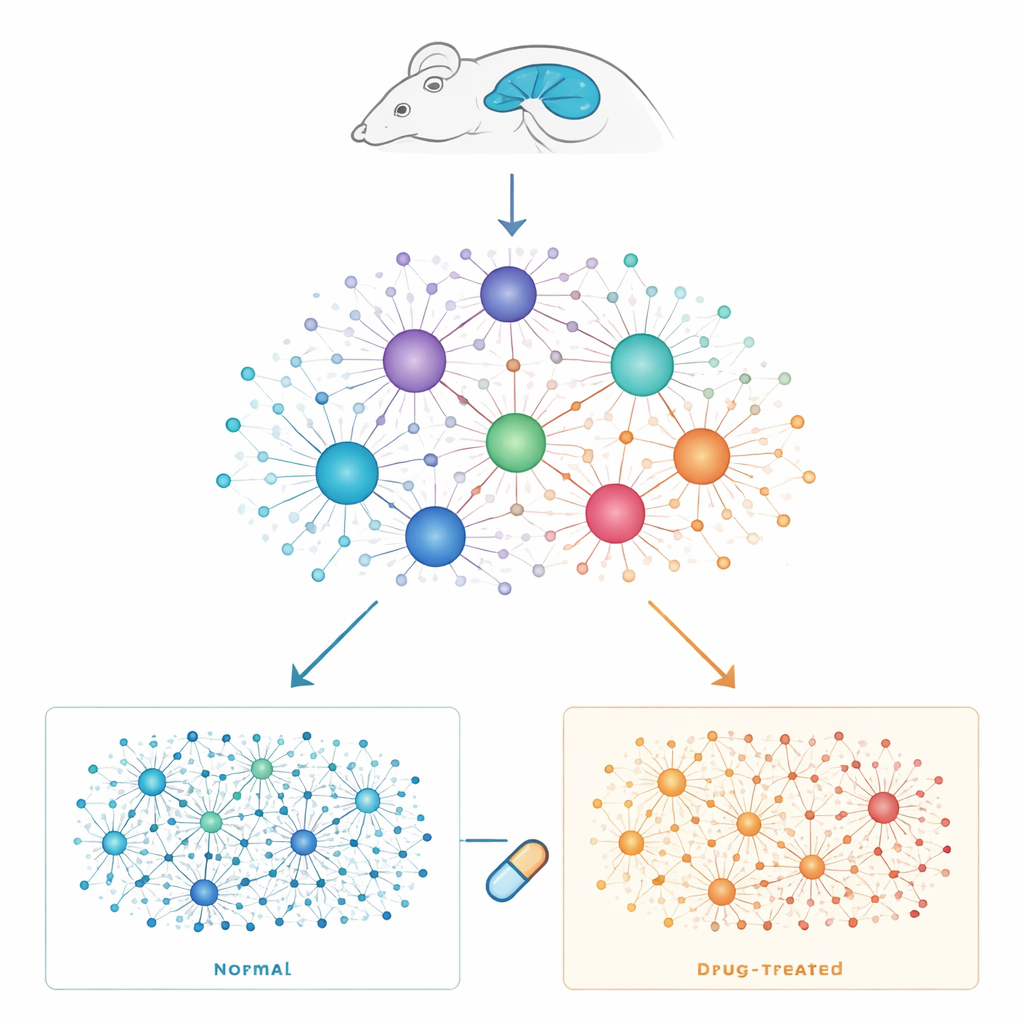
To capture a more realistic picture, the team studied eight proteins that have strong links to schizophrenia and important roles at synapses. Using rat hippocampus—a brain region tied to memory, emotion, and schizophrenia—they used antibodies to “fish out” each target protein along with its binding partners, then identified those partners by high-end mass spectrometry. By repeating this for all eight proteins, they assembled a brain-based schizophrenia network of 1612 distinct protein-protein interactions involving 1007 different proteins. Strikingly, more than 90% of these contacts had never been reported before, in part because past large-scale studies rarely used brain tissue. Many of the interacting proteins are found in the human hippocampus as well, suggesting that this rat network is relevant to the human condition.
What the Network Reveals About Brain Biology
When the authors analyzed what these connected proteins do, several themes emerged. Many were involved in shaping nerve cell branches, moving cargo inside cells, controlling chemical messengers, and making new proteins. A large fraction were found at synapses, with nearly half of the network mapping to known synaptic proteins. These were split between the sending and receiving sides of the synapse, reinforcing the idea that schizophrenia involves both sides of communication. Yet about 60% of the interactions came from outside classic synaptic locations, including proteins enriched in support cells like astrocytes. This fits with growing evidence that schizophrenia is not just a problem of neurons, but of multiple brain cell types that work together to maintain healthy signaling.
How a Psychosis-Mimicking Drug Distorts the Web
To probe how this network behaves under stress, the researchers used phencyclidine (PCP), a drug that blocks a key glutamate receptor and can trigger schizophrenia-like symptoms in people and animals. They briefly exposed rats to PCP, a time window too short to change gene expression, then repeated their protein-interaction measurements. Overall, PCP weakened most existing protein contacts in the network, but it also caused some new or stronger connections to appear, especially around certain risk proteins. A separate, isotope-based measurement strategy confirmed that many proteins changed in abundance within these complexes, even when standard interaction statistics would have missed them. Together, these results show that drug-induced psychosis rapidly reshapes the brain’s interaction web, not by switching proteins on and off, but by subtly tightening, loosening, or rewiring their partnerships.
Zooming In on Direct Contacts
One challenge with this kind of mapping is that it cannot easily tell whether two proteins touch directly or simply share a larger complex. To tackle this, the team turned to AlphaFold3, a cutting-edge structure prediction tool that can model how pairs of proteins might fit together. They focused on one key enzyme, a phosphatase called PP1 (specifically the Ppp1ca form), and scanned its 154 detected partners. AlphaFold3 successfully highlighted a small set of proteins with strong structural evidence for direct binding, including several known PP1 regulators and at least one likely new partner involved in helping protein complexes assemble. This demonstrates how computational structure tools can refine large experimental maps into a shortlist of likely direct interactions for future drug targeting.
What This Means for Future Treatments
Put simply, this work shows that many schizophrenia risk proteins physically converge into a shared, brain-specific web of interactions, and that this web is highly sensitive to a psychosis-inducing drug. Rather than acting in isolation, risk genes appear to cluster in interconnected modules that span synapses and multiple cell types, especially neurons and astrocytes. Mapping these modules in living brain tissue, and seeing how they flex under disturbance, offers a more realistic blueprint of the disease than gene lists alone. In the long run, such detailed interaction maps could guide new therapies that aim not just at single receptors, but at the specific protein complexes and connections that go awry in schizophrenia, potentially leading to more precise drugs with fewer side effects.
Citation: McClatchy, D.B., Lane, J., Powell, S.B. et al. In vivo mapping of protein-protein interactions of schizophrenia risk factors generates an interconnected disease network. Schizophr 12, 39 (2026). https://doi.org/10.1038/s41537-026-00734-1
Keywords: schizophrenia, protein networks, synapse, phencyclidine, neurobiology