Clear Sky Science · en
The diffusion-driven orthorhombic to tetragonal transition in YBa2Cu3O7 derived with a machine learning interatomic potential
Why tiny shifts in atoms matter
Superconducting wires that can carry huge electric currents with almost no loss are key ingredients in future fusion reactors and powerful particle accelerators. One of the most promising materials for these wires is a copper oxide compound called YBCO. But YBCO is full of atomic defects that can weaken its performance, especially under radiation and high heat. This study shows how a new kind of computer model can track those defects in detail and explain a subtle shape change of the crystal that happens as temperature rises.
A crystal used in high tech magnets
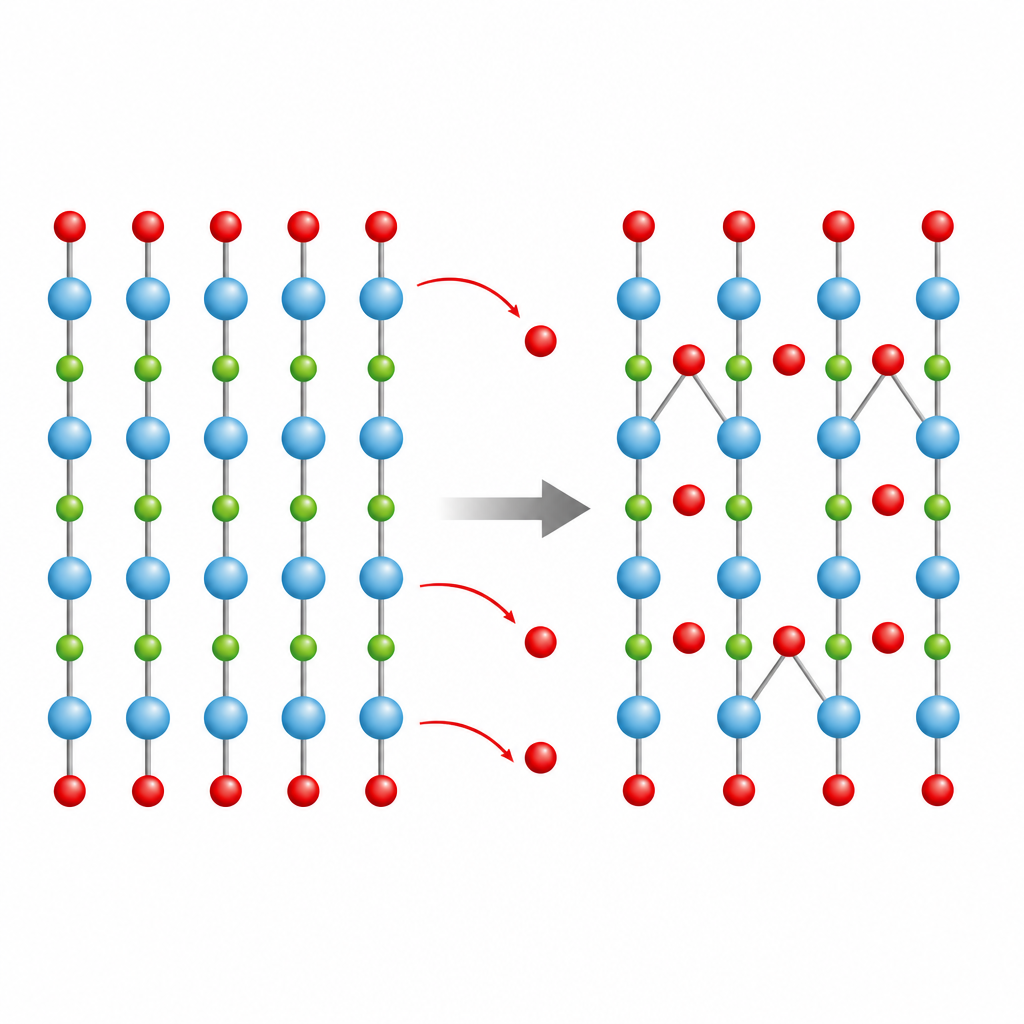
YBCO belongs to a family of high temperature superconductors used in advanced tapes for compact fusion devices and accelerator magnets. Its useful properties depend sensitively on how oxygen atoms are arranged inside the crystal. If too many oxygen atoms are missing or misplaced, the material can switch from being a good superconductor to behaving more like an ordinary metal or even an insulator. Radiation, as in a fusion reactor, can knock atoms out of place and create such defects. Experiments suggest that simply heating irradiated samples can repair some of the damage, hinting that oxygen atoms are mobile enough to move back into better positions.
Teaching a computer to feel atomic forces
To understand these atomic rearrangements, the authors built a machine learning model of how YBCO’s atoms interact. Instead of relying on simple, fixed formulas for the forces between atoms, they trained an “interatomic potential” using thousands of detailed quantum mechanical calculations. The training data included perfect crystals, structures stretched or compressed in different ways, and many configurations with vacancies, extra atoms squeezed into the lattice, and highly disordered regions. This breadth allows the model to recognize both calm and chaotic environments that arise when oxygen atoms move.
Putting the model to the test
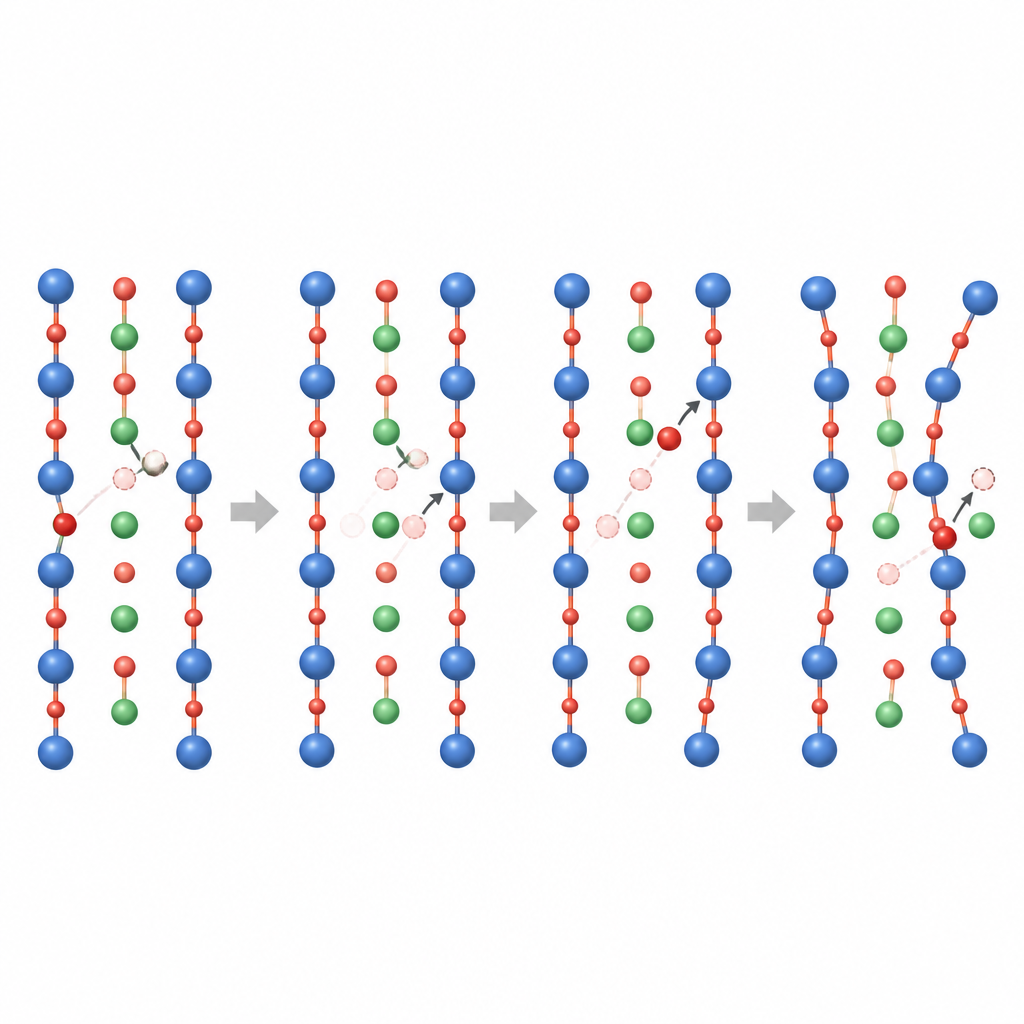
The team checked that their machine learning potential could reproduce basic properties of YBCO, such as how its energy changes when the crystal is squeezed or expanded and how the distances between atoms respond. They also examined specific oxygen defects where one oxygen atom leaves its normal site and occupies an in-between position, creating what is known as a Frenkel pair. These moves come with an energy cost and a barrier that must be crossed. The new model matched demanding quantum calculations for these quantities far better than earlier empirical models, especially for the energy barriers that control how easily oxygen can diffuse.
Following a subtle shape change with heat
Armed with this accurate model, the researchers ran long molecular dynamics simulations of large crystals as they were heated from a few hundred to more than one thousand degrees Kelvin. At low temperature the crystal has a slightly rectangular footprint: chains of oxygen atoms run along one in-plane direction, giving an “orthorhombic” shape. As the temperature rises, oxygen atoms hop from these chains into neighboring sites between chains. This gradually breaks up the long straight chains and removes the preferred direction in the plane. Around 800 Kelvin in the simulations, the crystal becomes almost square in cross-section, a “tetragonal” form, echoing what experiments see at somewhat higher temperatures.
Disorder, entropy, and why the change happens
By tracking how often oxygen atoms hop and how the energy cost of Frenkel pairs changes as the lattice expands, the authors show that the transition is not driven purely by energy savings. At temperatures near the transition, forming these defects still costs energy, but the growing number of ways to arrange the oxygen atoms increases the system’s entropy, which favors disorder. This entropic push, aided by a modest drop in defect energy at larger volumes, drives the crystal from an ordered chain state to a more disordered but symmetric one. The model also suggests that small amounts of missing oxygen slightly speed up the transition, in line with experimental hints.
What this means for future superconducting devices
For non-specialists, the key message is that a carefully trained machine learning model can now follow the dance of oxygen atoms in a complex superconductor and explain how their motion reshapes the crystal at high temperature. This ability opens the door to realistic, large scale simulations of how YBCO responds to radiation and heat in working magnets, and how heating treatments might restore its performance. More broadly, the work shows that machine learning can handle oxides with several elements and intricate chemistry, offering a new tool to design and protect advanced superconducting materials.
Citation: Gambino, D., Di Eugenio, N., Byggmästar, J. et al. The diffusion-driven orthorhombic to tetragonal transition in YBa2Cu3O7 derived with a machine learning interatomic potential. npj Quantum Mater. 11, 41 (2026). https://doi.org/10.1038/s41535-026-00891-7
Keywords: YBCO, oxygen diffusion, machine learning potential, superconductors, phase transition